
Choosing a BLDC motor is only part of designing a good motion system. How the motor is controlled can have just as much influence on noise, torque smoothness, efficiency, low-speed behavior, and even the size of the electronics.
Two common approaches are Six-Step Commutation and Field-Oriented Control (FOC).
Six-Step is straightforward: switch the motor phases according to rotor position and keep the control structure relatively simple. FOC takes a different approach. It continuously regulates the current vector relative to the rotor magnetic field, giving the controller much finer control over torque.
FOC is generally the stronger option when smoothness and precise control matter. FOC is not always the best choice for every BLDC motor application.
For many pumps, fans, blowers, power tools, and cost-sensitive drives, Six-Step remains a practical solution.
The better method depends on what the machine actually needs.
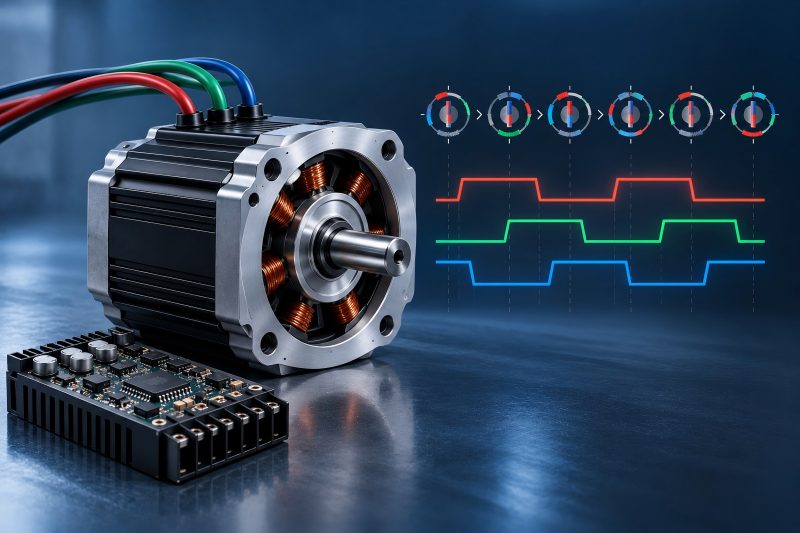
How Six-Step Commutation Works
A three-phase BLDC motor has three stator phases. In Six-Step control, the inverter switches through six electrical states during each electrical cycle.
At a given step, two phases normally conduct while the third phase is left unpowered. After the rotor advances approximately 60 electrical degrees, the controller changes to the next commutation state.
The sequence continues:
Step 1 → Step 2 → Step 3 → Step 4 → Step 5 → Step 6 → Repeat
Rotor position can be determined using Hall sensors or estimated from signals such as back-EMF.
The main advantage is obvious: the controller does not need a complicated mathematical model to determine the current vector continuously. The switching logic is relatively easy to understand, implement, and troubleshoot.
This makes Six-Step attractive where the motor mainly needs to rotate reliably at a controlled speed, rather than deliver exceptionally smooth torque.
However, the discrete commutation also creates its main weakness.
Instead of rotating the stator field continuously, Six-Step effectively moves it from one sector to another. The torque-producing angle therefore changes within each commutation sector, and switching between sectors introduces additional disturbances.
The result is greater torque ripple, vibration, and potentially more audible noise.
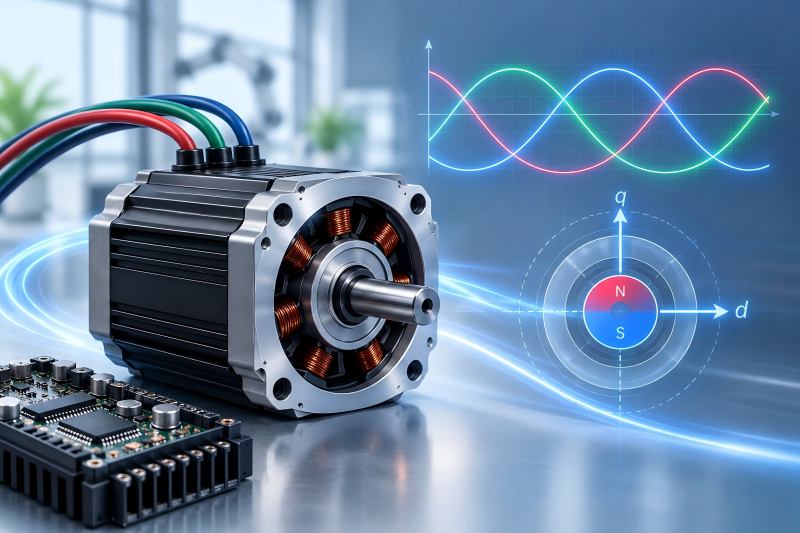
How Field-Oriented Control Works
FOC approaches the same motor from a different direction.
Rather than simply deciding which two phases should conduct, FOC tries to control the magnitude and direction of the stator magnetic field relative to the rotor.
The three-phase currents are mathematically transformed into a rotating coordinate system, commonly represented by two components:
- d-axis current (Id)— associated with magnetic flux
- q-axis current (Iq)— primarily responsible for torque
For many permanent-magnet motor operating conditions, the controller attempts to maintain the required torque through Iq while keeping Id near its desired value.
A typical control chain looks roughly like:
Current Measurement → Clarke Transform → Park Transform → Id/Iq Control → Inverse Transform → PWM/SVPWM → Inverter
The key is how FOC improves motor control. The practical difference is that FOC continuously adjusts the current vector instead of waiting for the next 60-degree commutation point.
That produces a much smoother electromagnetic interaction between the stator and rotor.
FOC vs Six-Step at a Glance
| Factor | Six-Step Commutation | FOC |
| Control principle | Discrete 6-sector commutation | Continuous current-vector control |
| Phase current | Typically block/trapezoidal | Typically sinusoidal |
| Torque ripple | Higher | Lower |
| Low-speed smoothness | Moderate to poor | Very good when properly implemented |
| Acoustic noise | Generally higher | Generally lower |
| Torque control | Basic | Precise |
| Efficiency potential | Good | Very good |
| MCU requirement | Low | Higher |
| Current sensing | Relatively simple | More demanding |
| Software complexity | Low | High |
| Tuning requirement | Limited | Significant |
| Development cost | Lower | Higher |
| Best fit | Simple, cost-sensitive drives | Precision and high-performance drives |
This table makes FOC look like the obvious winner, but engineering decisions should not be made from performance specifications alone.
The additional performance has a cost.
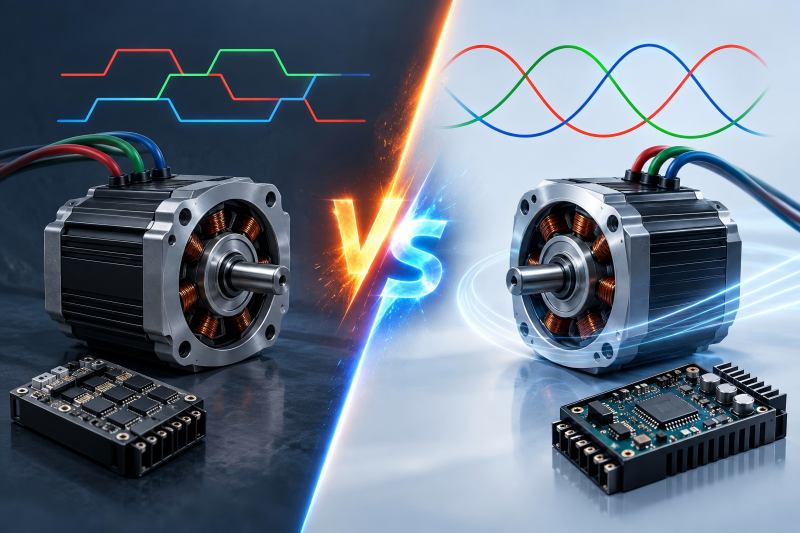
Torque Smoothness: The Biggest Difference
Torque ripple is usually where the difference becomes easiest to feel.
In Six-Step control, the relationship between the rotor magnetic field and stator current is not perfectly maintained throughout the entire electrical cycle. Commutation events also create transient changes in current.
At high speed, mechanical inertia can hide much of this behavior.
It becomes more noticeable at lower speeds. A motor may exhibit slight speed pulsation, vibration, audible commutation noise, or uneven motion under light load.
FOC largely avoids the large periodic torque disturbance associated with block commutation because the current vector follows the rotor continuously.
This matters in applications such as:
- robotic joints
- servo mechanisms
- precision positioning systems
- electric power steering
- AGVs and mobile robots
- quiet household appliances
- medical equipment
If a motor is driving a high-speed centrifugal fan, however, a small amount of torque ripple may have little effect on the final machine.
The application determines whether smoother torque is valuable or merely technically impressive.
Low-Speed Performance
Low-speed operation exposes weaknesses in a motor-control system.
At high speed, rotor inertia smooths torque variations. At low speed, every commutation event becomes more visible mechanically.
Six-Step systems can therefore feel less refined when operating slowly, particularly when using Hall sensors with relatively coarse rotor-position information.
FOC can provide substantially smoother low-speed operation because the controller regulates phase current according to a much more precise rotor angle.
But there is an important condition:
FOC needs reliable rotor-position information.
With an encoder or resolver, accurate low-speed and zero-speed control is relatively straightforward.
Sensorless FOC is more complicated.
At very low speed, back-EMF becomes weak, so the controller may need advanced estimation methods, high-frequency injection, open-loop startup strategies, or other techniques to establish rotor position.
Therefore, “FOC provides excellent zero-speed performance” is only true when the rotor-position strategy supports it.
Efficiency: FOC Usually Has an Advantage, but Not Everywhere
FOC is often described as the more efficient method because it can keep the stator current better aligned with the torque-producing direction.
This reduces unnecessary current and can lower motor copper losses.
For equipment operating continuously—such as HVAC blowers, industrial pumps, compressors, or electric vehicles—even a modest efficiency improvement can become meaningful over thousands of operating hours.
But efficiency should be evaluated at system level, not just from the control algorithm.
FOC usually involves continuous PWM operation and relatively high switching frequencies. That creates switching losses in the MOSFETs or IGBTs.
Six-Step can sometimes operate with simpler switching patterns and lower inverter losses.
The motor itself also matters.
A motor designed around a strongly trapezoidal back-EMF waveform may work very well with Six-Step control, while a motor with a more sinusoidal back-EMF profile is generally better suited to sinusoidal current control.
A better question to ask is: “Is FOC more efficient?”
It is:
“Which control strategy gives this motor the highest system efficiency across its real operating range?”
That distinction matters.
Noise and Vibration
Noise is becoming an increasingly important reason to use FOC.
Six-Step commutation introduces periodic electromagnetic excitation. Depending on motor construction, speed, mechanical resonance, and enclosure design, these harmonics can become audible.
This may not matter in an industrial pump installed inside a factory.
It matters considerably in:
- residential HVAC systems
- refrigerator compressors
- premium fans
- medical equipment
- office automation
- automotive cabin systems
- collaborative robots
FOC cannot eliminate every source of motor noise. Bearings, cogging torque, rotor imbalance, PWM frequency, structural resonance, and mechanical transmission components still matter.
But removing strong commutation-related torque disturbances gives engineers a much better starting point for designing a quiet system.
Hardware and Software Complexity
This is where Six-Step fights back.
A Six-Step controller can be relatively compact. Depending on the design, it may require Hall inputs or back-EMF detection, a basic speed loop, PWM generation, and straightforward commutation logic.
FOC needs considerably more.
The controller may need to perform:
Current Sampling → Coordinate Transformations → PI Current Regulation → Rotor-Angle Processing → Voltage Calculation → PWM Generation
and repeat this control loop thousands of times per second.
Current measurement also becomes more important. ADC timing, amplifier offset, current-sensor bandwidth, dead-time compensation, rotor-angle accuracy, and control-loop tuning can all affect performance.
A poorly implemented FOC controller can actually perform worse than a well-designed Six-Step controller.
This is one of the most overlooked points when comparing the two methods.
FOC offers a higher performance ceiling, but it also demands better engineering.
Cost Is More Than MCU Price
Modern microcontrollers have reduced the hardware-cost gap considerably.
Processors capable of Clarke/Park transforms, PI control, SVPWM, and rotor estimation are now widely available.
But development cost still matters.
FOC may require more engineering time for:
- motor parameter identification
- current-loop tuning
- speed-loop tuning
- sensor calibration
- startup optimization
- sensorless estimator development
- fault testing
- EMI optimization
If a manufacturer produces hundreds of thousands of low-cost fans, adding unnecessary development effort or electronics cost can be difficult to justify.
For a high-value robot actuator, the opposite is true. Better torque control and smooth motion may easily justify a more sophisticated controller.
Sensorless Operation Changes the Comparison
Both Six-Step and FOC can operate without mechanical rotor-position sensors.
Sensorless Six-Step commonly uses back-EMF information from the unpowered phase to determine commutation timing.
The concept is relatively simple and works well once the motor reaches sufficient speed.
Sensorless FOC estimates rotor position continuously using measured electrical behavior and a mathematical observer or estimator.
This can provide excellent performance, but implementation becomes significantly more demanding—particularly during startup and very-low-speed operation.
For applications that spend most of their life at moderate or high speed, sensorless Six-Step can therefore provide a very attractive balance between cost and performance.
For applications requiring smooth acceleration, wide speed range, controlled torque, and refined dynamic response, sensorless FOC may justify the extra development work.
Application-Based Selection
| Application | Recommended Approach | Main Reason |
| Low-cost cooling fan | Six-Step | Cost and simplicity |
| Basic industrial pump | Six-Step / FOC | Depends on efficiency target |
| HVAC blower | FOC | Noise and energy efficiency |
| Power tool | Six-Step / FOC | Depends on torque-control requirement |
| Robot joint | FOC | Smooth low-speed torque |
| Servo actuator | FOC | Precise torque and position control |
| AGV drive | FOC | Low-speed control and efficiency |
| E-bike | Both possible | Cost vs refinement |
| EV traction motor | FOC | Wide speed range and torque control |
| Medical motion system | FOC | Low noise and smooth motion |
There is no universal dividing line.
A premium pump may benefit from FOC, while a basic pump running continuously near one operating point may work perfectly well with Six-Step.
When Six-Step Is the Better Engineering Choice
Six-Step should not be treated as outdated technology.
It is often the better solution when:
- Product cost is highly sensitive
- Motor speed is mostly moderate or high
- Small torque ripple is acceptable
- Precise torque control is unnecessary
- Acoustic noise is not critical
- Development time needs to remain short
- The motor is already optimized for trapezoidal commutation
In these conditions, moving to FOC may increase complexity without creating enough value for the final product.
A control algorithm should solve an application problem, not simply make the specification sheet more sophisticated.
When FOC Is Worth the Extra Complexity
FOC becomes much easier to justify when the system requires several performance characteristics simultaneously.
For example, a motor may need to run quietly at 200 rpm, accelerate rapidly to several thousand rpm, maintain accurate torque under changing loads, operate efficiently for long periods, and provide controlled deceleration.
Six-Step can make the motor rotate through that operating range.
FOC can make the motor behave predictably throughout that range.
That distinction is important in high-performance motion systems.
FOC is particularly valuable when the application demands:
- smooth low-speed operation
- low torque ripple
- accurate torque regulation
- quiet operation
- fast dynamic response
- high efficiency over variable loads
- wide speed range
- field weakening
- precise position or velocity control
Which Method Is Better?
FOC is technically more capable, but Six-Step can still be the better product decision.
If the application is a simple fan, pump, blower, or other cost-sensitive drive that spends most of its operating life at relatively stable speed, Six-Step may provide everything the machine needs with less hardware, software, and development effort.
If the application requires smooth low-speed operation, low noise, accurate torque control, wide speed range, or strong dynamic performance, FOC is usually worth the additional complexity.
The most useful way to compare them is therefore:
Six-Step optimizes simplicity. FOC optimizes control quality.
Neither should be selected from the motor nameplate alone.
Motor back-EMF shape, speed range, load profile, required torque smoothness, acoustic limits, current-sensing architecture, controller capability, and production cost should all be considered together.
In a well-designed BLDC system, the best control method is not necessarily the most advanced one.
It is the one that delivers the required motor behavior without adding complexity that the application does not need.