
Designing a DC gear motor requires a complete understanding of load, speed, torque, voltage, gearbox ratio, duty cycle, efficiency, noise, heat, and installation structure. The best design is not always the motor with the highest torque or the largest gearbox. The best design is the one that matches the real application with stable performance, suitable cost, long service life, and reliable operation.
For OEM projects, the design process should start from the application requirements, then move to torque calculation, speed selection, gear ratio design, motor matching, gearbox structure, material choice, and final testing. A well-designed DC gear motor can improve product reliability, reduce failure rates, lower noise, extend service life, and help the final equipment perform more smoothly.
Quick Overview of DC Gear Motor Design Factors
| Design Factor | What to Consider | Why It Matters |
| Output torque | Load torque, safety margin, starting torque | Prevents stalling and overload |
| Output speed | Required RPM after gearbox reduction | Matches equipment movement speed |
| Gear ratio | Motor speed divided by output speed | Controls torque and speed conversion |
| Voltage | 3V, 6V, 12V, 24V, or custom voltage | Affects speed, current, and power |
| Duty cycle | Continuous, intermittent, or short-time use | Affects heat and motor life |
| Gear material | Plastic, powder metal, brass, steel | Impacts noise, strength, and cost |
| Gearbox type | Spur, planetary, worm, right-angle | Affects size, torque, efficiency, and noise |
| Noise level | Gear precision, bearing, lubrication | Important for smart home and medical use |
| Lifetime | Load, speed, temperature, wear | Determines long-term reliability |
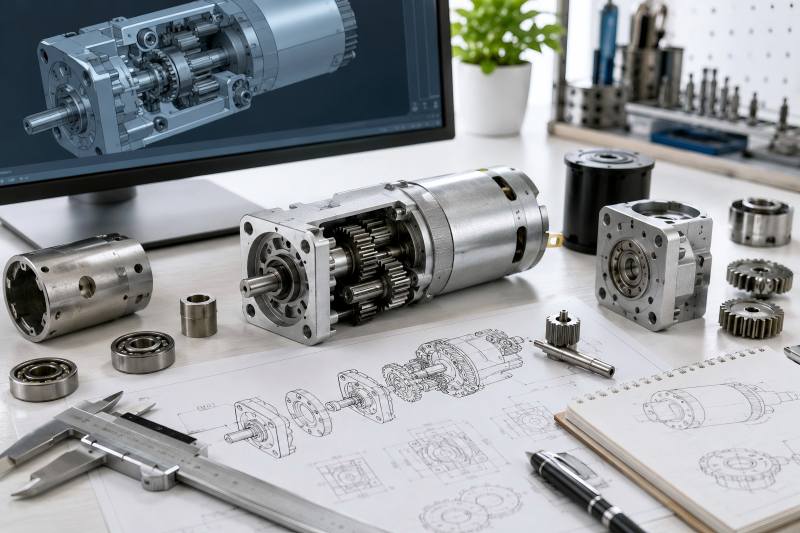
Start with the Application Requirements
The first step in designing a DC gear motor is understanding the application. Different products need different motor designs. A smart lock may need low noise and short-time high torque. A vending machine may need stable operation and strong anti-jamming ability. A robot joint may need compact size, accurate control, and high torque density.
Before selecting the motor, you should define these basic requirements:
- What load will the motor drive?
- What output speed is required?
- How much torque is needed?
- How long does the motor run each time?
- How often does it start and stop?
- Is the movement horizontal, vertical, or rotating?
- Is low noise important?
- Is position control required?
- What is the available installation space?
- What voltage and power supply are available?
Without these details, the design may look correct on paper but fail during real use.
Calculate the Required Output Torque
Torque is one of the most important parameters in DC gear motor design. Low torque can cause stalling, overheating, and premature failure. If the torque is too high, the motor may become larger, heavier, more expensive, and less efficient.
The required torque depends on the load type. For a rotating load, torque is related to force and radius:
Torque = Force × Radius
For example, if a gear motor needs to drive a wheel, pulley, lever, or rotating shaft, you must calculate the force needed at the working point and multiply it by the distance from the shaft center.
You should also consider starting torque. Many applications require more torque at startup than during normal operation. Friction, inertia, gear resistance, and load changes can all increase the required starting torque.
Engineers usually include extra torque capacity for safety. For stable operation, the rated output torque should usually be higher than the calculated load torque.
| Application Type | Torque Design Focus | Suggested Safety Margin |
| Smart lock | Short-time high starting torque | 1.5–2 times |
| Vending machine | Anti-jam and stable pushing force | 1.5–2.5 times |
| Robot mechanism | Dynamic load and acceleration | 2 times or more |
| Medical device | Smooth and reliable movement | 1.5–2 times |
| Industrial actuator | Heavy load and repeated operation | 2–3 times |
Define the Required Output Speed
After torque, the next key factor is output speed. The output speed is the final RPM after the gearbox reduction. Different products need very different speed ranges.
For example, a small fan mechanism may need a higher speed. A smart lock may need slow and controlled rotation. A lifting actuator may need very low speed but high torque.
The basic relationship is:
Output Speed = Motor Speed ÷ Gear Ratio
If a DC motor runs at 6000 RPM and uses a 100:1 gearbox, the output speed is about 60 RPM before considering load losses.
However, actual output speed may be lower under load. Heavier loads reduce motor speed, so test speed under real operating conditions.
Choose the Gear Ratio
The gear ratio determines how much the gearbox reduces speed and increases torque. A larger gear ratio lowers speed while increasing torque. A lower gear ratio creates higher output speed and lower torque.
However, increasing the gear ratio is not always better. A very high gear ratio may reduce efficiency, increase gear wear, increase noise, and make the gearbox larger.
When choosing the gear ratio, you should consider:
- Required output RPM
- Required output torque
- Gearbox efficiency
- Noise level
- Space limitation
- Backlash requirement
- Motor speed range
- Service life requirement
For simple products, spur gearboxes are often used because they are cost-effective and easy to manufacture. For compact high-torque applications, planetary gearboxes are often better. For self-locking or right-angle output, worm gearboxes may be selected, but their efficiency is usually lower.
Select the DC Motor
The motor must provide enough speed, power, and current capacity for the gearbox. A good gearbox cannot solve a poorly selected motor. Insufficient motor power can cause overheating or stalling. If the motor is too powerful, the product may waste energy and increase cost.
When selecting a DC motor, consider:
- Rated voltage
- No-load speed
- Rated speed
- Rated torque
- Stall torque
- No-load current
- Rated current
- Stall current
- Brush material
- Magnet type
- Motor diameter and length
- Noise and vibration level
For battery-powered devices, current consumption is very important. A motor with high stall current may drain the battery quickly or damage the control circuit. For plug-in devices, thermal performance and long-term stability may be more important.
Choose the Gearbox Type
The gearbox structure has a strong influence on torque, size, efficiency, noise, and cost. Different gearbox types are suitable for different applications.
| Gearbox Type | Advantages | Common Applications |
| Spur gearbox | Simple, low cost, easy production | Toys, locks, small appliances, light mechanisms |
| Planetary gearbox | Compact, high torque density, good stability | Robotics, automation, precision devices |
| Worm gearbox | Right-angle output, possible self-locking | Actuators, valves, lifting mechanisms |
| Metal gearbox | Higher strength and longer life | Industrial devices, heavy-load applications |
| Plastic gearbox | Low noise and lower cost | Smart home, consumer products |
For quiet applications, gear material and gear accuracy are very important. Plastic gears lower noise but limit torque capacity. Metal gears can carry higher loads but may produce more gear noise if not designed properly.
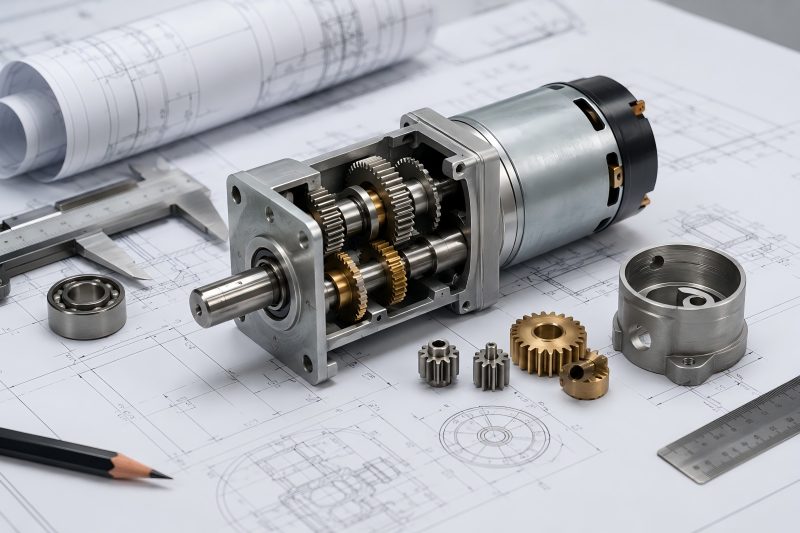
Design for Efficiency and Heat Control
Efficiency is often overlooked in DC gear motor design. Every gearbox has power loss caused by friction, gear meshing, bearing resistance, and lubrication. The motor also produces heat while running.
If the gear motor runs continuously, heat control becomes very important. High temperature can reduce magnet performance, damage brushes, dry out lubricant, deform plastic gears, and shorten motor life.
To reduce heat and improve efficiency:
- Avoid unnecessarily high gear ratios
- Use suitable gear materials
- Select proper lubrication
- Reduce gear friction
- Choose the correct motor power
- Avoid long-time overload
- Improve housing heat dissipation
- Match the duty cycle correctly
For intermittent applications, short-time overload may be acceptable. For continuous operation, the motor should work near its rated load, not near stall condition.
Consider Noise and Vibration
Noise is important for smart locks, medical devices, home appliances, office equipment, and consumer products. DC gear motor noise usually comes from motor electromagnetic noise, brush friction, gear meshing, bearing noise, shaft vibration, and assembly tolerance.
To reduce noise, the design can use:
- Higher precision gears
- Optimized tooth profile
- Proper gear lubrication
- Low-noise motor brushes
- Better shaft alignment
- Stronger gearbox housing
- Rubber mounting or vibration isolation
- Balanced rotor design
Noise testing should be done under real working load. A gear motor may sound quiet in no-load testing but become noisy after installation.
Check Shaft, Mounting, and Mechanical Interface
The output shaft must match the final product structure. Shaft design affects assembly, torque transmission, and durability.
Common output shaft types include:
- Round shaft
- D-cut shaft
- Double D shaft
- Splined shaft
- Threaded shaft
- Hollow shaft
- Custom shaft
Mounting holes, gearbox shape, output direction, shaft length, and connector type should all match the customer’s product design. For OEM projects, custom shaft and mounting design are often required.
Test the Final DC Gear Motor Design
A DC gear motor should not only meet the drawing requirements, but also perform well in real working conditions.
Important tests include:
| Test Item | Purpose |
| No-load speed test | Checks basic motor and gearbox performance |
| Load speed test | Confirms real output speed under working load |
| Torque test | Verifies rated torque and starting torque |
| Current test | Checks power consumption and overload risk |
| Temperature rise test | Confirms thermal safety during operation |
| Noise test | Measures sound level under real load |
| Life cycle test | Evaluates long-term durability |
| Stall test | Checks short-time overload behavior |
| Gear wear inspection | Confirms gearbox reliability after testing |
Testing helps identify problems such as insufficient torque, excessive current, gear wear, overheating, unstable speed, high noise, and poor assembly accuracy.