
Choosing the right electric motor for a wheelchair requires more than comparing voltage and wattage.
The correct approach is to begin with the complete wheelchair: total load, wheel size, maximum slope, target speed, operating environment, duty cycle, and packaging space. From these conditions, engineers can determine the required wheel torque, motor speed, gear ratio, voltage, thermal capacity, and braking performance.
The best wheelchair motor is the motor that produces the required torque efficiently, operates within a safe thermal range, works smoothly with the controller, fits the mechanical structure, and still has enough performance reserve for demanding conditions.
Start With the Wheelchair, Not the Motor
Before discussing motor specifications, define the operating conditions of the wheelchair.
The most important questions are:
- What is the maximum user and wheelchair weight?
- What maximum gradient must the wheelchair climb?
- What is the target driving speed?
- What is the drive-wheel diameter?
- Will it mainly operate indoors or outdoors?
- Does it need to start frequently on slopes?
- How compact must the motor system be?
- Is a gearbox acceptable?
- What battery voltage is available?
These conditions determine the real load on the motor.
For example, a lightweight folding wheelchair used mainly indoors may prioritize low motor weight and compact dimensions. A heavy-duty outdoor wheelchair may require considerably higher continuous torque and better heat dissipation.
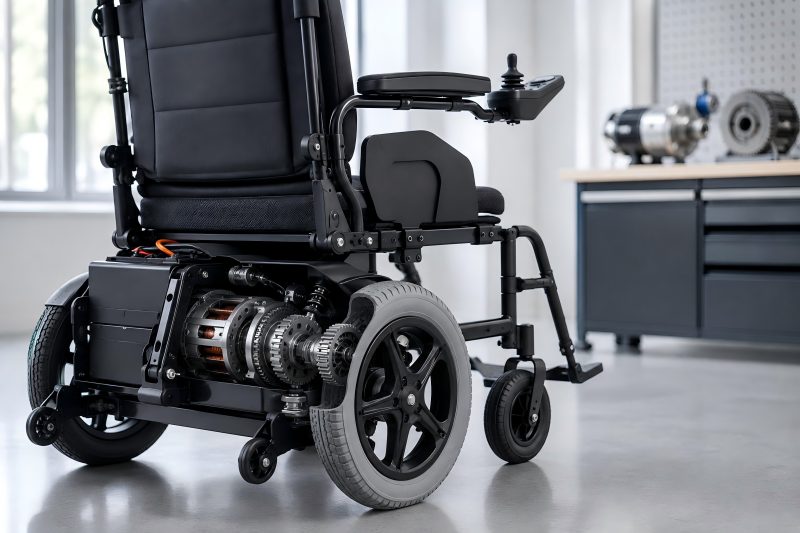
Typical Motor Priorities by Wheelchair Type
| Wheelchair Type | Main Motor Requirement | Typical Priority |
| Standard electric wheelchair | Balanced torque and efficiency | Reliability |
| Folding wheelchair | Compact, lightweight drive | Low weight |
| Heavy-duty wheelchair | High continuous torque | Load capacity |
| Outdoor wheelchair | Strong climbing performance | Torque |
| Indoor wheelchair | Smooth low-speed control | Precision |
| All-terrain wheelchair | High torque and thermal capacity | Durability |
The motor should therefore be treated as part of the complete drive system rather than an independent component.
Calculate Torque Before Motor Power
One of the most common mistakes I see in motor selection is starting with wattage.
For wheelchairs, torque is usually more important.
The motor must generate enough wheel torque to overcome rolling resistance, accelerate the wheelchair, and climb slopes. Higher wheelchair weight and steeper slopes both increase the required motor torque.
A simplified way to think about the relationship is:
Required wheel torque = driving force × wheel radius
Suppose the total wheelchair system weighs 150 kg. A motor used on level ground may only need moderate torque to maintain movement. However, when the same wheelchair starts from rest on an 8° or 10° slope, required torque increases significantly.
Starting torque is particularly important because the wheelchair must overcome inertia before it begins moving.
This is why I would never select a wheelchair motor using rated power alone.
Torque Requirements Under Different Conditions
| Operating Condition | Torque Demand | Engineering Concern |
| Flat indoor floor | Low | Smooth control |
| Rough pavement | Medium | Continuous torque |
| Frequent acceleration | Medium-High | Peak torque |
| Ramp climbing | High | Low-speed torque |
| Starting on a slope | Very High | Peak current |
| Heavy passenger load | High | Thermal capacity |
A reasonable design should include torque reserve rather than operating continuously near the motor’s maximum capability.
Distinguish Rated Torque From Peak Torque
Motor specifications often include both rated torque and peak torque.
These numbers should not be confused.
Rated torque is the continuous torque a motor can deliver safely without overheating.
Peak torque is available only for a short period.
A wheelchair may require peak torque when:
- Starting from rest
- Climbing over a threshold
- Starting on an incline
- Accelerating quickly
- Crossing uneven terrain
However, if the wheelchair needs peak torque continuously just to climb an ordinary ramp, the motor is probably undersized.
For motor selection, I normally pay more attention to whether the required driving condition falls within the motor’s continuous operating range.
That makes the system more reliable and also reduces the risk of overheating.
Match Motor Speed With Wheel Diameter
Motor speed cannot be selected independently from wheel size.
The relationship is straightforward: larger wheels travel farther per revolution. Therefore, for the same vehicle speed, a larger wheel requires lower wheel RPM.
Consider two wheelchairs using 8-inch and 14-inch drive wheels. If both are designed for the same maximum speed, the required wheel RPM will be different.
This affects both motor speed and gearbox ratio.
Example Wheel Size Effects
| Drive Wheel | Wheel RPM for Same Vehicle Speed | Torque Requirement at Wheel |
| Small wheel | Higher | Lower lever arm |
| Medium wheel | Medium | Balanced |
| Large wheel | Lower | Higher lever arm |
A larger wheel generally increases the torque required at the drive axle because the wheel radius is larger.
That is an important detail. Changing wheel diameter after the motor has already been selected can significantly change driving performance.
Select the Gear Ratio Carefully
Most conventional electric wheelchair motors use a reduction gearbox.
The motor itself normally runs much faster than the wheel. The gearbox converts high motor speed into lower speed with greater output torque.
For example, if a motor produces 0.8 Nm before reduction and the gearbox ratio is approximately 25:1, theoretical output torque is greatly increased. Actual torque will be slightly lower because of mechanical losses.
A higher gear ratio provides:
- Higher output torque
- Better climbing ability
- Lower output speed
A lower gear ratio provides:
- Higher wheelchair speed
- Lower output torque
- Potentially lower mechanical resistance
There is no universally correct gearbox ratio.
For a heavy wheelchair, I would normally prefer enough reduction to keep the motor operating comfortably rather than forcing a small motor to produce excessive current at low speed.
Choose the Correct Motor Type
Several motor types can be used in wheelchair applications, but geared brushed DC motors and brushless DC motors are among the most common choices.
Brushed DC Motor
Brushed motors remain practical for many wheelchair systems.
Advantages include:
- Relatively simple control
- Good starting torque
- Mature manufacturing process
- Competitive cost
The main disadvantage is brush wear. Over long operating periods, brushes and commutators become maintenance points.
Brushless DC Motor
BLDC motors remove mechanical brushes and use electronic commutation.
Their main advantages are:
- Higher efficiency
- Longer service life
- Lower maintenance
- Good power density
- Better suitability for compact designs
However, the motor and controller must be matched carefully.
For newer wheelchair projects where size, efficiency, and product life are important, I often consider a BLDC motor first. For cost-sensitive designs with established control architecture, a brushed motor can still be a sensible solution.
Hub Motors
Hub motors are particularly interesting for compact and folding electric wheelchairs because the drive system can be integrated directly into the wheel.
This can eliminate a separate external gearbox and reduce the number of mechanical transmission components.
The trade-off is that wheel size, motor structure, braking, heat dissipation, and installation become more closely connected. Hub motors therefore require stronger system-level design rather than simply replacing a conventional geared motor.
Consider Battery Voltage Early
Common wheelchair systems may use voltages such as 24 V, 36 V, or higher depending on the design.
Voltage affects current.
For the same mechanical output power, a lower-voltage motor generally requires higher current. Higher current means heavier cables, greater controller current capacity, and more electrical losses.
For example, two motors may deliver similar output power while operating at different voltage and current combinations.
From an engineering perspective, I prefer to select motor voltage together with:
- Battery pack
- Controller
- Cable size
- Connectors
- Protection devices
Changing motor voltage late in the development process can create unnecessary redesign work.
Do Not Ignore Motor Efficiency
Efficiency directly affects wheelchair range.
Energy not converted into mechanical power is dissipated as heat within the motor. A motor operating at poor efficiency can produce several problems at once:
- Shorter battery life
- Higher motor temperature
- Lower driving range
- Greater controller current
- Reduced component life
However, the highest peak efficiency number on a motor datasheet is not enough.
The important question is where that efficiency occurs.
If a motor reaches excellent efficiency at high speed but the wheelchair spends most of its time operating at low speed and high torque, that efficiency figure may not represent real-world performance.
The motor should operate efficiently near the wheelchair’s normal working region.
Evaluate Thermal Performance
Thermal performance is often overlooked when designing an electric wheelchair drive system. A motor can produce enough torque for a short test while still failing after prolonged operation.
Imagine a heavy-duty wheelchair climbing long ramps repeatedly. Motor current rises, copper losses increase, and winding temperature begins to climb.
If heat cannot escape effectively, the motor may experience:
- Winding insulation degradation
- Magnet performance reduction
- Bearing life reduction
- Grease deterioration
- Controller thermal protection
For this reason, continuous-load testing is more valuable than a short no-load speed test.
When developing a custom motor, I would normally test temperature rise under realistic loads rather than relying entirely on theoretical calculations.
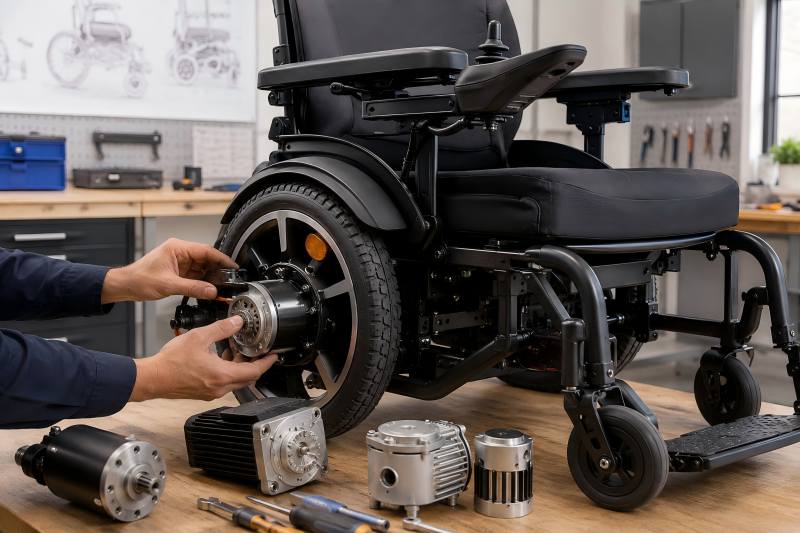
Low-Speed Control Matters More Than Maximum Speed
Wheelchairs operate very differently from scooters or ordinary small electric vehicles.
Users frequently need extremely controlled movement when:
- Entering elevators
- Approaching tables
- Turning in narrow spaces
- Passing through doors
- Moving beside other people
A motor that accelerates aggressively but cannot maintain smooth low-speed movement creates a poor driving experience.
Good wheelchair control requires the motor, gearbox, controller, and feedback system to work together.
Encoders or Hall sensors can improve speed feedback and control accuracy in brushless systems.
For wheelchair applications, stable movement at very low speed is often more valuable than achieving a slightly higher maximum speed.
Check Braking Requirements
Motor selection should also include braking.
Many electric wheelchair systems use an electromagnetic brake integrated with the motor or gearbox.
When electrical power is removed, the brake can mechanically hold the wheelchair.
This is particularly important when the wheelchair stops on a slope.
A suitable braking system should consider:
- Wheelchair gross weight
- Maximum gradient
- Wheel diameter
- Required holding torque
- Brake response time
- Manual release mechanism
The brake should not be selected simply according to motor size. It needs enough holding torque at the wheel under the worst expected condition.
Consider Noise and Vibration
Motor noise may appear secondary during early engineering work, but wheelchair users experience the drive system at very close distance.
Gear mesh noise, bearing noise, electromagnetic noise, and structural vibration can all affect perceived product quality.
A quiet system requires attention to:
- Gear tooth design
- Gear manufacturing accuracy
- Bearing quality
- Rotor balance
- Motor commutation
- Housing rigidity
- Mounting structure
Increasing motor power will not solve a noisy gearbox.
Noise problems are usually best addressed at component and structural levels during development.
Leave Enough Performance Margin
Designing a motor system exactly around calculated nominal demand is risky.
Real wheelchairs experience conditions that are difficult to represent with one calculation:
- Tire pressure changes
- User weight differences
- Uneven surfaces
- Bearing friction
- Gearbox efficiency changes
- Battery voltage drop
- Cold starts
- Repeated slope climbing
For this reason, some torque and thermal margin should be included.
This does not mean selecting the largest available motor. The goal is to provide enough reserve without creating unnecessary weight and cost.
Key Specifications to Give Your Motor Manufacturer
When developing a wheelchair motor, providing only voltage and wattage is rarely enough.
A useful motor specification should include:
| Parameter | Why It Matters |
| Rated voltage | Defines electrical system |
| Rated torque | Determines continuous driving capability |
| Peak torque | Supports starting and climbing |
| Rated speed | Matches vehicle speed target |
| Wheel diameter | Affects torque and RPM |
| Gear ratio | Determines output torque and speed |
| Maximum load | Defines mechanical demand |
| Maximum slope | Defines climbing requirement |
| Duty cycle | Affects thermal design |
| Brake torque | Ensures safe parking |
| Shaft dimensions | Determines mechanical connection |
| Mounting interface | Controls installation compatibility |
| Encoder/Hall requirement | Supports motor control |
| Protection level | Important for outdoor use |
Detailed operating requirements help ensure the motor matches actual wheelchair performance needs.
Final Selection Should Be Verified on the Wheelchair
Motor calculations are extremely useful, but they are still only the first stage.
A prototype should be tested under realistic wheelchair operating conditions.
I would normally verify at least:
- Maximum loaded speed
- Acceleration
- Ramp climbing
- Slope starting
- Motor current
- Motor temperature
- Controller temperature
- Brake holding ability
- Low-speed smoothness
- Noise
- Battery consumption
Testing should also be performed with the intended passenger load rather than with an unloaded wheelchair.
This is where many design problems become visible.
A motor that looks correct mathematically may behave differently once gearbox efficiency, tire deformation, battery voltage drop, and real road resistance are introduced.