
Electric wheelchairs are not simply mobility devices driven by a standard motor. Behind smooth acceleration, stable climbing, precise control, and long battery life is a carefully matched motor system. For manufacturers developing different wheelchair platforms, choosing the right motor parameters is often more important than simply selecting a motor with higher power.
A customized wheelchair motor needs to balance four key factors: voltage, torque, speed, and gear ratio. These parameters are closely connected. Changing one factor usually affects the others, which means motor design must consider the entire wheelchair system rather than a single performance target.
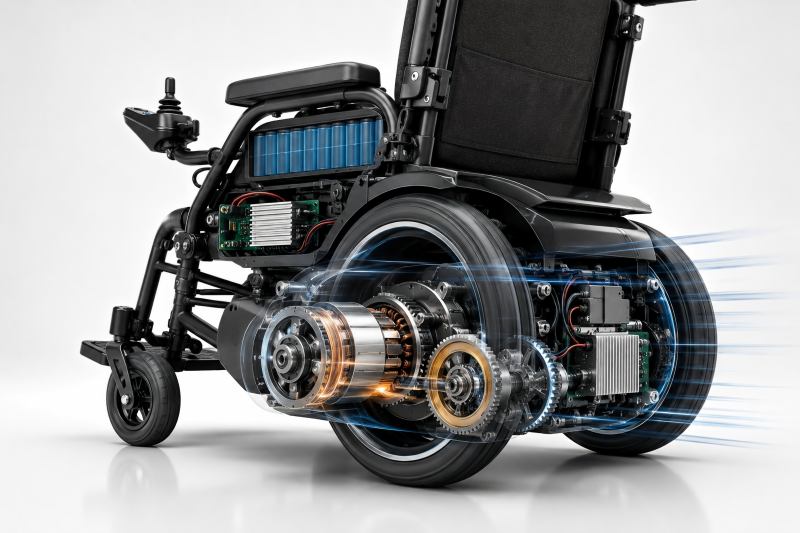
Why Custom Wheelchair Motors Require Precise Design
Electric wheelchairs are used in very different environments. A lightweight folding wheelchair mainly focuses on portability and energy efficiency, while a heavy-duty wheelchair requires high torque to move heavier loads and overcome slopes.
A motor that works well in one wheelchair model may not perform well in another because the requirements are different:
| Wheelchair Type | Main Requirement | Typical Motor Focus |
| Folding Electric Wheelchair | Lightweight, compact size, low power consumption | Small hub motor or compact geared motor |
| Standard Electric Wheelchair | Daily mobility and reliability | Balanced torque and efficiency |
| Heavy-Duty Electric Wheelchair | High load capacity and climbing ability | High torque geared motor |
| Outdoor All-Terrain Wheelchair | Strong traction and durability | High torque, waterproof design |
Therefore, custom motor development starts with understanding the wheelchair structure, wheel size, user weight, driving environment, and battery system.
Voltage Selection: Matching Motor Power With Battery Systems
Voltage is one of the first parameters considered when designing a wheelchair motor. It determines how the motor works with the battery and controller system.
Common wheelchair motor systems usually operate at 12V, 24V, or higher voltage levels. Among them, 24V systems are widely used because they provide a good balance between power output and electrical efficiency.
The relationship between voltage and motor performance can be understood simply:
- Higher voltage allows the motor to achieve higher power output with lower current.
- Lower current reduces heat generation in wires and motor components.
- A suitable voltage improves overall system efficiency.
For example, if two motors produce the same output power, the higher-voltage motor requires less current.
| System Voltage | Advantages | Suitable Applications |
| 12V | Simple structure, lower cost | Small mobility devices |
| 24V | Good balance of power and efficiency | Most electric wheelchairs |
| 36V+ | Higher performance capability | Heavy-duty or high-speed applications |
Higher voltage does not always provide the optimal solution. A higher voltage system may require a different controller, battery configuration, and electrical protection design. For wheelchair applications, reliability and safety are usually more important than simply increasing output power.
When customizing a motor, manufacturers need to match the motor voltage with:
- Battery voltage
- Controller specifications
- Required driving distance
- Motor thermal performance
A well-matched voltage system helps the wheelchair achieve stable operation without unnecessary energy loss.
Torque: The Most Important Parameter for Wheelchair Motors
For electric wheelchairs, torque is often more important than maximum speed.
The motor must generate enough torque to:
- Start smoothly from a stationary position
- Carry the user’s weight
- Climb ramps and slopes
- Overcome outdoor obstacles
- Maintain stable movement at low speed
Unlike vehicles designed mainly for high-speed driving, wheelchairs operate mostly at low speeds but require strong pulling force.
The required torque depends on several factors:
| Factor | Effect on Motor Torque Requirement |
| User Weight | Higher weight requires more torque |
| Wheel Diameter | Larger wheels require higher torque |
| Slope Angle | Steeper slopes increase load |
| Ground Condition | Rough surfaces require additional torque |
| Gear Ratio | Higher reduction increases wheel torque |
For example, a compact indoor wheelchair may only need moderate torque because it operates on flat floors. However, an outdoor wheelchair designed for grass, gravel, or slopes needs significantly higher torque.
This is why many wheelchair motors use gear reduction systems. The motor itself can operate at an efficient speed while the gearbox increases output torque at the wheel.
A common mistake is judging motors only by wattage. Motors with the same power rating may deliver different results due to variations in torque output and gear ratio design.
Speed Design: Finding the Right Balance Between Mobility and Control
Motor speed affects how fast the wheelchair can move, but higher speed is not always better.
Most electric wheelchairs are designed for controlled movement rather than high-speed transportation. Excessive speed may reduce safety, especially when turning or driving on uneven surfaces.
When designing wheelchair motors, engineers usually consider:
- Maximum travel speed
- Acceleration smoothness
- Controller response
- User comfort
- Battery consumption
A typical wheelchair motor design focuses on:
Low-speed stability + sufficient torque + smooth control
instead of focusing on the highest rotation speed.
For example, a motor running at very high RPM may require a larger reduction gearbox to achieve suitable wheel speed. This can increase mechanical complexity and reduce efficiency.
The ideal motor speed depends on:
- Wheel diameter
- Desired vehicle speed
- Gear reduction ratio
- Controller settings
The relationship can be simplified as:
Wheel Speed = Motor Speed ÷ Gear Reduction Ratio
A custom motor supplier needs to calculate these parameters together instead of selecting speed independently.
Gear Ratio: Converting Motor Speed Into Driving Force
The gearbox is a critical component in wheelchair motor systems. It transforms the motor’s high-speed rotation into usable wheel torque.
Electric motors generally operate efficiently at higher speeds, but wheelchair wheels require slower rotation with greater force. The gear system bridges this difference.
For example:
- Motor speed: 3000 RPM
- Gear ratio: 20:1
The output speed becomes approximately:
3000 ÷ 20 = 150 RPM
Meanwhile, torque output is significantly enhanced. Different gear ratios create different performance characteristics:
| Gear Ratio | Characteristics | Application |
| Lower Ratio | Higher speed, lower torque | Lightweight indoor wheelchairs |
| Medium Ratio | Balanced speed and torque | Standard wheelchairs |
| Higher Ratio | Strong torque, lower speed | Heavy-duty applications |
Choosing the wrong gear ratio can create problems.
A gear ratio that is too low may cause:
- Weak climbing ability
- Poor acceleration
- Motor overload
A gear ratio that is too high may cause:
- Reduced travel speed
- Lower efficiency
- Larger gearbox size
Therefore, gear ratio selection should be based on the complete wheelchair design.
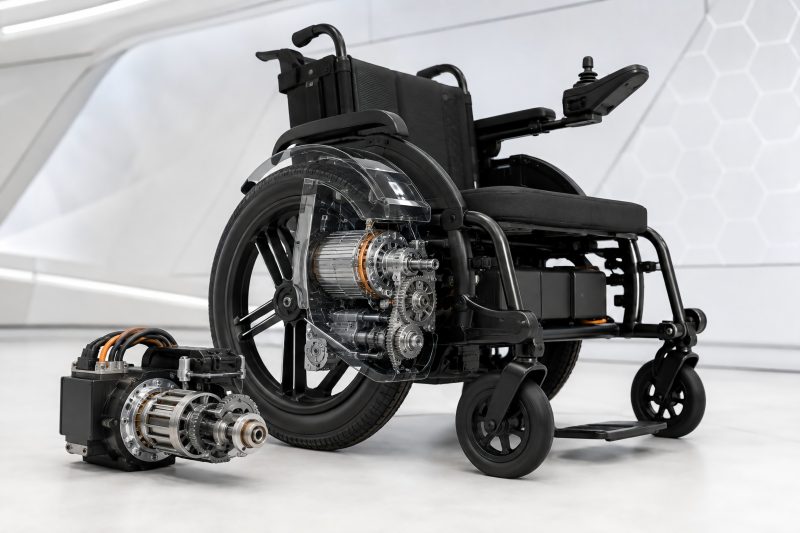
How Manufacturers Customize Wheelchair Motors
A professional wheelchair motor manufacturer usually does not start with a motor model. Instead, the process begins with application analysis.
1. Understanding Application Requirements
Engineers first evaluate:
- Wheelchair type
- Maximum load
- Driving environment
- Battery voltage
- Required speed
- Expected operating hours
This information defines the basic motor requirements.
2. Motor Electromagnetic Design
The motor structure is optimized according to torque and efficiency requirements.
Important design factors include:
- Magnet strength
- Stator design
- Winding configuration
- Heat generation
- Efficiency curve
For wheelchair applications, motors are usually designed for frequent starting and stopping rather than continuous high-speed operation.
3. Gearbox Matching
Gearbox selection depends on the target output torque and desired wheel speed. A good gearbox design should provide:
- High transmission efficiency
- Low noise operation
- Long service life
- Compact installation size
4. Performance Testing
Before mass production, customized motors should be tested under real operating conditions.
Typical tests include:
| Test Item | Purpose |
| Torque Test | Verify output force |
| Temperature Test | Check thermal performance |
| Noise Test | Improve user comfort |
| Load Test | Confirm durability |
| Life Test | Evaluate long-term reliability |
Hub Motor vs Geared Motor for Wheelchairs
Different wheelchair designs may require different motor structures.
Geared Motor
Geared motors are widely used in traditional electric wheelchairs.
Advantages:
- High torque output
- Strong climbing ability
- Suitable for heavy loads
- Mature technology
Disadvantages:
- Larger mechanical structure
- More moving components
- Possible gearbox noise
Hub Motor
Hub motors combine the motor unit with the wheel structure.
Advantages:
- Compact design
- Easy installation
- Reduced mechanical transmission loss
- Suitable for folding wheelchairs
Disadvantages:
- More difficult heat management
- Limited space for high-power designs
The best choice depends on the wheelchair application rather than the motor type itself.
Future Trends in Wheelchair Motor Design
As electric wheelchair technology develops, motor systems are moving toward:
Smaller size with higher torque density
Users expect wheelchairs to become lighter and easier to transport, while still maintaining strong performance.
Higher efficiency
Improved motor design helps extend battery range and reduce charging frequency.
Smarter control
Motor systems are increasingly integrated with intelligent controllers, sensors, and feedback systems to improve driving comfort.
Enhanced Environmental Protection
Outdoor wheelchair motors require enhanced protection against dust, moisture, and varying environmental conditions.
Custom wheelchair motors are a combination of electrical design, mechanical engineering, and application understanding. Voltage determines the electrical foundation, torque provides the necessary driving force, speed affects mobility and comfort, while gear ratio converts motor performance into practical wheelchair movement.
No single motor fits every electric wheelchair application. A lightweight folding wheelchair and a heavy-duty outdoor wheelchair have completely different requirements.