
Outrunner BLDC motors are popular in drones because they offer the right combination of high torque, efficient low-speed operation, lightweight structure, fast response, direct-drive capability, and reliable brushless performance.
Their ability to drive propellers directly makes them especially suitable for multirotor drones, where thrust, control accuracy, battery life, and stability are critical. Whether used in FPV racing drones, camera drones, agricultural UAVs, or industrial inspection drones, outrunner BLDC motors help improve flight performance and system efficiency.
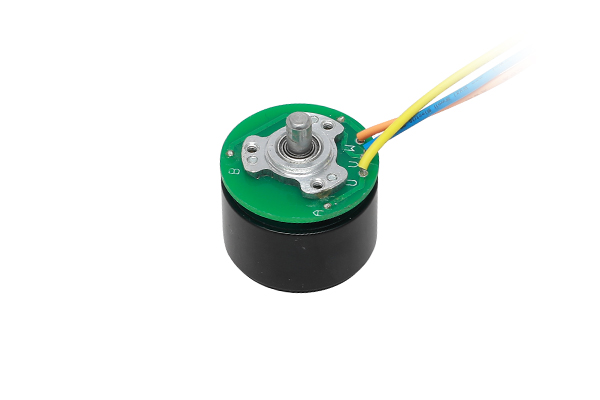
What Is an Outrunner BLDC Motor?
An outrunner BLDC motor is a brushless DC motor where the outer shell rotates around a fixed inner stator. The permanent magnets are usually mounted inside the rotating outer bell, while the stator with copper windings remains stationary in the center.
Unlike inrunner BLDC motors, its rotor rotates around the stator.
Because the outer rotor has a larger diameter, an outrunner motor can generate more torque at lower speeds. This feature is very important for drones because propellers need torque to produce thrust efficiently.
Why Drones Use Outrunner BLDC Motors
| Reason | Benefit for Drones |
| High torque output | Drives large propellers directly |
| Low RPM efficiency | Improves lift and battery performance |
| Compact structure | Reduces size and weight. |
| Direct-drive capability | No gearbox needed |
| Fast throttle response | Improves flight stability and control |
| Good heat dissipation | Supports continuous flight operation |
| Wide size range | Suitable for FPV, camera, agricultural, and industrial drones |
High Torque for Better Propeller Thrust
One of the biggest reasons outrunner BLDC motors are used in drones is their high torque output.
Drone propellers require strong torque to generate stable lifting force. Outrunner motors have a larger rotor diameter, which gives them better leverage and higher torque compared with many inrunner designs of similar size.
This is especially useful for:
- Heavy-lift drones
- Agricultural spraying drones
- Camera drones
- Delivery drones
- Industrial inspection UAVs
For example, a small FPV drone may use high-KV outrunner motors for speed and agility, while a large agricultural drone may use low-KV outrunner motors to drive larger propellers for stronger lift.
Direct Drive Without a Gearbox
Outrunner BLDC motors can usually drive drone propellers directly. This means the propeller is mounted directly onto the motor shaft or motor bell.
This direct-drive design brings several advantages:
- Fewer mechanical parts
- Lower system weight
- Less power loss
- Lower maintenance requirements
- Faster response to throttle changes
In drone applications, every gram matters. Eliminating the gearbox reduces weight and improves flight efficiency. It also reduces mechanical failure risks, which is important for long-distance or high-value drone operations.
Better Efficiency at Low to Medium RPM
Most drone propellers work best at low to medium rotational speeds. Large propellers do not need extremely high RPM to generate lift. Instead, they need stable torque and efficient airflow.
Outrunner BLDC motors are well suited for this because they can produce strong torque at lower RPM.
| Motor Feature | Outrunner BLDC Motor Advantage |
| Larger rotor diameter | More torque leverage |
| Lower KV options | Better for large propellers |
| Direct propeller drive | Less mechanical energy loss |
| Brushless design | Higher efficiency and longer life |
| Electronic speed control | Accurate speed adjustment |
A lower-KV outrunner motor is often paired with a larger propeller. This combination can improve lifting efficiency and reduce unnecessary battery drain.
Lightweight and Compact Design
A heavier motor increases battery consumption and reduces flight time.
Outrunner BLDC motors offer a strong power-to-weight ratio. They can deliver high thrust without requiring a large or complex mechanical transmission system.
This makes them suitable for:
- Compact consumer drones
- Lightweight FPV racing drones
- Portable mapping drones
- Foldable camera drones
- Industrial UAV platforms
A compact motor structure also gives drone designers more flexibility when designing arms, frames, payload mounts, and battery layouts.
Fast Response for Stable Flight Control
Drones rely on rapid motor speed changes to stay stable in the air. When the flight controller detects movement, wind, tilt, or direction change, it sends signals to the ESC. The ESC then adjusts motor speed immediately.
Outrunner BLDC motors respond quickly to these commands, helping the drone maintain balance and control.
This is important for:
- Hovering stability
- Wind resistance
- Smooth turning
- Fast acceleration
- Precise landing
- Payload balance
For FPV drones, fast motor response improves agility and maneuverability. For camera drones, smooth response helps reduce vibration and improve image stability.
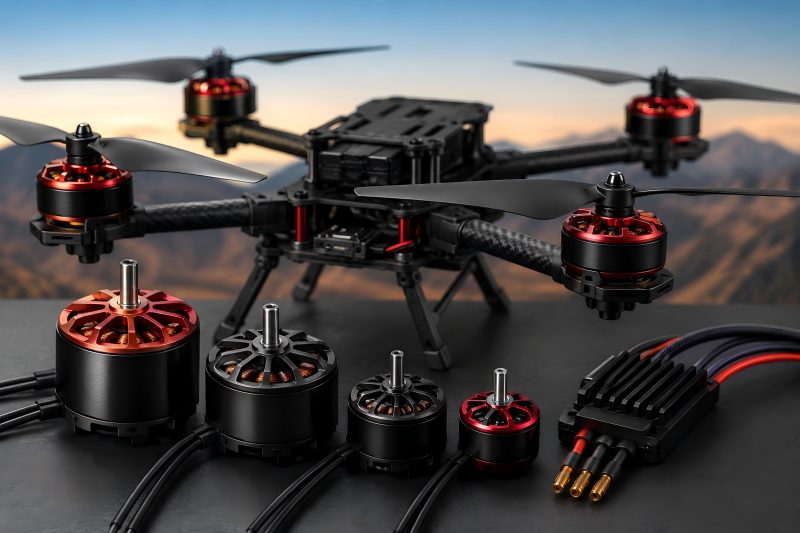
Good Match with Electronic Speed Controllers
Outrunner BLDC motors work together with ESCs to control speed, torque, braking, and acceleration. The ESC converts battery power into controlled three-phase current for the motor.
A good motor and ESC combination can improve:
- Throttle smoothness
- Motor synchronization
- Flight efficiency
- Heat control
- Battery protection
- Response accuracy
For professional drone applications, the motor should be selected together with the ESC, propeller, battery voltage, and payload requirement. A mismatch can cause overheating, poor thrust, short flight time, or unstable control.
Suitable for Different Drone Types
Outrunner BLDC motors are available in many sizes, KV ratings, power levels, and mounting designs.
| Drone Type | Common Motor Requirement | Why Outrunner BLDC Motors Fit |
| FPV racing drone | High speed and fast response | High KV and strong acceleration |
| Camera drone | Smooth and stable operation | Low vibration and precise control |
| Agricultural drone | High thrust and heavy payload | Large propeller direct drive |
| Mapping drone | Long flight time | Efficient low-RPM operation |
| Delivery drone | Strong lift and reliability | High torque and stable output |
| Inspection drone | Compact and durable structure | Lightweight and efficient design |
Because drone applications are highly different, motor selection should not only depend on size. It should also consider thrust, voltage, current, propeller diameter, heat dissipation, and working environment.
High Power-to-Weight Ratio
Drone motors must generate enough thrust while staying lightweight. Outrunner BLDC motors are popular because they offer a strong balance between power and weight.
A good outrunner motor can provide high thrust without making the drone too heavy. This directly affects:
- Flight time
- Payload capacity
- Climb speed
- Maneuverability
- Battery efficiency
For commercial drones, this can also affect operating cost. A more efficient motor system may reduce battery consumption, extend working time, and improve mission productivity.
Lower Maintenance Compared with Brushed Motors
Outrunner BLDC motors do not use brushes or mechanical commutators. This reduces friction, wear, sparks, and maintenance problems.
Compared with brushed motors, BLDC motors usually provide:
- Longer service life
- Higher efficiency
- Lower heat generation
- Better speed control
- More reliable continuous operation
For drones, reliability is critical. A motor failure during flight can lead to equipment damage, mission failure, or safety risks.
Good Heat Dissipation for Continuous Operation
Drone motors often work under changing loads. During takeoff, climbing, carrying payloads, or flying in windy conditions, the motor may draw higher current and generate more heat.
Outrunner motors usually have an exposed rotating bell structure, which helps move air around the motor during operation. This can support better cooling compared with fully enclosed designs.
However, heat performance still depends on:
- Motor size
- Winding quality
- Magnet material
- ESC settings
- Propeller load
- Battery voltage
- Ambient temperature
If the propeller is too large or the current is too high, even a high-quality outrunner BLDC motor may overheat. Proper motor matching is always important.
Key Factors When Choosing an Outrunner BLDC Motor for Drones
When selecting an outrunner BLDC motor, drone manufacturers should consider the complete power system, not just the motor itself.
Important factors include:
- Motor KV rating
- Maximum current
- Rated power
- Battery voltage
- Propeller size
- ESC compatibility
- Thrust requirement
- Drone weight
- Payload weight
- Heat dissipation
- Flight time target
- Mounting structure
A high-KV motor is not always better. High-KV motors spin faster but may not be suitable for large propellers. Low-KV motors are often better for large propellers and heavy-lift drones.
Common Applications of Outrunner BLDC Motors in Drones
Outrunner BLDC motors are widely used in both consumer and industrial UAV systems.
Common applications include:
- Aerial photography drones
- FPV racing drones
- Agricultural spraying drones
- Surveying and mapping drones
- Power line inspection drones
- Solar farm inspection drones
- Security patrol drones
- Delivery drones
- Heavy-lift industrial drones
- Research and educational UAVs
For each application, the motor design may be different. FPV drones need fast acceleration, while agricultural drones need stable high thrust. Camera drones require smooth operation with low vibration.