
Gear motors are perfect for industrial jobs like conveying, lifting, and mixing because they combine an electric motor with a gearbox to boost torque and decrease speed.
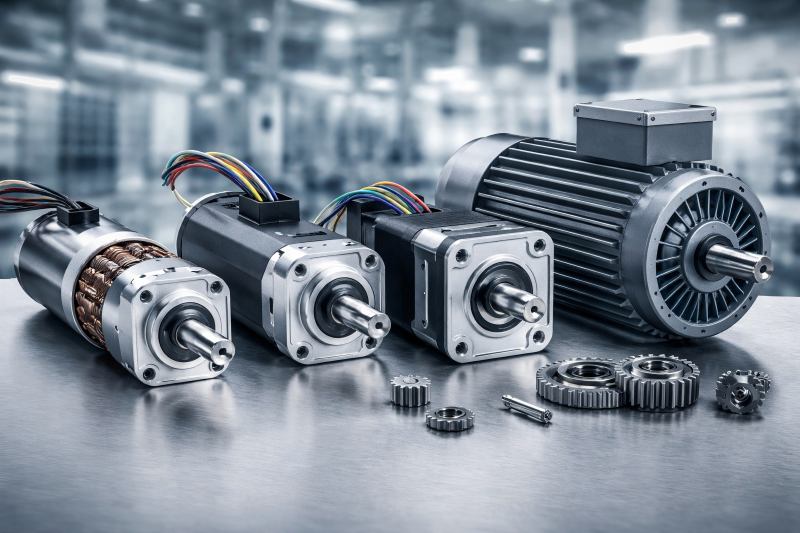
What Is a Gear Motor?
A gear motor combines two essential elements to satisfy particular industrial requirements:
Electric Motor:
- Supplies the initial power for rotation.
- Can be an AC motor, DC motor, brushless DC motor, or servo motor depending on the application.
Gearbox:
- Modifies the motor’s rotational power to achieve the desired output.
- Reduces the motor’s high speed and increases torque, addressing the mismatch between motor speed and industrial machinery requirements.
- Gear motors use AC, DC, brushless DC, or servo motors. They can also use different gearbox designs, including helical, worm, planetary, bevel, and spur gear systems.
Main Functions of a Gear Motor
| Function | Description | Industrial Benefit |
| Speed Reduction | Lowers the high speed of the motor | Matches machine operating requirements |
| Torque Multiplication | Increases output force at lower speed | Handles heavier loads |
| Motion Transmission | Transfers rotational energy to machine components | Supports stable operation |
| Control Improvement | Enables more precise output movement | Improves automation accuracy |
| Compact Integration | Integrates a gearbox and motor into a single unit. | Reduces the amount of installation space |
Gear Motor Basic Working Principle
First, the electric motor receives electrical energy from a power source. At this stage, the motor shaft spins at its rated speed, which is often much higher than what the machine actually needs.
Second, this rotation enters the gearbox. Inside the gearbox, a series of gears mesh together. These gears are designed with specific tooth counts and diameters. A smaller gear drives a larger one, reducing speed, increasing torque.
Third, the reduced-speed, high-torque output is transferred from the gearbox output shaft to the machine or driven equipment. This results in smoother, more powerful, and controlled motion.
In simple terms, the motor creates motion, and the gears reshape that motion into a more useful form for industrial work.
Gear Motor Energy Conversion Process
| Stage | Input | Process | Output |
| Motor Stage | Electrical energy | Electromagnetic conversion | Rotational motion |
| Gearbox Stage | High-speed rotation | Gear reduction | Lower speed, higher torque |
| Output Stage | Conditioned rotation | Mechanical transmission | Useful machine movement |
How Gear Reduction Works
The gearbox is the core reason a gear motor behaves differently from a standard motor. To understand this, it helps to look at the concept of gear ratio.
For instance, a 10-tooth gear driving a 50-tooth gear reduces speed by 5 and increases torque fivefold, minus friction losses.
This principle allows a gear motor to deliver strong rotational force without requiring an oversized motor. In industrial design, this is extremely useful because it keeps machines compact while still providing enough power for heavy-duty work.
Example of Gear Reduction Effect
| Parameter | Motor Only | After 10:1 Gear Reduction |
| Speed | 1500 rpm | 150 rpm |
| Torque | 10 Nm | About 100 Nm* |
| Output Behavior | Fast, lower force | Slower, stronger force |
This example shows why gear motors are so common in industrial machinery. Many applications prefer controlled low-speed movement with stronger force rather than raw motor speed.
Main Components of a Gear Motor
A gear motor may vary in design, but most units include the following main components.
Electric Motor
The motor is the power source of the unit. It generates the initial rotational movement. The motor can be AC, DC, brushless DC, or servo.
Gearbox
The gearbox houses the gears that reduce speed and increase torque. It is the most important component for adapting the motor’s performance to the application.
Input Shaft
The input shaft connects the motor output to the gearbox input, transferring rotational power into the gear train.
Gear Train
This is the arrangement of intermeshing gears inside the gearbox. The gear train design affects reduction ratio, efficiency, and capacity.
Output Shaft
The output shaft delivers the final motion to the driven machine, such as a conveyor roller, agitator, screw feeder, or lifting drum.
Bearings and Lubrication System
Bearings support rotating parts and reduce friction. Lubrication helps minimize wear, heat, and energy loss inside the gearbox.
Housing
The housing shields components from dust, moisture, shock, and contamination. In industrial settings, robust housing is critical for long service life.
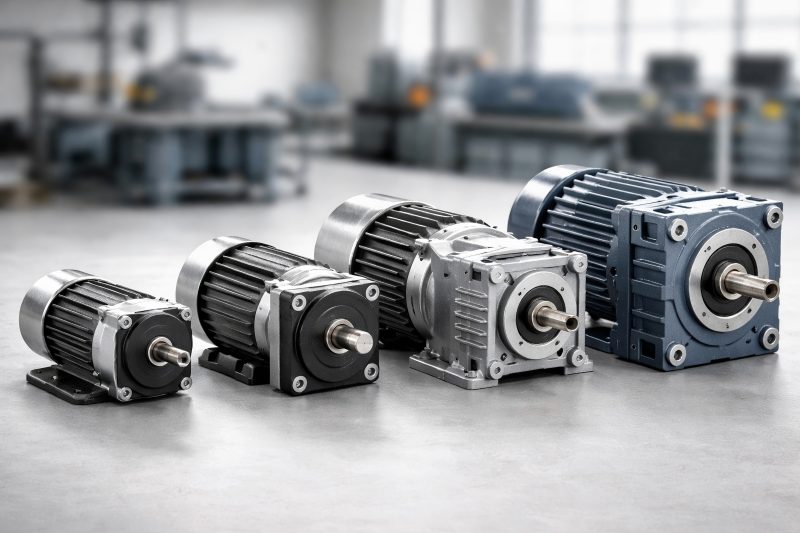
Gear Motor Types for Industry
Different industries choose different gear motor designs depending on load direction, space limitations, efficiency requirements, and torque needs.
Common Types of Gear Motors
| Type | Main Feature | Typical Industrial Use |
| Helical Gear Motor | Smooth, efficient, quiet operation | Conveyors, packaging lines, production machinery |
| Worm Gear Motor | High reduction ratio, compact design | Lifts, gates, positioning systems |
| Planetary Gear Motor | High torque density, compact size | Robotics, automation, precision equipment |
| Bevel Gear Motor | Changes rotation direction | Material handling, corner drives |
| Spur Gear Motor | Simple and cost-effective | Light-duty industrial systems |
Helical gear motors are popular because they offer good efficiency and lower noise. Worm gear motors are often selected where high reduction in a compact footprint is needed, although they may have lower efficiency. Planetary gear motors provide high torque in compact spaces.
Importance of Gear Motors in Industry
Industrial machines rarely operate under ideal no-load conditions. They must move products, rotate drums, drive belts, lift parts, or resist variable resistance from materials and processes. A standard motor alone often cannot provide the right balance of torque and speed for these tasks.
A gear motor solves that issue by delivering usable motion directly to the machine. This reduces the need for additional transmission systems and improves reliability.
Main Industrial Advantages
| Advantage | Explanation |
| Higher Output Torque | Supports heavy-duty mechanical loads |
| Better Speed Control | Matches machine requirements more precisely |
| Compact System Design | Reduces installation complexity |
| Improved Energy Use | Avoids oversizing the motor unnecessarily |
| Reliable Continuous Operation | Suitable for demanding industrial cycles |
| Lower Maintenance in Integrated Designs | Fewer separate drive components |
Because of these benefits, gear motors are used in almost every industrial sector, from food processing and logistics to mining and heavy manufacturing.
Working Principle of a Gear Motor in Real Industrial Scenarios
To better understand the principle, it helps to look at real industrial examples.
Conveyor Systems
In a conveyor system, the belt must move at a controlled speed while carrying products or materials. If the conveyor runs too fast, products may slip or become unstable. If it lacks torque, it may stall under load. A gear motor reduces the motor speed and increases torque so the conveyor can move smoothly and continuously.
Mixers and Agitators
Industrial mixers often need slow but powerful rotation to blend liquids, powders, or semi-solid materials. A motor alone may spin too fast for effective mixing. A gear motor delivers lower speed and stronger turning force, allowing the mixing blades to work efficiently.
Hoists and Lifting Equipment
Lifting applications require strong torque and controlled motion for safety. Gear motors help raise and lower loads steadily, preventing sudden acceleration or insufficient lifting force.
Packaging Machinery
Packaging equipment relies on synchronized motion. Gear motors drive rollers, feeders, and sealing units at stable speeds. Their predictable output helps maintain product consistency and reduce downtime.
Automated Production Lines
In automated systems, each mechanical movement must be repeatable. Gear motors support indexing, positioning, feeding, and transfer operations by converting motor speed into controlled mechanical output.
Relationship Between Speed, Torque, and Efficiency
A gear motor is always about balancing three factors: speed, torque, and efficiency.
When speed goes down through gear reduction, torque goes up. However, this is never perfectly lossless. Energy is lost due to friction, heat, and internal mechanical resistance. That is why gearbox efficiency matters.
For example, helical and planetary gearboxes are usually more efficient than worm gearboxes. The application determines whether maximum efficiency, compactness, or high reduction ratio is more important.
Performance Comparison Overview
| Gear Type | Speed Reduction Capability | Torque Output | Efficiency | Noise Level |
| Helical | Medium to High | High | High | Low |
| Worm | High | Medium to High | Moderate to Low | Low |
| Planetary | High | Very High | High | Moderate |
| Spur | Medium | Medium | Moderate to High | Moderate |
| Bevel | Medium | High | High | Moderate |
Selecting the right gear motor means understanding which of these characteristics matters most in the industrial application.
Factors That Affect Gear Motor Performance
Even if two gear motors look similar, their real performance may differ depending on operating conditions.
Load Conditions
A heavily loaded machine needs higher torque. An undersized gear motor may overheat, stall, or wear prematurely.
Duty Cycle
Some gear motors run continuously, others cycle on and off. Frequent starts can place extra stress on gears and motor windings.
Ambient Environment
Dust, moisture, chemicals, or high temperatures can affect motor insulation, lubrication quality, and gearbox durability.
Mounting Position
Vertical or unusual mounting positions may influence lubrication flow and bearing stress.
Lubrication Quality
Poor lubrication increases friction, heat, and gear wear. Good lubrication is essential for smooth power transmission.
Alignment and Installation
Improper alignment between the gear motor and driven load can create vibration, shaft stress, and seal failure.
Common Problems and Their Causes
Although gear motors are reliable, problems can occur if they are not selected or maintained correctly.
Common Gear Motor Issues
| Problem | Possible Cause | Effect |
| Overheating | Overload, poor ventilation, incorrect duty cycle | Reduced lifespan |
| Excessive Noise | Gear wear, misalignment, poor lubrication | Unstable operation |
| Vibration | Shaft imbalance, loose mounting, damaged bearings | Mechanical damage |
| Oil Leakage | Worn seals, overfilled gearbox, poor installation | Lubrication loss |
| Reduced Torque | Gear wear, motor damage, wrong gear ratio | Weak output |
| Frequent Failure | Incorrect sizing, harsh environment, poor maintenance | Downtime increase |
Regular inspection and correct application design can prevent most of these issues.
Selecting the Ideal Gear Motor for Industrial Use
Selecting a gear motor requires assessing the machine’s actual operating demands, not just power rating.
Important considerations include required torque, output speed, load type, operating cycle, mounting method, and environmental conditions. A motor too small may fail quickly, while one too large increases cost and lowers efficiency.
Basic Selection Checklist
| Selection Factor | What to Consider |
| Output Speed | Required rpm at the machine |
| Torque Demand | Load size and resistance |
| Power Rating | Sufficient motor capacity |
| Gear Ratio | Needed speed reduction level |
| Gear Type | Helical, worm, planetary, bevel, or spur |
| Duty Cycle | Continuous, intermittent, or start-stop |
| Installation Space | Available mounting dimensions |
| Environment | Dust, humidity, washdown, heat, chemicals |
In industrial settings, proper matching between the gear motor and the driven equipment is the key to long-term performance.
Maintenance and Service Considerations
A gear motor is a mechanical and electrical product, so it needs both motor care and gearbox care. Preventive maintenance is crucial for heavy loads and long operations.
Routine maintenance may include checking lubrication condition, monitoring temperature, listening for unusual noise, inspecting seals for leakage, and confirming that bolts and mounting points remain secure.
Predictive maintenance is also becoming more common. Some factories use vibration monitoring and thermal analysis to detect gear motor problems before failure occurs. This helps reduce unexpected downtime and improves equipment planning.
Future Trends in Industrial Gear Motors
Modern industrial systems demand greater precision, efficiency, and integration. As a result, gear motors are evolving in several directions.
Manufacturers are improving gear tooth design to reduce noise and increase efficiency. Compact high-torque planetary systems are becoming more popular in automation. Smart monitoring systems are also being integrated into industrial drives to enable real-time tracking of temperature, vibration, and operating status.
In addition, energy efficiency regulations are pushing the development of more efficient motors and optimized gearbox combinations. This trend is especially important in factories that run continuously and want to reduce long-term operating costs.