
Planetary gear motors support precise motion in many automated systems. They are valued for their compact structure, high torque density, smooth transmission, and good load distribution.
However, one important performance factor buyers often consider is backlash. Backlash can directly affect positioning accuracy, motion smoothness, repeatability, noise level, and service life. For applications that require precise control, understanding what causes backlash in planetary gear motors is essential.
Understanding Backlash in Planetary Gear Motors
Backlash refers to the small clearance or free movement between mating gear teeth before torque is transmitted in the opposite direction.
In simple terms, when the motor changes direction, there may be a slight delay before the output shaft responds. This delay is caused by the gap between gears, bearings, shafts, and other transmission components.
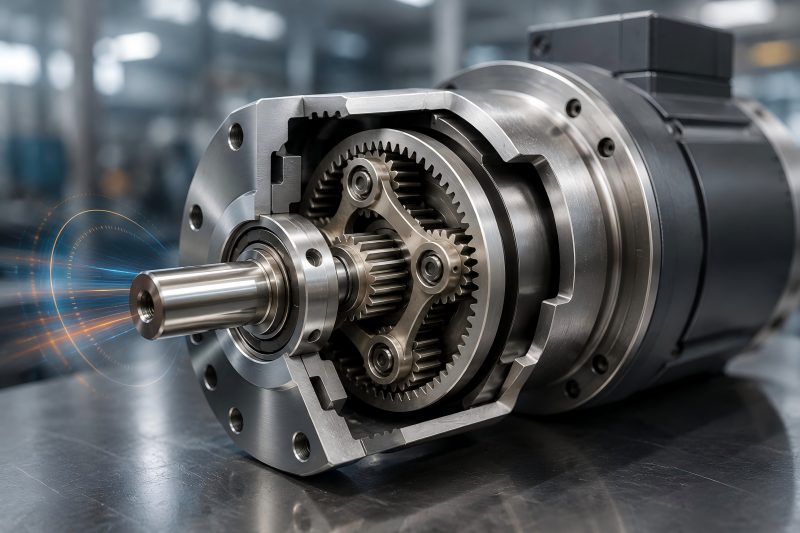
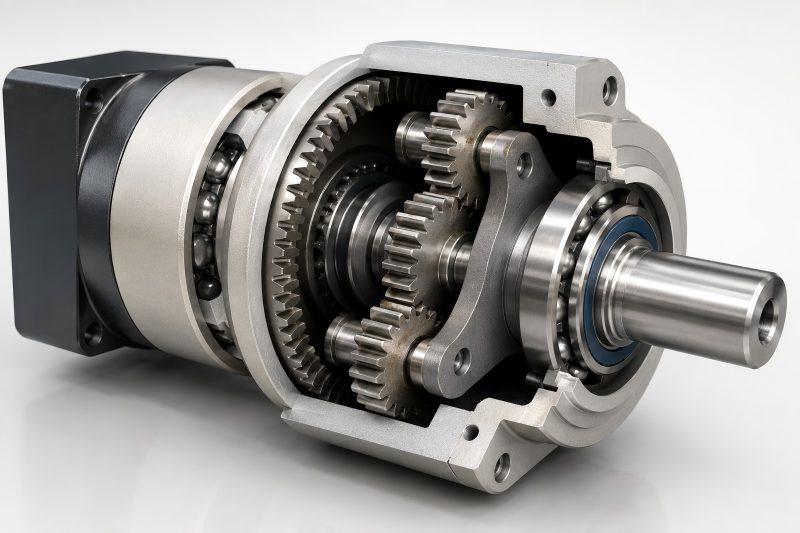
In a planetary gear motor, backlash mainly comes from the interaction between:
- Sun gear
- Planet gears
- Ring gear
- Planet carrier
- Bearings
- Output shaft
- Assembly clearances
A certain amount of backlash is normal and necessary. Without clearance, gears may generate excessive friction, heat, wear, and even jamming. Control backlash to match application requirements.
Common Causes of Backlash in Planetary Gear Motors
Gear Tooth Clearance
The most direct cause of backlash is the clearance between gear teeth. Planetary gear motors contain multiple gear meshing points. The sun gear engages planet gears, which then engage the internal ring gear.
If the clearance between these gear teeth is too large, the output shaft will have more free movement when changing direction.
Gear tooth clearance may be affected by:
- Gear design
- Machining accuracy
- Gear module
- Tooth profile
- Heat treatment deformation
- Assembly tolerance
For standard industrial applications, a small amount of backlash is acceptable. But for robotics, servo systems, and precision positioning equipment, excessive tooth clearance can reduce motion accuracy.
Manufacturing Tolerances
Planetary gear motors require high-precision manufacturing. Even a small dimensional deviation in gears, shafts, bearings, or housings can increase backlash.
Common manufacturing-related factors include:
- Gear profile error
- Uneven tooth spacing
- Poor concentricity
- Shaft machining deviation
- Housing bore tolerance
- Carrier hole position error
Because planetary gearboxes have several internal transmission parts, tolerance accumulation can become a major source of backlash. A small error in each component may result in noticeable play at the output shaft.
Poor Gear Machining Accuracy
Gear machining quality strongly affects backlash. If the gear teeth are not accurately cut, ground, or finished, the gear mesh will not be smooth.
Low machining accuracy can cause:
- Uneven tooth contact
- Larger gear clearance
- Irregular motion
- Higher noise
- Faster wear
High-precision planetary gear motors usually use better gear processing methods, such as precision hobbing, shaving, grinding, or high-accuracy CNC machining. These processes help improve gear fit and reduce backlash.
Bearing Clearance
Bearings support the rotating parts inside the planetary gear motor. If the bearings have excessive radial or axial clearance, the gears may shift slightly during operation.
This movement can increase backlash and reduce output stability.
Bearing-related backlash may come from:
- Low-quality bearings
- Incorrect bearing selection
- Poor preload control
- Bearing wear
- Heavy radial or axial load
For high-precision planetary gear motors, bearing quality and preload design are very important. Stable bearing support helps maintain accurate gear alignment and reduce movement inside the gearbox.
Planet Carrier Clearance
The planet carrier transfers torque; poor precision or loose fitting can increase gear play and backlash. Possible causes include:
- Oversized pin holes
- Loose planet gear pins
- Poor carrier rigidity
- Shaft-to-carrier clearance
- Wear around the carrier structure
The planet carrier is especially important because it directly affects output rotation. A rigid and precisely machined carrier helps improve torsional stiffness and reduce transmission error.
Main Causes of Backlash in Planetary Gear Motors
| Cause | How It Creates Backlash | Common Result |
| Gear tooth clearance | Gap between mating gear teeth | Delay during direction change |
| Manufacturing tolerance | Dimensional errors accumulate | Lower positioning accuracy |
| Bearing clearance | Gear shafts shift during load changes | Unstable output movement |
| Planet carrier clearance | Planet gears or carrier pins move slightly | Increased output shaft play |
| Wear over time | Gear teeth and bearings gradually wear | Backlash becomes larger |
| Improper assembly | Parts are not aligned or preloaded correctly | Noise, vibration, and looseness |
| Overload operation | Excessive torque damages contact surfaces | Faster wear and higher backlash |
Wear During Long-Term Operation
Backlash may increase after long-term use. Even if a planetary gear motor has low backlash when new, wear can gradually enlarge the clearance between moving parts.
Wear may occur on:
- Gear teeth
- Bearings
- Planet pins
- Output shaft
- Internal ring gear
- Lubrication contact surfaces
Heavy-duty operation, frequent start-stop motion, shock loads, and poor lubrication can accelerate wear. Once internal parts become worn, backlash usually increases and the motor may become noisier.
Insufficient Lubrication
Lubrication reduces friction between gear teeth and helps protect internal components. If lubrication is poor, gear wear may increase quickly.
Lubrication problems include:
- Too little grease or oil
- Wrong lubricant type
- Lubricant aging
- Contamination by dust or metal particles
- High operating temperature
When lubrication fails, gear teeth may wear unevenly. This increases clearance and leads to greater backlash. Good lubrication is important not only for service life but also for backlash stability.
Overload and Shock Load
Planetary gear motors are designed for specific torque ranges. If the gearbox is often overloaded, gear teeth and bearings may deform or wear faster.
Backlash caused by overload may appear in applications such as:
- Robotic arms with sudden direction changes
- AGV drive wheels under impact
- Packaging machines with frequent stops
- Automation systems with heavy inertia loads
- Lifting or clamping mechanisms
Shock load can damage gear contact surfaces and loosen internal fits. Over time, this may create larger backlash, vibration, and abnormal noise.
Improper Assembly
Even if all parts are manufactured accurately, poor assembly can still cause backlash. Planetary gear motors require precise alignment between gears, bearings, shafts, and housing parts.
Assembly issues may include:
- Incorrect bearing preload
- Misaligned gears
- Uneven gear engagement
- Loose fasteners
- Poor shaft fitting
- Inaccurate carrier positioning
High-quality planetary gear motor manufacturers usually control backlash through strict assembly inspection and final testing.
Temperature Change
Temperature can also influence backlash. Metal parts change size with temperature variations. In high-temperature or low-temperature environments, gear clearance may change slightly.
Temperature-related factors include:
- Motor heating during continuous operation
- High ambient temperature
- Low-temperature startup
- Lubricant viscosity changes
- Thermal expansion of housing and gears
In most standard applications, temperature influence is limited. But in precision equipment or harsh environments, thermal stability should be considered during gearbox selection.
Backlash Symptoms and Possible Causes
| Symptom | Possible Cause | What to Check |
| Delay when reversing direction | Gear tooth clearance or worn gears | Output shaft play |
| Abnormal clicking noise | Excessive clearance or loose parts | Gear mesh and carrier fit |
| Poor positioning accuracy | High backlash or low torsional stiffness | Servo feedback and gearbox output |
| Vibration during operation | Misalignment or bearing wear | Bearings, shafts, and housing |
| Backlash increases over time | Wear, overload, or poor lubrication | Lubricant condition and gear wear |
| Uneven motion | Gear machining error or assembly problem | Gear contact pattern |
Why Backlash Matters in Planetary Gear Motors
Backlash is not always a problem. For many general transmission applications, standard backlash is acceptable. However, in precision applications, it can significantly affect machine performance.
Excessive backlash may cause:
- Lower positioning accuracy
- Poor repeatability
- Motion delay
- Reduced servo control performance
- Higher noise and vibration
- Shorter gearbox service life
- Lower equipment stability
For example, in a robotic arm, backlash may cause inaccurate end-position control. In a CNC machine, it may reduce machining precision. In an AGV drive system, it may affect smooth acceleration and stopping.
That is why buyers should choose the backlash level according to the actual application, not simply choose the lowest value in every case.
Backlash Requirements by Application
| Application | Backlash Requirement | Selection Suggestion |
| General conveyor system | Standard backlash acceptable | Focus on torque and durability |
| Packaging machine | Low to medium backlash | Balance accuracy and cost |
| AGV / mobile robot | Low backlash preferred | Consider shock load and service life |
| Robotic arm | Low backlash required | Choose precision planetary gear motor |
| CNC equipment | Very low backlash required | Use high-precision gearbox |
| Medical device | Low backlash and smooth motion | Focus on noise, stability, and precision |
| Servo positioning system | Low backlash required | Match gearbox with servo motor accuracy |
How to Reduce Backlash in Planetary Gear Motors
Choose a Precision Planetary Gear Motor
Precision planetary gear motors are designed with tighter tolerances, better gear machining, stronger bearing support, and more accurate assembly. They are suitable for robotics, automation, servo drives, and positioning systems.
Select the Right Gear Ratio
A higher gear ratio may increase torque but can also influence transmission error and internal gear stages. Choosing the correct ratio helps balance torque, speed, accuracy, and efficiency.
Avoid Overload
Operating beyond rated torque can increase wear and enlarge backlash. Always consider rated torque, peak torque, radial load, axial load, and service factor when selecting a planetary gear motor.
Ensure Proper Installation
Incorrect motor mounting, shaft misalignment, or coupling error can increase vibration and wear. Proper installation helps maintain stable gearbox performance.
Maintain Good Lubrication
For long-term use, lubrication quality is important. The correct grease or oil can reduce wear, noise, and temperature rise.
Use Servo Compensation When Needed
In some servo systems, control software can compensate for a certain amount of backlash. However, mechanical backlash should still be minimized first, especially in high-precision applications.
How to Choose the Right Backlash Level
When selecting a planetary gear motor, buyers should consider the actual accuracy requirement of the equipment.
Key questions include:
- Does the system require frequent direction changes?
- Is positioning accuracy important?
- Is the load stable or impact-heavy?
- What is the required output torque?
- What is the acceptable positioning error?
- Will the gearbox work with a servo motor or stepper motor?
- Is low noise important?
- What is the expected service life?
For cost-sensitive applications, a standard backlash planetary gear motor may be enough. For robotics, CNC, medical devices, and automation systems, a low-backlash or precision planetary gear motor is usually a better choice.
Backlash in planetary gear motors is mainly caused by gear tooth clearance, manufacturing tolerances, bearing clearance, planet carrier movement, wear, poor lubrication, overload, and improper assembly.
Slight backlash is necessary to prevent friction and ensure smooth gear movement. However, excessive backlash can reduce positioning accuracy, create noise, increase vibration, and affect equipment performance.