
Planetary gear motors for robotics offer high torque density, compact size, smooth operation, and strong positioning performance. They are widely used in robotic arms, AGVs, AMRs, service robots, inspection robots, and industrial automation systems.
Why Planetary Gear Motors Are Used in Robotics
Robots often need to perform repeated movements with high accuracy. A simple motor may rotate too fast and provide insufficient torque for heavy-load or precision tasks. A planetary gearbox solves this problem by reducing speed and increasing torque.
For example, a robotic joint may need slow, controlled rotation while carrying a tool, gripper, or payload. A planetary gear motor can provide the required torque while helping the control system maintain smooth and accurate motion.
Common Robotics Applications
| Robotics Application | Function of Planetary Gear Motor | Key Requirements |
| Robotic arms | Joint rotation and positioning | High torque, low backlash, smooth control |
| AGVs and AMRs | Wheel drive and steering | Durability, efficiency, compact size |
| Service robots | Arm, wheel, or lifting motion | Quiet operation, stable speed |
| Inspection robots | Track, wheel, or camera movement | Shock resistance, reliable control |
| Collaborative robots | Joint motion and lightweight drive | Precision, safety, compact design |
| Warehouse automation robots | Lifting, moving, and positioning | High duty cycle, long service life |
Key Benefits of Planetary Gear Motors for Robotics
High Torque in a Compact Size
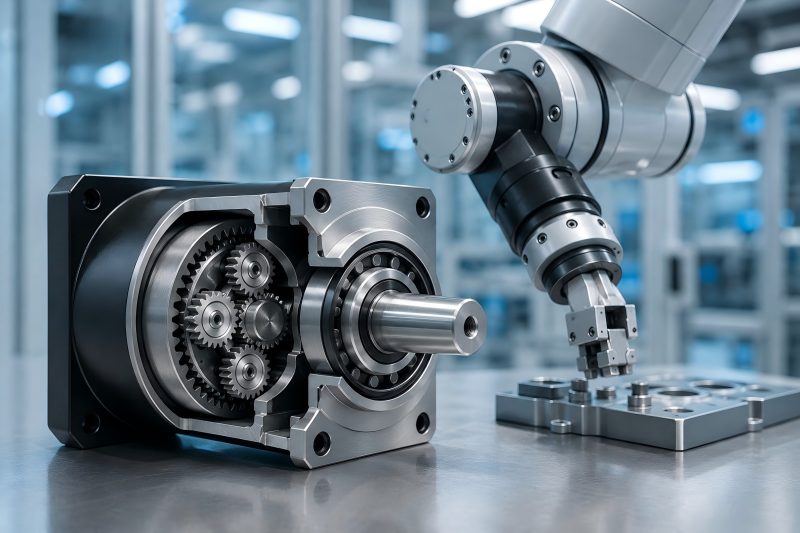
One of the biggest advantages of planetary gear motors is their high torque density. Because the load is shared by several planet gears, the gearbox can transmit more torque without requiring a large structure.
This matters in robotics, where compact internal space is essential. Robotic arms, mobile platforms, and compact automation systems all benefit from a smaller drive unit with strong output power.
Better Motion Precision
Robotics applications often require accurate position control. Planetary gear motors can support precise movement when combined with suitable motors, encoders, and control systems.
Low-backlash planetary gearboxes are especially useful for robotic joints, grippers, and positioning mechanisms. Lower backlash means less movement error when the motor changes direction.
Smooth Low-Speed Operation
Many robotic movements require controlled low-speed operation rather than fast rotation. A planetary gearbox reduces motor speed while increasing output torque.
This helps robots move more smoothly during lifting, turning, gripping, rotating, and positioning tasks.
Strong Load Distribution
Planetary gears share the load across several contact points, improving strength and helping the gearbox withstand frequent starts, stops, and reverse movements.
For industrial robots and warehouse robots, this is important because they often work continuously under demanding conditions.
High Efficiency
Compared with some traditional gear reduction systems, planetary gearboxes usually offer good transmission efficiency. This improves efficiency and reduces heat buildup.
For battery-powered robots, such as AGVs, AMRs, delivery robots, and inspection robots, higher efficiency can support longer operating time.
Compact and Flexible Installation
Planetary gear motors are available in different sizes, ratios, output shaft styles, and mounting options. This allows easier integration into diverse robot designs.
They can be used in wheel modules, robotic joints, rotary platforms, lifting systems, and customized automation devices.
Planetary Gear Motor vs Other Gear Motor Types in Robotics
| Gear Motor Type | Advantages | Limitations | Suitable Robotics Use |
| Planetary gear motor | High torque density, compact, efficient, precise | Higher cost than simple gearboxes | Robotic arms, AGVs, AMRs, precision joints |
| Worm gear motor | High reduction ratio, self-locking option | Lower efficiency, more heat | Lifting mechanisms, low-speed systems |
| Spur gear motor | Simple structure, cost-effective | More noise, lower torque density | Basic robots, light-duty motion |
| Helical gear motor | Smooth operation, higher load capacity | Larger size, more complex structure | Industrial automation and heavy-duty robots |
| Harmonic drive motor | Very high precision, compact | Higher cost, lower shock resistance | Collaborative robots, precision robotic joints |
For many robotics applications, planetary gear motors provide a practical balance between precision, torque, efficiency, and cost.
Important Selection Tips for Planetary Gear Motors in Robotics
Choosing the right planetary gear motor is not only about motor power. The selection should consider torque, speed, backlash, duty cycle, control method, installation space, and operating environment.
Define the Load Requirement
Start by calculating the load that the robot needs to move. This includes the weight of the robot part, payload, tools, wheels, arms, or lifting mechanism.
For robotic arms, the torque requirement changes depending on arm length and payload position. For mobile robots, the motor must overcome rolling resistance, acceleration demand, slope angle, and payload weight.
Key factors include:
- Payload weight
- Arm length or wheel radius
- Acceleration requirement
- Operating angle
- Friction and resistance
- Safety factor
A motor that is too small may overheat or fail early. A motor that is too large may increase cost, weight, and energy consumption.
Choose the Correct Gear Ratio
| Gear Ratio Range | Output Feature | Typical Robotics Application |
| 3:1–10:1 | Higher speed, moderate torque | Fast rotary movement, light-duty wheels |
| 10:1–30:1 | Balanced speed and torque | Robotic joints, service robots, small AGVs |
| 30:1–100:1 | High torque, lower speed | Lifting, heavy-load joints, steering modules |
| 100:1+ | Very high torque, very low speed | Special positioning or heavy-duty automation |
The best gear ratio should match the robot’s required speed and torque, not just the maximum motor capacity.
Pay Attention to Backlash
Backlash is the small movement gap between gears. In robotics, backlash can affect positioning accuracy, repeatability, and control response.
For simple wheel drive systems, moderate backlash may be acceptable. For robotic arms, camera positioning systems, or precision grippers, low backlash is usually required.
General guidance:
- High-precision robotic joints: choose low-backlash planetary gearboxes
- Mobile robot wheels: standard backlash may be acceptable
- Inspection or camera robots: lower backlash improves pointing accuracy
- Collaborative robots: low backlash supports smoother and safer movement
Match the Motor Type
Planetary gearboxes can be combined with different motors, including DC motors, brushless DC motors, stepper motors, and servo motors.
Each motor type has different advantages.
| Motor Type | Advantages | Best Used For |
| DC motor with planetary gearbox | Simple control, cost-effective | Small robots, light-duty motion |
| BLDC planetary gear motor | High efficiency, long life, low maintenance | AGVs, AMRs, service robots |
| Stepper planetary gear motor | Good positioning, open-loop control possible | Low-speed positioning, small automation |
| Servo planetary gear motor | High precision, fast response, closed-loop control | Robotic arms, precision joints, industrial robots |
For high-performance robotics, servo or BLDC planetary gear motors are often preferred because they provide better control, efficiency, and reliability.
Consider Efficiency and Heat
Robots often work for long periods. If the gear motor has low efficiency, it may generate more heat and consume more power.
This is especially important for:
- Battery-powered mobile robots
- Enclosed robotic joints
- High-duty-cycle automation systems
- Robots working in warm environments
A high-efficiency planetary gear motor helps improve operating time, reduce thermal stress, and protect internal components.
Check Size and Mounting Space
Robotic systems usually have strict space limits. Before selecting a planetary gear motor, check the available installation space, mounting hole pattern, shaft type, cable direction, and gearbox length.
Important dimensions include:
- Gearbox diameter
- Total motor length
- Output shaft diameter
- Mounting flange size
- Cable or connector position
- Encoder space requirement
For compact robots, a shorter and lighter planetary gear motor can improve mechanical layout and reduce overall system weight.
Evaluate Duty Cycle and Service Life
Robotics applications may involve frequent start-stop motion, repeated reversing, shock loads, or continuous operation. The selected gear motor must be able to handle the actual duty cycle.
For industrial robots or AGVs, durability is critical. The gearbox should have strong bearings, stable lubrication, hardened gears, and suitable sealing.
You should consider:
- Continuous or intermittent operation
- Number of starts and stops per hour
- Direction changes
- Load fluctuation
- Expected operating hours
- Maintenance requirements
Select the Right Encoder and Control Feedback
For precision robotics, the motor may need an encoder for position, speed, and direction feedback. This allows the control system to monitor movement and correct errors.
Encoder selection depends on the required accuracy. Higher-resolution encoders provide better feedback but may increase cost and control complexity.
Robotic arms, collaborative robots, and camera positioning systems usually need better feedback control than simple wheel drive robots.
Common Mistakes When Selecting Planetary Gear Motors for Robotics
Many selection problems come from focusing only on rated torque or motor power. In real robotic systems, performance depends on the full operating condition.
Common mistakes include:
- Choosing a gear ratio without checking final output speed
- Ignoring peak torque during acceleration
- Using standard backlash gearboxes for precision joints
- Selecting a motor too large for the robot structure
- Ignoring heat buildup in enclosed spaces
- Forgetting encoder and controller compatibility
- Not considering shock loads and repeated reversing
- Choosing by price instead of lifecycle performance
A correct selection process should balance performance, size, control, durability, and cost.
How to Choose a Planetary Gear Motor for a Robotics Project
A practical selection process can follow these steps:
- Define the robot movement type: wheel drive, joint rotation, lifting, gripping, or steering.
- Calculate required torque and speed at the output shaft.
- Select a suitable gear ratio based on speed and torque needs.
- Choose the motor type according to control requirements.
- Confirm backlash level for positioning accuracy.
- Check voltage, current, controller, and encoder compatibility.
- Review size, weight, mounting structure, and shaft design.
- Consider operating environment, duty cycle, and service life.
- Test the motor under real load conditions before mass production.