
Hub motors and mid-drive motors represent two different approaches to BLDC motor design for electric bikes.
Hub motors provide a simple, reliable, and economical solution, making them suitable for city e-bikes, folding bicycles, and applications that require easy maintenance.
Mid-drive motors focus on performance, torque control, and riding adaptability. They are better suited for mountain bikes, cargo bikes, and demanding riding environments.
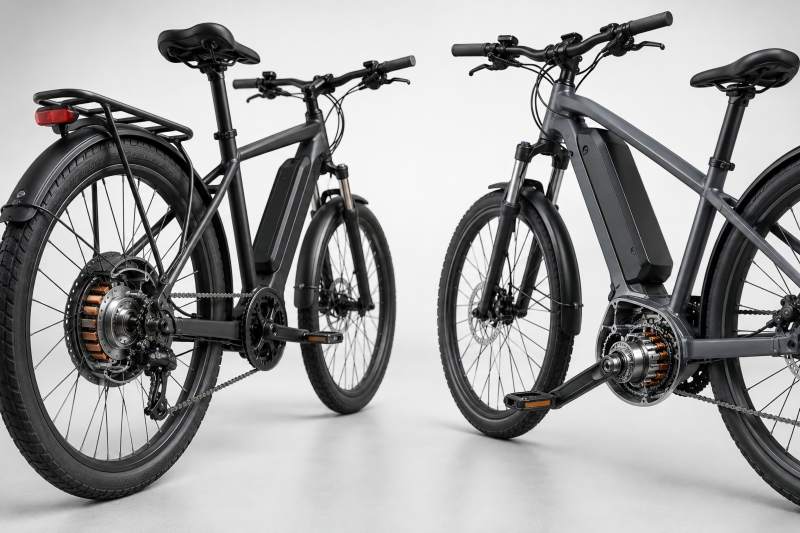
Understanding Hub Motor and Mid-Drive Motor Designs
Before comparing their performance, it is important to understand how these two BLDC motor systems work.
Hub Motor Design
A hub motor sits inside the wheel hub to drive directly. The motor rotates the wheel directly and converts electrical energy into driving force.
There are two common types:
- Direct drive hub motors
- Geared hub motors
Direct drive motors have a simple structure with fewer mechanical parts, while geared hub motors use internal gears to increase torque output and improve efficiency.
Because the motor is located inside the wheel, the drivetrain structure of the bicycle remains relatively simple.
Mid-Drive Motor Design
The motor drives the bicycle through its existing gear transmission system. This allows the motor to use different gear ratios depending on riding conditions.
For example, when climbing a steep hill, the rider can shift to a lower gear, allowing the motor to operate more efficiently with higher torque output.
Hub Motor vs. Mid-Drive Motor: Basic Comparison
| Feature | Hub Motor | Mid Drive Motor |
| Installation Position | Front or rear wheel hub | Bicycle bottom bracket |
| Power Transmission | Directly drives wheel | Uses bicycle drivetrain |
| Structure Complexity | Simple | More complex |
| Manufacturing Cost | Lower | Higher |
| Maintenance Requirement | Low | Higher |
| Climbing Ability | Moderate to good | Excellent |
| Weight Distribution | More concentrated at wheel | More centralized |
| Best Application | City riding, commuting | Mountain and high-performance riding |
Torque Performance: Why Mid Drive Has an Advantage
Torque is one of the most important factors for an e-bike motor, especially when riding uphill or carrying heavy loads.
A hub motor generates direct wheel drive. This design is simple, but the available torque is limited by the motor size and wheel diameter.
A larger wheel generally requires more torque because the motor needs more force to rotate the wheel under the same load.
For example:
- A 250W hub motor may perform well on flat roads.
- A cargo e-bike carrying additional weight may require a higher torque motor.
- A mountain e-bike climbing steep slopes benefits from a mid-drive system.
A mid-drive motor uses the bicycle’s gears to improve torque and efficiency. When climbing:
Low bicycle gear → Higher mechanical advantage → More wheel torque
This allows a relatively compact motor to achieve strong climbing performance.
| Riding Condition | Better Choice |
| Flat city roads | Hub Motor |
| Moderate slopes | Both systems can work |
| Steep hills | Mid-Drive Motor |
| Heavy cargo loads | Mid-Drive Motor |
However, this does not mean hub motors cannot provide high torque. Modern high-power BLDC hub motors can achieve excellent performance, especially when using optimized winding designs and suitable gear reduction systems.
Efficiency and Battery Consumption
Motor efficiency directly affects riding range.
A motor operating efficiently converts more battery energy into useful mechanical power. When operating outside its ideal range, energy losses increase and heat generation becomes higher.
Hub motors usually perform efficiently in:
- Flat roads
- Constant-speed riding
- Daily commuting conditions
Because the motor directly drives the wheel, the system has fewer transmission losses.
Mid-drive motors have an advantage when riding conditions change frequently.
For example:
A commuter riding on flat roads at a constant speed may not notice a significant efficiency difference.
But a mountain rider constantly changing between flat roads, climbs, and descents can benefit from the gear adaptability of a mid drive system.
| Application | Energy Efficiency Advantage |
| Long-distance flat commuting | Hub Motor |
| Mixed terrain riding | Mid Drive Motor |
| Frequent climbing | Mid Drive Motor |
| Lightweight city e-bike | Hub Motor |
Weight Distribution and Riding Experience
Motor location has a significant impact on how an e-bike feels.
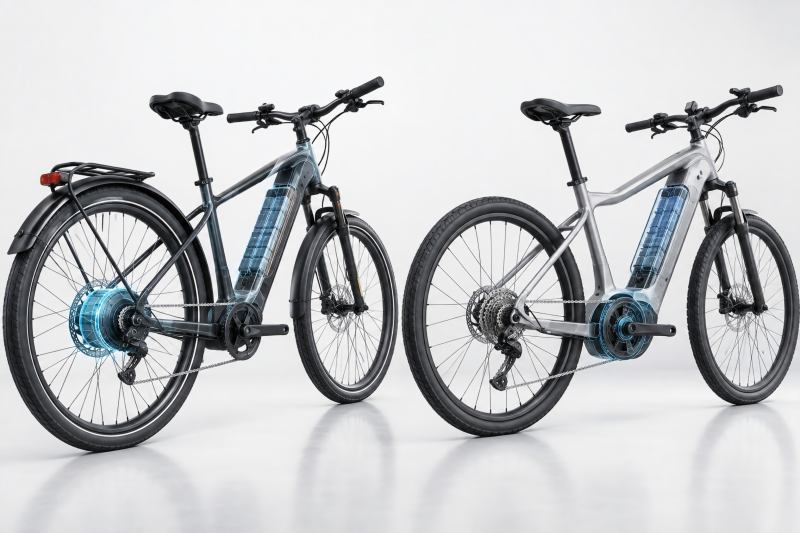
A hub motor increases wheel weight directly. This increases unsprung weight, which may slightly affect suspension response and handling.
Advantages:
- Simple structure
- Easy assembly
- Stable operation
However, the additional wheel weight can make the bike feel less agile.
Mid-drive motor position weight closer to the bike’s center. This creates better balance and a more natural riding feeling.
This is especially important for:
- Mountain bikes
- Performance e-bikes
- Off-road applications
A balanced center of gravity improves:
- Cornering stability
- Bike control
- Suspension performance
For everyday commuting, the difference may not be obvious. But for demanding riding environments, weight distribution becomes an important factor.
Maintenance and Reliability Comparison
From a manufacturing and user perspective, reliability is a major consideration.
Hub Motor Reliability
Hub motors have a relatively simple structure:
- Motor
- Bearings
- Controller connection
- Wheel assembly
Because they do not depend on the bicycle chain system, mechanical wear is limited.
Common advantages:
- Low maintenance
- Long service life
- Easy replacement
- Suitable for mass production
This makes hub motors popular for commuter e-bikes and rental fleets.
Mid-Drive Motor Reliability
Mid-drive motors provide better performance but involve more mechanical interaction.
Since power passes through:
Motor → Gear system → Chain/Belt → Cassette → Wheel
More components are involved.
Potential maintenance areas include:
- Chain wear
- Gear wear
- Transmission adjustment
For high-performance users, these additional maintenance requirements are usually acceptable because they gain better riding capability.
Manufacturing Considerations for BLDC Motor Design
From a motor manufacturer’s perspective, hub motors and mid-drive motors require different engineering approaches.
Hub Motor Development Focus
The main design challenges include:
Thermal Management
The motor is enclosed inside the wheel, making heat dissipation more difficult.
Engineers need to optimize:
- Stator design
- Magnetic circuit
- Aluminum housing structure
- Heat transfer paths
Weight Reduction
A lighter hub motor improves bicycle handling while maintaining sufficient torque.
Waterproof Protection
Because the motor is exposed near the wheel, protection against:
- Rain
- Mud
- Dust
- Road splash
Mid-Drive Motor Development Focus
High Torque Density
The motor needs to provide strong torque while maintaining compact size.
Gearbox Design
Internal reduction gears must balance:
- Efficiency
- Noise
- Durability
Controller Coordination
Because mid-drive motors experience changing loads, the controller must provide smooth power delivery.
Which BLDC Motor Design Is Better for Different E-Bikes?
The right choice depends on the e-bike’s intended use. The better choice depends on the application.
Urban Commuter E-Bikes
Recommended: Hub Motor
Reasons:
- Lower cost
- Simple maintenance
- Enough performance for flat roads
- Efficient at steady speeds
Mountain E-Bikes
Recommended: Mid Drive Motor
Reasons:
- Higher climbing ability
- Better weight balance
- Works with bicycle gears
- Improved control on uneven terrain
Cargo E-Bikes
Recommended: Mid-Drive Motor or High-Torque Hub Motor
Cargo bikes require strong low-speed torque. A mid-drive system usually provides better adaptability, but powerful hub motors can also meet many commercial requirements.
Folding Electric Bikes
Recommended: Compact Hub Motor
Reasons:
- Space-saving design
- Lower system complexity
- Easier manufacturing integration
Future Development Trends of E-Bike BLDC Motors
As electric mobility continues to develop, motor designs are moving toward higher efficiency and smarter control.
Future BLDC motors will likely focus on:
Higher torque density
Manufacturers are improving magnetic materials, winding technology, and motor structures to produce smaller motors with stronger output.
Better thermal performance
Heat management will remain a key challenge, especially for compact high-power motors.
Integrated intelligent control
Motor controllers will increasingly work with sensors to optimize:
- Power delivery
- Battery usage
- Riding comfort
Lightweight construction
Reducing motor weight while maintaining performance will become increasingly important for premium e-bikes.
A powerful motor is not always the ideal solution. A successful e-bike motor design requires balancing torque, efficiency, weight, cost, and application requirements.
For manufacturers developing electric bike solutions, selecting the right BLDC motor structure early in the design process can determine the final riding experience and the product’s market competitiveness.