
Choose a hollow shaft harmonic drive motor when the equipment needs internal routing for cables, tubes, shafts, vacuum lines, or optical paths. It is especially suitable for robot joints, multi-axis automation systems, semiconductor equipment, medical robotics, and precision machines that require clean, compact, and protected cable management.
Choose a solid shaft harmonic drive motor when the machine structure is simple, through-axis routing is not required, cost control is important, and external cable routing is acceptable. It is a practical choice for general automation axes, indexing tables, packaging machines, conveyor adjustment systems, and simple rotary positioning devices.
What Is a Hollow Shaft Harmonic Drive Motor?
A hollow shaft harmonic drive motor is designed with a hole through the center of the output axis. This hole can be used to route electrical cables, air tubes, vacuum lines, sensor wiring, fiber optics, laser beams, or even a mechanical shaft through the rotating center.
This structure is very useful when the automation system needs continuous rotation or when cables must be protected from twisting. For example, in a robot wrist joint, a hollow shaft allows cables for the end effector, camera, gripper, or welding torch to pass through the joint center. In an inspection machine, optical components or air lines can pass through the rotating axis without creating external cable loops.
Harmonic Drive hollow shaft gear units are designed to let shafts, wires, tubing, or other components pass directly through the center of the gear while maintaining accuracy and repeatability.
What Is a Solid Shaft Harmonic Drive Motor?
A solid shaft harmonic drive motor uses a conventional shaft or output flange. It does not have a large through-hole in the center. The output can connect directly to a pulley, coupling, arm, table, fixture, or other mechanical part.
Solid shaft designs are common in many automation machines because they are simple, compact, and easy to install. If the system does not require through-axis cable routing, a solid shaft harmonic drive motor can be a practical and cost-effective choice.
For example, solid shaft motors are often used in small rotary positioning stages, indexing tables, packaging machine axes, simple robot joints, conveyor adjustment axes, and laboratory automation equipment. In these applications, cables can be routed outside the rotating mechanism, so a hollow center is not necessary.
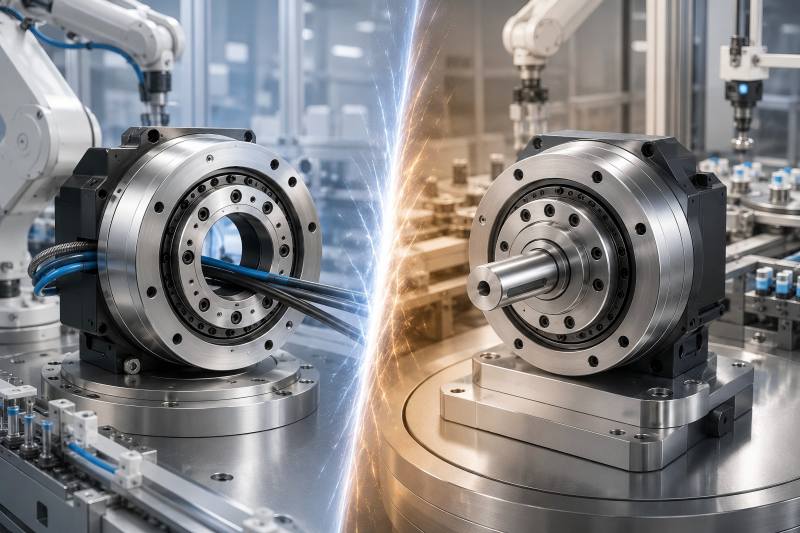
Hollow Shaft vs Solid Shaft Harmonic Drive Motors
| Item | Hollow Shaft Harmonic Drive Motor | Solid Shaft Harmonic Drive Motor |
| Shaft structure | Central through-hole | Conventional output shaft or flange |
| Cable routing | Cables, tubes, or shafts can pass through the center | Cables usually route outside the axis |
| Mechanical layout | Cleaner for complex rotating systems | Simpler for standard mechanisms |
| Best for | Robot joints, rotary tables, optical equipment, multi-axis systems | General automation, indexing, packaging, simple rotary motion |
| Installation space | Can reduce external cable loops | Often compact and straightforward |
| Cost | Usually higher | Usually lower |
| Design complexity | Requires attention to through-hole size and cable protection | Easier to design and assemble |
| Maintenance | Easier cable protection, but internal routing must be planned | Easier access to external cables |
| Typical advantage | Better integration and cable management | Simpler structure and lower cost |
| Selection risk | Through-hole may reduce available space for bearings or structure depending on design | External cables may twist or interfere with motion |
When to Choose a Hollow Shaft Harmonic Drive Motor
When Cables Need to Pass Through the Rotation Axis
The most important reason to choose a hollow shaft motor is cable routing. If the machine has electrical wires, pneumatic tubes, hydraulic lines, vacuum tubes, optical fibers, or sensor cables that must pass through a rotating joint, a hollow shaft design is usually the better choice.
This is common in:
- Robot wrist joints
- Collaborative robot joints
- Welding robot end effectors
- Camera inspection systems
- Laser processing equipment
- Semiconductor wafer handling systems
- Medical robotic arms
- Rotary tables with vacuum fixtures
Without a hollow shaft, cables may need to bend around the outside of the joint. This can increase wear, limit rotation angle, and create maintenance problems.
When Continuous Rotation Is Required
If an axis needs to rotate continuously or frequently over a wide angle, external cables may twist, bend, or break. A hollow shaft allows the designer to route cables through the center and combine the design with a slip ring, rotary union, or cable management system.
This is especially useful for rotary tables, robotic wrists, and automated inspection systems where the axis may rotate repeatedly during production.
When the Machine Needs a Cleaner Layout
A hollow shaft motor can make the machine layout cleaner. Instead of having cables exposed around the outside of the axis, the designer can hide them inside the center. This improves appearance and can reduce the risk of cable damage.
For high-end automation equipment, clean cable routing is not only about appearance. It also helps reduce interference with moving parts, improves safety, and makes the equipment easier to integrate into compact spaces.
When Optical or Fluid Lines Must Pass Through the Center
Some systems require more than electrical cables. For example, a laser inspection system may need a light path through the center of rotation. A vacuum rotary table may need a vacuum channel through the axis. A semiconductor machine may require air, vacuum, or fluid routing through a rotating mechanism.
In these cases, a hollow shaft design can simplify the whole machine structure.
When the Application Is a Robot Joint
Robot joints are one of the most common applications for hollow shaft harmonic drive motors. In multi-axis robots, each joint often needs motor power cables, encoder cables, brake cables, sensor wires, and end-effector lines. If all of these cables are routed externally, the robot becomes bulky and harder to maintain.
A hollow shaft design allows internal cable routing, which supports a more compact and professional robot structure.
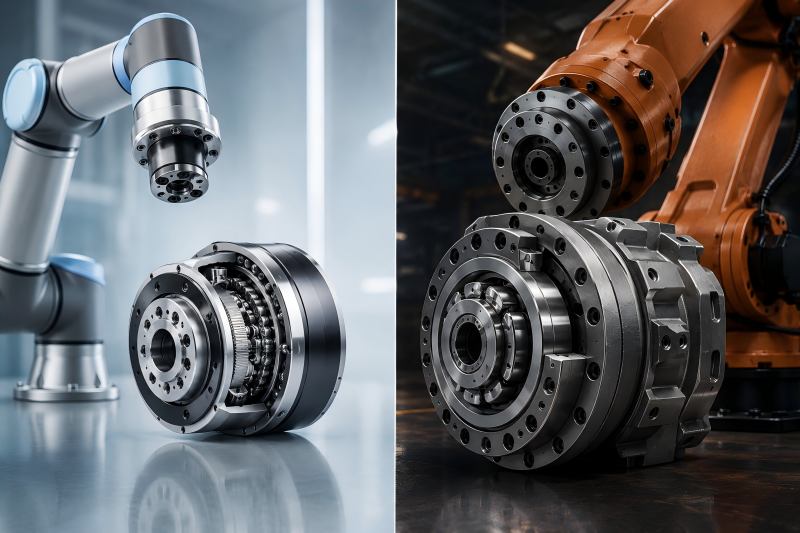
When to Choose a Solid Shaft Harmonic Drive Motor
When Through-Axis Routing Is Not Needed
If your automation equipment does not need cables, tubes, or shafts to pass through the center, a solid shaft harmonic drive motor is often enough. There is no need to pay for a hollow shaft structure if the machine can work well with external cable routing.
For example, a simple rotary positioning axis may only need the motor to rotate a table or fixture. In this case, a solid shaft design is usually practical.
When Cost Control Is Important
Hollow shaft designs are usually more complex. They may require special bearings, larger housing space, more careful sealing, and more precise assembly. Therefore, they usually cost more than standard solid shaft models.
For cost-sensitive automation equipment, a solid shaft motor may be the better option if it meets the torque, speed, accuracy, and installation requirements.
When the Machine Structure Is Simple
For many packaging machines, conveyor adjustment systems, small indexing tables, and general automation devices, the mechanical structure is straightforward. The axis rotates within a limited angle, and cables can be fixed outside the moving part.
In these cases, a solid shaft harmonic drive motor is easier to install and easier to maintain.
When Higher Simplicity and Robustness Are Preferred
A solid shaft layout can be mechanically simple. There is no need to consider the inner hole diameter, cable bending radius inside the shaft, or internal routing space. For applications with shock load, frequent start-stop motion, or simple rotary output, this simplicity can be valuable.
However, strength and overload capacity always depend on the specific product series, reducer size, bearing design, and shaft structure. For example, Nabtesco notes that in strain wave gear designs, hat-type gears can provide a larger hollow shaft, while cup-type gears can offer higher overload capacity. This shows why engineers should compare actual catalog data instead of assuming one structure is always stronger than the other.
Key Selection Factors
Cable and Tube Routing
This is the first question:
Will cables, tubes, or components pass through the rotating center?
If yes, choose a hollow shaft design. If no, a solid shaft design may be more economical and simpler.
Required Torque
Both hollow shaft and solid shaft harmonic drive motors can provide high torque, but the rated torque depends on the frame size, reduction ratio, bearing design, and motor power. Harmonic Drive’s FBS hollow-shaft gear unit series, for example, is designed with a large hollow shaft and compact outer diameter for robots and machines requiring complex cabling through the rotation axis, while also emphasizing torque, torsional stiffness, long life, and smooth rotation.
When selecting, compare:
- Continuous torque
- Peak torque
- Emergency stop torque
- Allowable acceleration torque
- Rated output speed
- Duty cycle
Do not choose only by shaft type. Always choose by actual load conditions.
Through-Hole Diameter
For hollow shaft motors, the through-hole size is critical. It must be large enough for all cables, tubes, or shafts that pass through it.
Check:
- Cable quantity
- Cable outer diameter
- Minimum bending radius
- Connector size
- Air tube or vacuum tube size
- Slip ring or rotary union size
- Future expansion space
A common mistake is selecting a hollow shaft motor with enough torque but not enough internal space for the cables.
Output Bearing Load
Many harmonic drive motors are connected directly to arms, turntables, fixtures, or robot links. The output bearing must handle side, thrust, and tilting forces.
Check these loads carefully:
| Load Type | Meaning | Typical Example |
| Radial load | Side load on the output | Belt tension, side-mounted fixture |
| Axial load | Push or pull along the shaft | Pressing, lifting, vertical load |
| Moment load | Tilting force on the output | Offset robot arm, cantilever table |
For hollow shaft motors, the internal hole may influence the bearing and housing design, depending on the specific product. For solid shaft motors, the output shaft may be easier to connect to simple couplings or pulleys. Final selection should follow the manufacturer’s rated load specifications.
Installation Space
A hollow shaft motor may reduce external cable space, but the motor body may be larger in diameter. A solid shaft motor may be smaller and easier to mount, but it may require extra cable routing space outside the axis.
So the real comparison is not only motor size. You should compare the total machine space, including:
- Motor body
- Cable path
- Connector clearance
- Cable protection
- Mounting bracket
- Coupling
- Slip ring
- Rotary union
- Maintenance access
Rotation Angle
If the axis rotates only 90 degrees or 180 degrees, external cables may be acceptable. If the axis rotates 360 degrees, multiple turns, or continuously, hollow shaft routing becomes much more valuable.
Application Comparison Table
| Application | Better Choice | Reason |
| Robot wrist joint | Hollow shaft | Internal cable routing for grippers, sensors, cameras, or tools |
| Simple indexing table | Solid shaft | Usually no need for through-axis cable routing |
| Semiconductor wafer handling | Hollow shaft | Clean routing for vacuum, air, and sensor lines |
| Packaging machine rotary axis | Solid shaft | Simple motion and cost-sensitive structure |
| Medical robotic arm | Hollow shaft | Compact and clean internal cable layout |
| Small inspection turntable | Solid shaft | Simple installation and lower cost |
| Laser processing equipment | Hollow shaft | Optical path or cable routing through the center |
| Conveyor adjustment axis | Solid shaft | Basic rotary motion with simple mechanical connection |
| Collaborative robot joint | Hollow shaft | Better cable protection and compact joint design |
| Heavy-duty fixture rotation | Depends on load | Compare torque, bearing load, and moment rating |
In the end, the best choice is not decided by hollow shaft or solid shaft alone. The correct harmonic drive motor must match the real torque, speed, accuracy, duty cycle, load inertia, bearing load, installation space, and cable routing requirements of the automation system. A hollow shaft design solves integration and routing problems. A solid shaft design offers simplicity and cost efficiency. The right solution is the one that fits both the mechanical structure and the motion performance requirements of your equipment.