
A harmonic drive motor is the better choice for lightweight, compact, and high-precision robot joints. It is ideal for collaborative robots, humanoid robots, medical robots, small robotic arms, and precision automation systems.
An RV reducer is the better choice for heavy-duty industrial robots that require high torque, high rigidity, and strong shock resistance. It is commonly used in robot base, shoulder, and elbow joints where load capacity is more important than compact size.
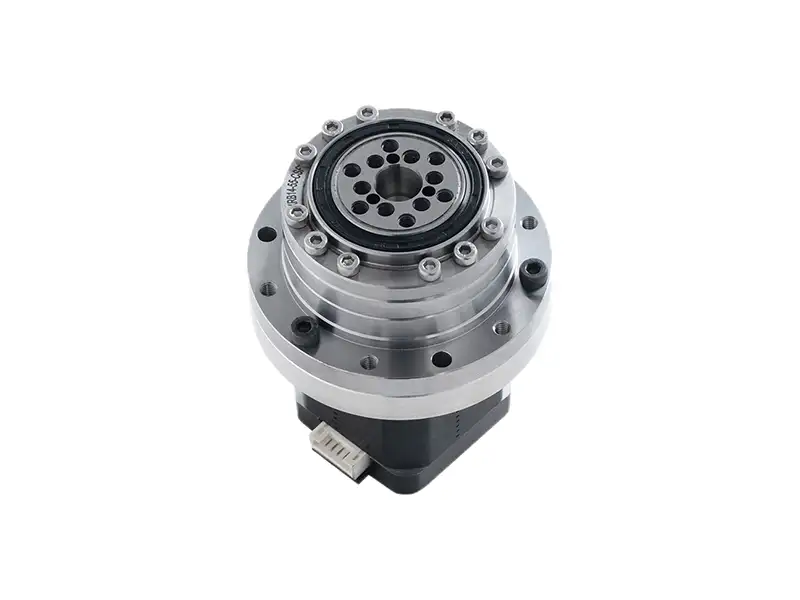
What Is a Harmonic Drive Motor?
A harmonic drive motor is an integrated motion unit that usually combines a servo motor, harmonic reducer, encoder, and sometimes a brake or driver. Its core reducer uses strain wave transmission.
A typical harmonic reducer contains three main parts:
| Component | Function |
| Wave generator | Creates elliptical deformation |
| Flex spline | Flexible gear with fewer teeth |
| Circular spline | Rigid outer gear with internal teeth |
The motor rotates the wave generator, flexing the spline for dual-point gear engagement. Because the flex spline has fewer teeth than the circular spline, relative motion is generated, producing a large reduction ratio in a compact structure.
Main Features of Harmonic Drive Motors
Harmonic drive motors are valued for their compact design, high reduction ratio, low backlash, and smooth motion. Ideal for compact, lightweight small-to-medium robot joints.
Common advantages include:
- Compact and lightweight structure
- High positioning accuracy
- Low backlash
- High reduction ratio in one stage
- Smooth and quiet movement
- Easy integration into robotic joints
- Suitable for lightweight and collaborative robots
Because of these features, harmonic drive motors are often used in robotic wrists, small robotic arms, humanoid robot joints, medical robots, semiconductor equipment, and precision automation systems.
What Is an RV Reducer?
An RV reducer, also known as a rotary vector reducer, is a precision cycloidal reducer. It usually combines a first-stage spur gear reduction with a second-stage cycloidal pin gear reduction.
The RV reducer is designed for high torque, high rigidity, and strong shock-load resistance. Compared with a harmonic reducer, it is usually larger and heavier, but it can handle much higher loads and has better torsional stiffness.
Main Features of RV Reducers
RV reducers are widely used in industrial robots, especially in large joints such as the base, shoulder, and elbow.
Common advantages include:
- High torque capacity
- Strong rigidity
- Excellent shock resistance
- Long service life
- High load-bearing ability
- Stable performance under heavy-duty operation
- Suitable for medium and large industrial robots
RV reducers are commonly used in welding robots, handling robots, palletizing robots, heavy-duty robotic arms, machine tool loading robots, and automotive production line robots.
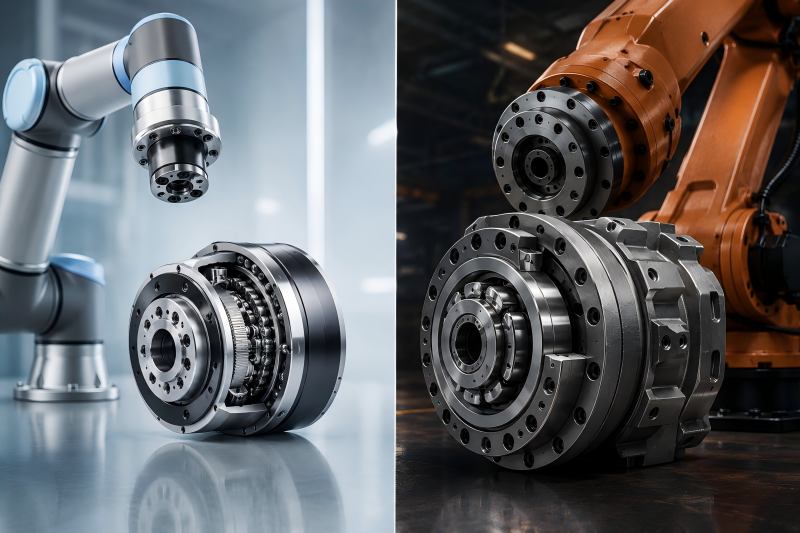
Harmonic Drive Motor vs RV Reducer: Key Differences
Both are used in robots, but each is optimized for different performance needs.
| Comparison Item | Harmonic Drive Motor | RV Reducer |
| Structure | Motor integrated with harmonic reducer | Precision cycloidal reducer |
| Size | More compact | Larger |
| Weight | Lighter | Heavier |
| Torque capacity | Medium | High |
| Rigidity | Moderate to high | Very high |
| Backlash | Very low | Very low |
| Shock resistance | Moderate | Strong |
| Load capacity | Suitable for light and medium loads | Suitable for medium and heavy loads |
| Common robot joints | Wrist, small arm, humanoid joints | Base, shoulder, elbow |
| Cost | Often lower for compact joints | Higher for heavy-duty joints |
| Best use | Lightweight precision motion | Heavy-load industrial motion |
Accuracy and Backlash
Both solutions deliver precise positioning with minimal backlash. However, their working principles are different.
A harmonic drive achieves precision through elastic deformation and multi-tooth engagement. It ensures minimal backlash for accurate positioning and smooth motion control.
An RV reducer achieves precision through cycloidal transmission and rolling contact. It also provides low backlash, but its main strength is maintaining accuracy under heavy load and repeated impact.
For small robot joints, a harmonic drive motor is often accurate enough and easier to integrate. For large industrial robot joints, an RV reducer is usually better because it can maintain accuracy under higher torque and stronger external forces.
Torque and Load Capacity
Torque capacity is one of the biggest differences between harmonic drive motors and RV reducers.
A harmonic drive motor is compact and lightweight, but its flexible spline limits its load capacity. It suits small and medium robot joints, but not heavy-duty load requirements.
An RV reducer has a more rigid structure and stronger load-bearing capacity. It is better for robot joints that must support large payloads, high acceleration, or frequent start-stop operation.
For example, in a six-axis industrial robot, the base, shoulder, and elbow joints usually require high torque and high rigidity. RV reducers are often preferred in these positions. The wrist joints require compact size, low weight, and high precision, so harmonic drive motors or harmonic reducers are often used there.
Size and Weight
For modern robots, especially collaborative robots and humanoid robots, size and weight are very important.
A harmonic drive motor has a major advantage in compactness. Because it can achieve a high reduction ratio in a small space, it helps reduce joint size and overall robot weight. This benefits robots requiring lightweight arms, smooth motion, and safe human interaction.
An RV reducer typically has a bulkier structure. While it offers better rigidity and load capacity, it may not be suitable for robots where compact structure is the main requirement.
Therefore, for lightweight robots, harmonic drive motors are often the better choice. For heavy-duty robots, the additional weight of an RV reducer is acceptable because it provides stronger performance.
Rigidity and Shock Resistance
Rigidity affects how well a robot can maintain position under load. Shock resistance affects how well the reducer can handle sudden external forces, impact, or high-speed operation.
RV reducers are usually stronger in both rigidity and shock resistance. This makes them suitable for industrial environments where robots handle heavy parts, weld metal components, load machine tools, or work continuously in production lines.
Harmonic drive motors are precise and compact, but the flexible spline is more sensitive to overload and shock impact. In applications with sudden heavy loads, improper use may reduce service life.
For stable, precise, and lightweight movement, harmonic drive motors are excellent. For harsh industrial use and heavy-load movement, RV reducers are usually more reliable.
Service Life and Maintenance
Service life depends on load, speed, lubrication, installation quality, working environment, and operating cycle.
RV reducers generally have strong durability in heavy-duty applications. Their rigid structure allows them to work for long periods under high load. However, they also require proper lubrication and installation.
Harmonic drive motors can also provide long service life when used within rated load limits. Integrated design often simplifies installation. However, overload, impact load, or improper selection may shorten the life of the flex spline.
In short, RV reducers are better for long-term heavy-duty operation, while harmonic drive motors are better for compact precision joints with suitable loads.
Application Comparison in Robots
Different robots require different transmission solutions.
| Robot Type | Better Choice | Reason |
| Collaborative robot | Harmonic drive motor | Compact, lightweight, precise |
| Humanoid robot | Harmonic drive motor | Small joint size and smooth motion |
| Medical robot | Harmonic drive motor | High precision and low noise |
| Semiconductor robot | Harmonic drive motor | Clean, precise, smooth movement |
| Heavy-duty industrial robot | RV reducer | High torque and strong rigidity |
| Welding robot | RV reducer | Stable under industrial load |
| Palletizing robot | RV reducer | High load and shock resistance |
| Six-axis robot wrist | Harmonic drive motor | Compact and accurate |
| Six-axis robot base | RV reducer | High torque and load capacity |
Which Is Better for Robots?
There is no single answer. A harmonic drive motor is better for robots that need compact size, light weight, high precision, and smooth motion. An RV reducer is better for robots that need high torque, high rigidity, strong shock resistance, and heavy-load operation.
Choose a Harmonic Drive Motor When:
- The robot needs a compact joint design
- Weight reduction is important
- The payload is light or medium
- Smooth and precise movement is required
- The joint is located at the wrist or end section
- The robot is collaborative, humanoid, medical, or precision automation equipment
Choose an RV Reducer When:
- The robot carries heavy loads
- The joint requires high torque
- Strong rigidity is required
- The robot works in harsh industrial environments
- Shock load or impact load is common
- The reducer is used in the base, shoulder, or elbow joint
Can Robots Use Both?
Yes. Many industrial robots use both types of reducers in different joints.
For example, a six-axis robot may use RV reducers in the first three axes because these joints carry most of the load. The same robot may use harmonic reducers or harmonic drive motors in the wrist axes because those joints need compact size, fast response, and high precision.
This combined design helps balance torque, accuracy, weight, size, and cost.
Robot manufacturers should match each reducer to the application. The key is to match the transmission system with the robot’s payload, joint position, motion speed, precision requirement, working environment, and cost target.
In general:
- For compact and lightweight robots, choose a harmonic drive motor.
- For heavy-load industrial robots, choose an RV reducer.
- For multi-axis industrial robots, use both where each performs best.
By selecting the right reducer for each robot joint, manufacturers can improve motion accuracy, extend service life, reduce weight, increase stability, and achieve better overall robot performance.