
Planetary gear motors are compact, efficient, and powerful drive solutions, but they must be correctly selected, installed, and maintained. Common problems such as overheating, noise, backlash increase, gear wear, bearing failure, leakage, vibration, and motor burnout are often linked to overload, poor lubrication, wrong gear ratio, harsh environments, or installation errors.
To avoid these problems, users should choose the right torque, speed, backlash, duty cycle, sealing level, and motor type from the beginning. Proper installation, regular inspection, and correct operating conditions can greatly improve the service life of planetary gear motors and reduce equipment downtime.
Common Planetary Gear Motor Problems
| Common Problem | Main Cause | Typical Sign | Prevention Method |
| Overheating | Overload, poor ventilation, wrong duty cycle | High surface temperature | Select proper torque and duty cycle |
| Excessive noise | Gear wear, poor lubrication, misalignment | Abnormal running sound | Check mounting, lubrication, and load |
| Backlash increase | Gear wear or shock load | Lower positioning accuracy | Choose precision gearbox and avoid impact load |
| Oil or grease leakage | Seal damage or high temperature | Lubricant around housing | Inspect seals and temperature regularly |
| Bearing failure | Radial overload or contamination | Vibration and rough rotation | Control shaft load and protect from dust |
| Gear tooth wear | Overload or poor lubrication | Torque loss, noise | Use correct load range and lubricant |
| Motor burnout | Overcurrent, poor heat dissipation | Motor stops or smells burnt | Match driver, voltage, and load correctly |
| Vibration | Unbalanced load or loose installation | Shaking during operation | Secure mounting and check alignment |
Overheating During Operation
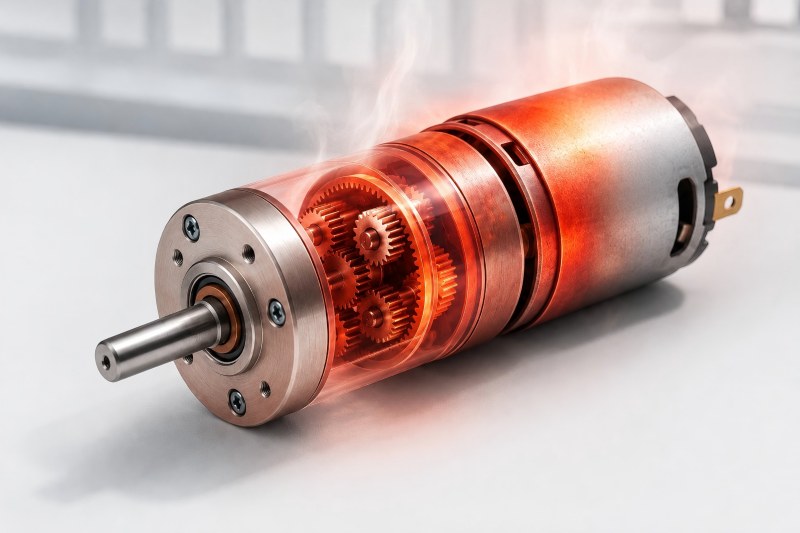
Excessive heat buildup is a frequent issue in planetary gear motors. A certain temperature rise is normal during operation, but excessive heat may shorten the life of gears, bearings, seals, lubricant, and motor windings.
Planetary gear motors usually overheat when they work beyond their rated torque, speed, or duty cycle. Poor ventilation, continuous operation without rest, high ambient temperature, and incorrect motor driver settings can also cause heat buildup.
How to Avoid Overheating
| Cause of Overheating | How to Avoid It |
| Motor or gearbox overloaded | Select a gear motor with enough torque margin |
| Continuous operation beyond duty cycle | Confirm working time, stop time, and load cycle |
| Poor heat dissipation | Leave space around the motor for ventilation |
| High ambient temperature | Use a suitable motor grade or cooling design |
| Incorrect voltage or driver setting | Match motor, gearbox, controller, and power supply |
When selecting a planetary gear motor, do not only consider rated torque. Starting torque, peak torque, duty cycle, acceleration time, and working environment should also be evaluated.
Excessive Noise
A high-quality planetary gear motor should run smoothly with controlled noise. If the motor suddenly becomes louder, produces grinding sounds, or creates irregular noise, it may indicate gear wear, bearing problems, poor lubrication, or installation errors.
Noise can also be caused by incorrect gear motor selection. For example, if a low-precision gearbox is used in a high-speed or high-accuracy application, noise and vibration may become more obvious.
Common Noise Types and Possible Reasons
| Noise Type | Possible Reason |
| Grinding noise | Gear tooth wear, poor lubrication, contamination |
| Clicking noise | Damaged gear teeth or internal clearance |
| Humming noise | Electrical issue, motor driver problem, resonance |
| High-pitched noise | High-speed operation or bearing wear |
| Irregular noise | Misalignment, loose screws, unstable load |
How to Avoid Excessive Noise
Use the correct gearbox precision grade for the application. For robotics, CNC auxiliary axes, medical equipment, and precision automation, a low-backlash planetary gearbox is usually recommended.
During installation, make sure the motor shaft, gearbox shaft, coupling, and driven equipment are properly aligned. Also avoid excessive radial or axial load on the output shaft.
Backlash Increase
Backlash refers to the small clearance between gear teeth. A certain level of backlash is unavoidable, but too much clearance can affect positioning precision and slow motion response.
In precision applications, such as robotic arms, automation indexing systems, servo positioning systems, and measuring equipment, backlash can directly affect final motion accuracy.
Main Causes of Backlash Increase
| Cause | Explanation |
| Gear tooth wear | Long-term friction enlarges gear clearance |
| Shock load | Sudden impact damages gear engagement |
| Overload operation | Excessive torque accelerates wear |
| Low gearbox precision | Not suitable for high-accuracy motion |
| Poor lubrication | Increases friction and tooth surface damage |
How to Avoid Backlash Problems
Choose a planetary gear motor with suitable backlash specifications. For general transmission, standard backlash may be acceptable. For precision motion, low-backlash or high-precision planetary gearboxes should be used.
Avoid frequent shock loading, sudden reversing, emergency stopping under heavy load, and exceeding peak torque limits. If the equipment needs frequent start-stop operation, the gearbox should have enough strength and safety factor.
Oil or Grease Leakage
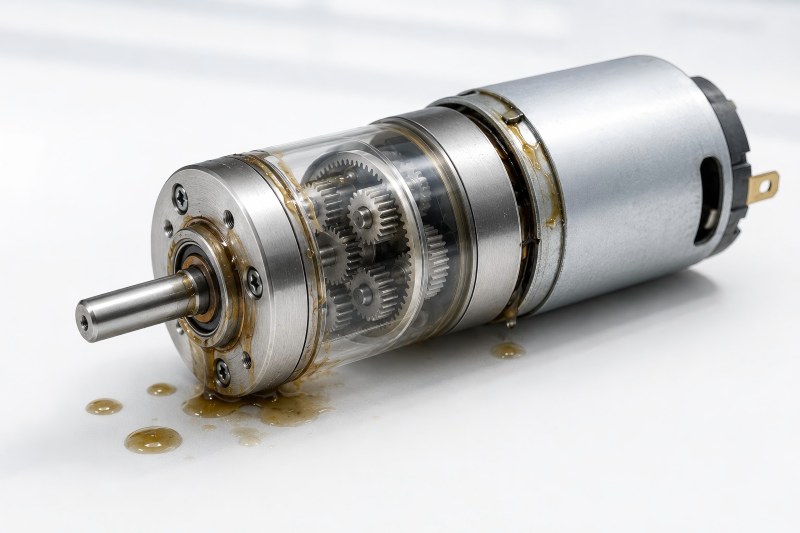
Lubricant leakage may happen around the output shaft, housing joint, or seal area. Small leakage can become a serious problem if ignored, because it may lead to lubrication loss, contamination, and internal wear.
Common Causes of Leakage
| Cause | Description |
| Seal aging | Long-term heat and friction damage the seal |
| Excessive temperature | Lubricant expands and seal performance drops |
| Overfilled lubricant | Internal pressure increases |
| Shaft damage | Seal lip cannot contact shaft properly |
| Poor installation | Housing or seal is damaged during assembly |
How to Avoid Leakage
Keep the gear motor within the recommended temperature range. Avoid installing the gear motor in dusty, wet, corrosive, or high-pressure cleaning environments unless it has proper sealing protection.
For food machinery, outdoor equipment, medical devices, or humid environments, choose planetary gear motors with suitable IP rating, sealing structure, and corrosion-resistant housing.
Bearing Failure
Bearings support the rotating parts of the planetary gear motor. If bearings fail, the gear motor may vibrate, become noisy, overheat, or rotate unevenly.
Bearing failure is often caused by excessive radial load, excessive axial load, contamination, poor lubrication, or shaft misalignment.
How to Avoid Bearing Failure
Avoid using the gear motor output shaft as a direct support point for heavy external loads. If the driven mechanism creates strong radial force, use external bearings, support structures, or couplings to reduce stress on the gearbox shaft.
During installation, avoid hammering the shaft or forcing the coupling into position. Improper assembly may damage bearings before the motor even starts working.
Gear Tooth Wear or Damage
The core of a planetary gearbox is its gear transmission system. If the gear teeth wear, crack, chip, or break, the planetary gear motor may lose torque, create noise, vibrate, or stop working.
Gear tooth damage usually happens because of overload, poor lubrication, material fatigue, improper assembly, or excessive impact.
Gear Wear Warning Signs
| Warning Sign | Possible Meaning |
| Increased noise | Gear surface wear or tooth damage |
| Reduced output torque | Gear engagement problem |
| Vibration | Uneven gear rotation or damaged teeth |
| Metal particles in lubricant | Internal wear |
| Unstable speed | Transmission failure or load fluctuation |
How to Avoid Gear Damage
Select the correct reduction ratio, rated torque, and service factor. In industrial machinery, it is safer to leave a torque margin instead of running the gear motor close to its limit for a long time.
For applications with heavy load, frequent reversing, or impact load, choose a planetary gear motor with hardened gears, strong bearing support, and high shock-load capacity.
Motor Burnout
Motor burnout is usually related to electrical overload, incorrect voltage, poor heat dissipation, blocked rotation, or improper driver parameters. Once the motor winding is damaged, the gear motor may stop working completely.
Electrical Problems to Check
| Problem | Possible Result |
| Voltage too high | Motor overheating or insulation damage |
| Voltage too low | Insufficient torque and high current |
| Overcurrent | Winding damage |
| Wrong driver setting | Unstable operation or overheating |
| Blocked rotor | Rapid temperature rise |
How to Avoid Motor Burnout
Make sure the motor voltage, power supply, controller, and driver are matched correctly. For servo planetary gear motors, driver parameters such as current limit, acceleration, deceleration, overload protection, and braking mode should be properly configured.
Do not allow the motor to stall under power for long periods. A locked rotor condition can create high current and serious heat buildup.
Vibration and Unstable Operation
Vibration affects machine accuracy, increases noise, and accelerates mechanical wear. In planetary gear motors, vibration may come from unbalanced loads, loose installation, misalignment, resonance, damaged gears, or bearing problems.
How to Avoid Vibration
| Inspection Point | What to Check |
| Mounting screws | Tighten all screws with even force. |
| Coupling | Check concentricity and installation gap |
| Load balance | Avoid eccentric or unstable load |
| Shaft alignment | Prevent radial stress on the output shaft |
| Gearbox condition | Listen for noise and check temperature |
For high-speed applications, resonance should also be considered. Sometimes changing the motor speed, reduction ratio, mounting method, or control parameters can reduce vibration.