
When choosing a motor system for an electric wheelchair, voltage is often one of the first specifications people notice. Among common configurations, 24V and 36V are two practical choices, but the higher voltage is not automatically the better one.
A 24V wheelchair can be compact, simple, and perfectly capable of daily indoor use. A 36V system, meanwhile, can make more sense when the wheelchair needs higher power, better hill-climbing performance, or lower current at the same output level.
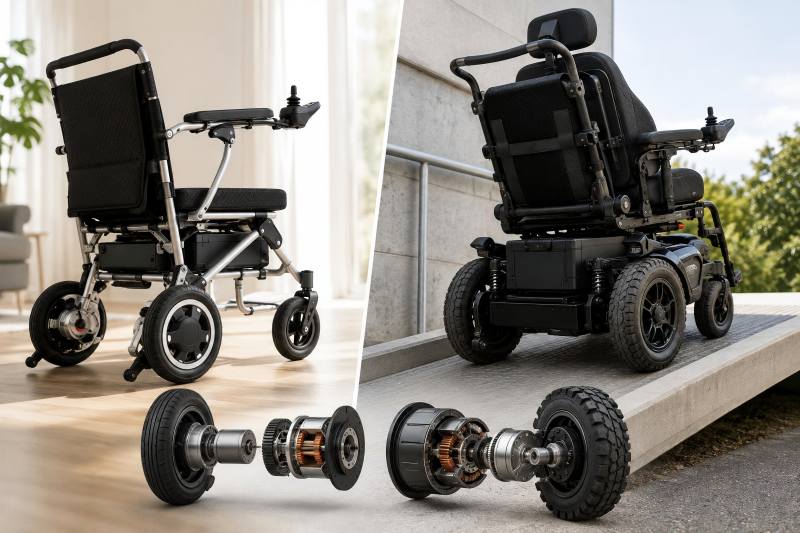
Comparison of 24V and 36V Motors
Voltage alone does not determine how strong a motor is. Motor winding, current, torque constant, gearbox ratio, controller, battery, and wheel size all matter.
Still, voltage has a clear influence on how the electrical system is designed.
| Comparison | 24V Motor System | 36V Motor System |
| Typical wheelchair | Standard, indoor, folding | Outdoor, heavy-duty, higher-performance |
| Electrical current at equal power | Higher | Lower |
| Wiring demand | Higher current capacity | Easier at higher power |
| Battery configuration | Simpler | More cells/batteries required |
| Controller cost | Usually lower | Often slightly higher |
| Power expansion | Moderate | Better |
| Heat management | More challenging at high current | Better at similar power |
| System weight | Can be lower | Depends heavily on battery design |
| Best use | Moderate loads and speeds | Higher load and torque demand |
This comparison is only a starting point. Two motors with the same voltage can behave completely differently, so the entire drive system still needs to be evaluated.
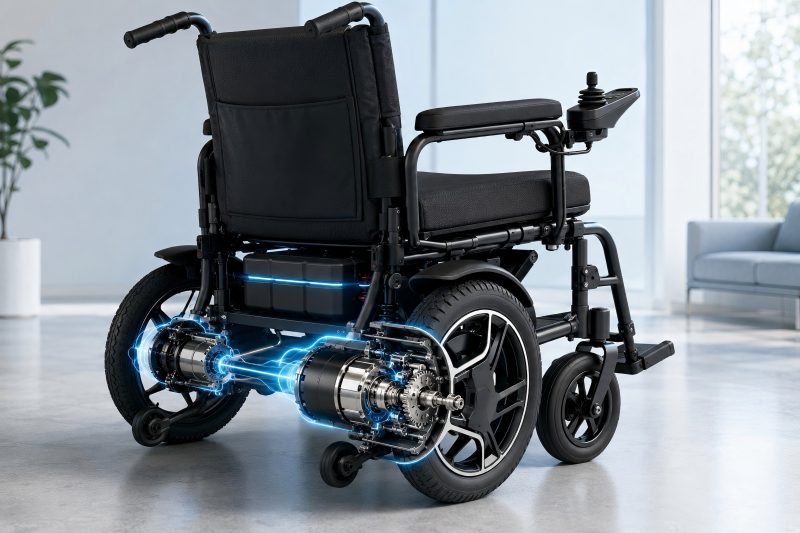
Why 24V Is So Common in Electric Wheelchairs
There is a reason many traditional electric wheelchairs use 24V systems.
They are relatively simple.
A common battery arrangement can use two 12V batteries connected in series. Controllers, chargers, brakes, and other compatible components are also widely available for this voltage class.
For an ordinary wheelchair moving at moderate speeds, there is often no strong technical reason to increase the voltage.
24V Works Well for Moderate Power
Imagine a standard electric wheelchair designed for indoor and light outdoor use.
It may only need moderate continuous motor power to move comfortably on flat ground. In this situation, a correctly designed 24V geared motor can provide more than enough torque.
Typical applications include:
- Indoor electric wheelchairs
- Standard rear-wheel-drive wheelchairs
- Lightweight mobility chairs
- Low-speed rehabilitation equipment
- Compact powered wheelchairs
For these applications, using 36V may add system complexity without creating a noticeable improvement for the user.
Where 24V Starts to Struggle
The limitation becomes clearer when power demand increases.
Electrical power can be understood approximately as:
Power = Voltage × Current
So if a wheelchair needs around 600W of electrical input:
- At 24V, theoretical current is around 25A.
- At 36V, theoretical current is around 16.7A.
Actual operating current varies with efficiency and load, but the comparison is useful.
The 24V system must carry significantly more current to deliver the same power.
That affects more than just the motor.
Higher current means greater demands on:
- Controller MOSFETs
- Wiring
- Connectors
- Battery discharge capability
- Fuses
- PCB traces
It also increases resistive losses.
This is one reason higher-voltage systems become attractive as wheelchair power increases.
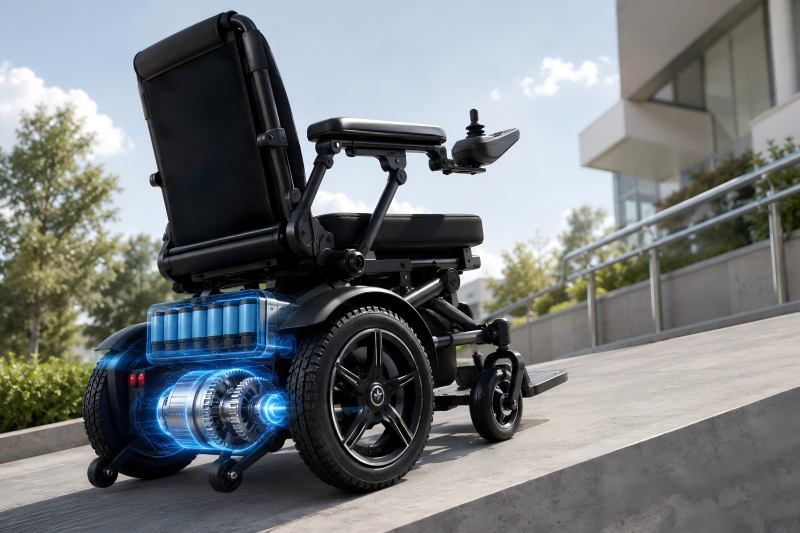
Why 36V Can Be Better for High-Power Wheelchairs
The main advantage of a 36V system is not simply that the wheelchair motor “runs stronger.”
Its real advantage is that more electrical power can be transmitted without requiring extremely high current.
Consider this simplified comparison:
| Required Input Power | Approx. Current at 24V | Approx. Current at 36V |
| 300W | 12.5A | 8.3A |
| 500W | 20.8A | 13.9A |
| 600W | 25A | 16.7A |
| 800W | 33.3A | 22.2A |
| 1000W | 41.7A | 27.8A |
Once power approaches the upper end of this range, reducing current becomes increasingly useful.
A heavy outdoor wheelchair may have two drive motors, meaning the combined electrical demand can become substantial during acceleration or climbing.
In that situation, 36V begins to make much more sense.
Does 36V Give More Torque?
Not automatically.
Torque primarily depends on motor electromagnetic design and current. Simply changing from a 24V motor to a 36V motor does not guarantee higher output torque.
A well-designed 24V geared motor can produce more wheel torque than a poorly matched 36V motor.
Voltage determines how efficiently the motor system supplies the power and speed required. For wheelchair design, I would look at these figures before deciding which motor is stronger:
- Rated output torque
- Peak torque
- Rated current
- Peak current
- Motor speed
- Gear ratio
- Gearbox efficiency
- Wheel diameter
The motor voltage should support these requirements rather than replace them.
Hill Climbing Makes the Difference More Obvious
Climbing is where motor systems are often pushed hardest.
When a wheelchair moves uphill, motor torque and current rise significantly. The situation becomes even harder when the wheelchair has to start from rest halfway up a ramp.
Suppose you have:
- 120 kg combined user and wheelchair weight
- Two driven wheels
- A moderate outdoor slope
- Frequent stop-and-start operation
A properly geared 24V motor system may handle this without difficulty.
Now increase total weight to 180 or 200 kg and expect the chair to climb longer ramps repeatedly.
The electrical load becomes much more demanding.
At this point, a 36V system can help reduce current for the same power output. That makes controller sizing, cable design, and thermal management easier.
For heavy-duty wheelchairs, I would therefore give 36V serious consideration.
Voltage Does Not Replace the Gearbox
Sometimes people try to solve a climbing problem simply by increasing motor voltage.
That is not always the correct approach.
Wheelchair climbing performance depends heavily on the gear reduction between the motor and the drive wheel.
A larger reduction ratio increases wheel torque but reduces maximum speed.
A smaller reduction ratio does the opposite.
If a wheelchair cannot climb properly because the motor is operating at an unsuitable torque-speed point, switching from 24V to 36V without changing the gearing may not solve the real problem.
For example:
| Design Goal | Motor/Gearbox Direction |
| Better hill climbing | Higher torque, larger reduction |
| Higher top speed | Higher output RPM |
| Heavy passenger capacity | Higher continuous torque |
| Smooth indoor control | Lower-speed optimized gearing |
| Long outdoor operation | Efficient motor operating range |
I would always determine the required wheel torque and wheel RPM first, then choose the motor and gearbox combination.
What About Driving Speed?
Here, higher voltage can provide more flexibility.
Motor back EMF rises as motor speed increases. At higher speeds, sufficient supply voltage is required to continue pushing current through the motor.
This means a 36V platform can be useful when higher motor speed is needed.
However, wheelchair speed should not be increased casually.
For most wheelchair applications, controllability is more important than top speed. A wheelchair that reaches a high maximum speed but moves poorly at 1 km/h is not a well-designed wheelchair.
A good system should provide:
- Smooth startup
- Predictable acceleration
- Stable low-speed movement
- Controlled turning
- Reliable braking
Voltage is only one part of achieving this.
24V May Be Better for Folding Wheelchairs
Higher voltage sounds attractive until weight and packaging enter the discussion.
Folding wheelchairs have very different priorities from heavy-duty outdoor chairs.
Their designers usually care about:
- Overall weight
- Battery size
- Folding dimensions
- Motor diameter
- Ease of transportation
A compact 24V BLDC hub motor can therefore be a very sensible solution.
If the wheelchair only needs moderate speed and torque, adding a larger 36V battery system may provide little real benefit.
The best design is often the lightest system that can reliably meet the required load.
Overengineering a folding wheelchair can make it less useful.
36V Makes More Sense as Power Demand Grows
I generally start considering 36V more seriously when several demanding requirements appear together.
For example:
- Higher passenger weight
- Larger drive wheels
- Frequent outdoor use
- Long slopes
- Rough surfaces
- Higher continuous power
- Higher travel speed
- Longer operating periods
None of these automatically requires 36V.
But when several occur at the same time, the current required from a 24V system can become inconveniently high.
This is where the system-level benefit of 36V becomes clear.
Battery Capacity Can Be Misleading
Battery capacity is another area where voltage comparisons can become confusing.
For example:
- A 24V 20Ah battery provides approximately 480Wh
- A 36V 20Ah battery stores approximately 720Wh
So comparing only “20Ah versus 20Ah” is misleading.
The 36V battery contains about 50% more nominal energy in this example.
If you want a fair battery comparison, use watt-hours rather than amp-hours.
| Battery | Nominal Energy |
| 24V 10Ah | 240Wh |
| 24V 20Ah | 480Wh |
| 36V 10Ah | 360Wh |
| 36V 20Ah | 720Wh |
This matters when evaluating wheelchair range.
A 36V wheelchair does not automatically travel farther because of voltage. It travels farther only if the complete battery stores more usable energy or the drive system operates more efficiently.
Efficiency Is About Operating Point
Another assumption is that 36V motors are always more efficient.
That is also too simple.
A motor has an efficiency map. Its efficiency changes with torque and speed.
A properly selected 24V motor operating near its efficient region may perform better than an oversized 36V motor operating far below its intended load.
The engineering goal is to make the motor spend most of its time in a useful operating region.
For a wheelchair, that includes:
- Normal cruising
- Low-speed maneuvering
- Moderate acceleration
- Short climbing periods
Peak efficiency on a datasheet means little if the wheelchair rarely operates there.
Heat Is Often the Hidden Selection Factor
This is where voltage starts affecting reliability indirectly.
Current causes copper losses in motor windings, cables, and other electrical components. As current rises, these losses increase rapidly.
During a short acceleration, this may not matter.
During a long climb, it does.
A motor may perform perfectly for 30 seconds and become too hot after 15 minutes of repeated slope operation.
That is why heavy-duty wheelchair motor selection should consider:
- Continuous current
- Peak current
- Winding temperature
- Motor housing temperature
- Controller temperature
- Duty cycle
For sustained high-load operation, 36V systems reduce current demand, helping control heat and improve thermal performance.
The Controller Must Match the Motor
Do not choose motor voltage without considering the controller.
A 36V motor cannot simply be dropped into a 24V wheelchair without reviewing the rest of the electrical system.
You may also need to change:
- Motor controller
- Battery pack
- Charger
- Brake voltage
- DC-DC converter
- Display electronics
- Protection circuitry
For a new wheelchair platform, this is manageable.
For an existing product, changing system voltage can trigger much more engineering work than expected.
If the current 24V platform already performs well, moving to 36V purely for marketing purposes rarely makes sense.
24V vs 36V: Final Comparison
| Requirement | Better Starting Point |
| Standard indoor wheelchair | 24V |
| Lightweight folding wheelchair | 24V |
| Basic daily mobility | 24V |
| Low-cost platform | 24V |
| Heavy-duty wheelchair | 36V |
| Frequent ramp climbing | 36V |
| Higher-power drive system | 36V |
| Long outdoor operation | 36V |
| Lowest electrical current | 36V |
| Simplest established architecture | 24V |
These are design directions rather than strict rules.
A 24V system can still power a heavy wheelchair if the motor, gearbox, controller, and battery are designed correctly. Likewise, using 36V does not automatically make a wheelchair powerful.