
There is no universal winner between a geared motor and a hub motor for electric wheelchairs.
A geared motor is usually the stronger engineering choice when torque, climbing capability, heavy loads, and drivetrain flexibility are priorities.
A hub motor becomes very attractive when compact packaging, folding structure, low mechanical complexity, and clean product design matter more.
If I were designing a heavy-duty outdoor wheelchair, I would probably start with a geared motor.
If I were designing a lightweight folding wheelchair for travel and indoor mobility, I would probably start with a hub motor.
The important thing is to choose the drivetrain around the wheelchair, not design the wheelchair around whatever motor happens to be available.
That is usually the difference between a motor that simply “works” and a drivetrain that actually feels right in daily use.
How Geared Motors Work in Electric Wheelchairs?
A geared wheelchair motor normally combines an electric motor with a reduction gearbox.
The motor itself usually runs at a relatively high speed. The gearbox reduces that speed and increases the torque delivered to the wheel.
For example, the motor may rotate several thousand revolutions per minute internally, while the wheelchair wheel only needs to rotate at a few hundred RPM or less.
That difference is exactly why a gearbox is useful.
A typical structure looks like this:
Motor → Gearbox → Output Shaft → Drive Wheel
Depending on the design, the gearbox may use spur gears, helical gears, worm gears, or a combination of several reduction stages.
For most conventional rear-wheel-drive electric wheelchairs, this is still a very practical architecture.
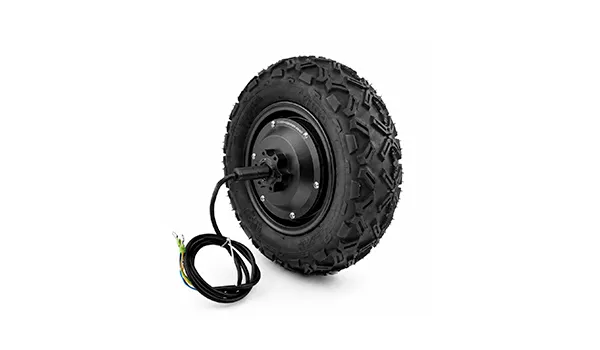
What Is a Hub Motor?
The motor is built directly into the wheel hub. Instead of using a separate motor, gearbox, output shaft, coupling, and drive wheel assembly, the wheel itself becomes part of the motor system.
The basic structure is closer to:
Stator + Rotor + Wheel
Some hub motors are completely gearless, while others contain a compact planetary reduction mechanism inside the hub.
For wheelchair applications, however, when we talk about hub motors, we are usually referring to a highly integrated wheel-drive system.
This is particularly interesting for folding and lightweight wheelchairs because there are fewer external transmission components.
Geared Motor vs Hub Motor: Basic Comparison
| Factor | Geared Motor | Hub Motor |
| Low-Speed Torque | Excellent | Moderate to good |
| Mechanical Structure | More components | Highly integrated |
| Installation Space | Requires motor and gearbox space | Mainly occupies wheel space |
| Weight Distribution | Motor weight inside chassis | Weight located at wheel |
| Noise | Gear noise possible | Usually quieter |
| Maintenance | Gearbox may require attention | Fewer transmission parts |
| Climbing Ability | Very strong when properly geared | Depends heavily on motor size |
| Folding Design | More difficult | Very suitable |
| Wheel Replacement | Usually easier | More complicated |
| Custom Gear Ratio | Flexible | Limited |
| Cost Control | Good for mature designs | Can increase with integration |
| Heavy-Duty Use | Very suitable | More challenging |
If I were designing a wheelchair without knowing anything else about the project, I would not immediately say one is better.
I would first ask: What does this wheelchair need to do?
That question usually gives us the answer.
Why Geared Motors Are Still So Common
The biggest advantage of a geared motor is simple: it lets us use motor speed efficiently.
Electric motors generally like to rotate faster than wheelchair wheels.
Suppose a motor produces its best efficiency at 3,000 RPM, but the wheel only needs to rotate at 150 RPM during normal driving.
A 20:1 reduction ratio gives us a much more useful wheel speed.
Ignoring losses for a moment, torque is also multiplied by roughly the same ratio.
That is extremely useful in a wheelchair.
Imagine that the motor itself produces 1.5 N·m of torque.
With a 20:1 gearbox:
1.5 × 20 = 30 N·m
The actual output will be slightly lower because gears are not 100% efficient, but you can already see the advantage.
Instead of building a physically much larger motor to generate 30 N·m directly, we can use a smaller high-speed motor and let the gearbox do part of the work.
That is why geared motors work particularly well for wheelchairs that need high starting torque.
Starting Torque Matters More Than Many Buyers Expect
A wheelchair rarely operates under a perfectly steady load.
It starts from zero speed.
It turns.
It climbs ramps.
It crosses carpet edges.
It may encounter uneven pavement.
It may carry a heavier user.
These conditions all create short periods of high torque demand.
From an engineering perspective, I am usually more interested in peak torque and low-speed thermal behavior than the number printed beside “rated power.”
Two motors can both be rated at 250 W and behave very differently in a wheelchair.
One may feel strong when starting on a ramp.
The other may reach the same top speed on flat ground but struggle during acceleration.
The gearbox plays a big part in this difference.
Where Hub Motors Become More Attractive
The hub motor solves a completely different problem.
Instead of asking, “How can I produce more wheel torque with a smaller motor?” it asks:
“How can I simplify the whole drive system?”
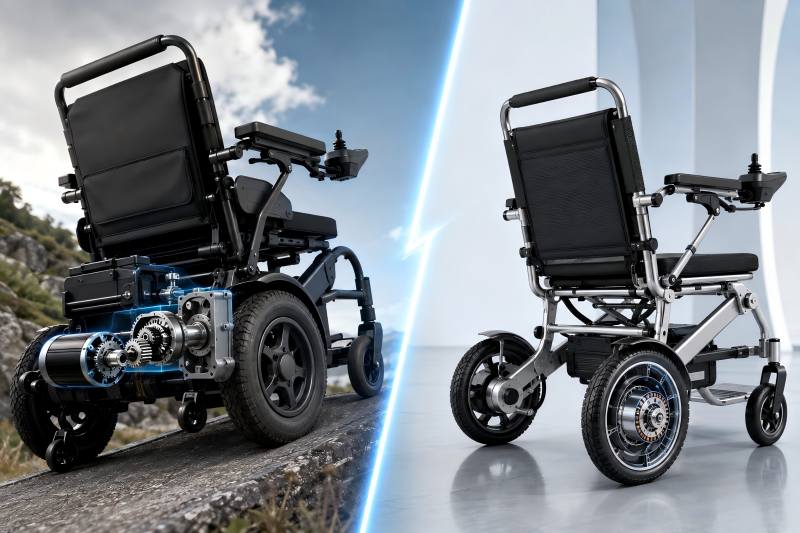
This becomes especially important in folding wheelchairs.
A folding wheelchair has very limited packaging space.
Traditional geared motors may interfere with:
- Folding mechanisms
- Battery placement
- Seat frames
- Footrest structures
- Rear suspension
- Wheel removal systems
Integrating the motor into the wheel simplifies the overall structure. You suddenly have much more freedom inside the chassis.That is a major design advantage.
Folding Wheelchairs Are a Natural Application for Hub Motors
If I were working on a lightweight folding electric wheelchair, I would seriously consider a hub motor very early in the design process.
Why?
Because folding products are extremely sensitive to packaging.
You are fighting for every millimeter.
A traditional drivetrain might require:
- Motor body
- Gearbox
- Mounting bracket
- Output shaft
- Coupling
- Brake
- Wheel connection
With a hub motor, much of that structure becomes one assembly.
This can make the mechanical layout noticeably cleaner.
It can also make the wheelchair look more like a normal manual wheelchair, which some product designers prefer.
But Hub Motors Have a Torque Challenge
The disadvantage is that you lose some of the mechanical leverage provided by a gearbox.
A direct-drive hub motor must generate wheel torque more directly.
That means the motor may need:
- Larger diameter
- Stronger magnets
- More copper
- Higher current
- Better thermal design
The key question is not simply whether the system uses a gearbox. If the wheelchair is designed mainly for flat indoor environments, the required torque may be manageable.
For a heavy-duty outdoor wheelchair climbing steep slopes, the situation becomes more difficult.
You can certainly design a powerful hub motor, but at some point the motor becomes heavier, more expensive, and harder to cool.
That is where a geared motor often becomes the more practical solution again.
Climbing Performance
If climbing ability is one of the main requirements, I normally prefer having a gearbox available.
Consider a wheelchair carrying:
- User: 100 kg
- Wheelchair: 40 kg
- Total mass: 140 kg
Now add an uphill ramp.
The drive wheels must generate enough force to overcome gravity plus rolling resistance.
As slope angle increases, required wheel torque rises quickly.
A gearbox gives the designer a convenient way to increase torque without dramatically increasing motor diameter.
| Application | Geared Motor | Hub Motor |
| Indoor Flat Floor | Excellent | Excellent |
| Shopping Mall / Hospital | Excellent | Excellent |
| Small Ramps | Excellent | Good |
| Frequent Outdoor Slopes | Excellent | Design dependent |
| Heavy User Loads | Excellent | Requires larger motor |
| Rough Outdoor Terrain | Excellent | More challenging |
This does not mean a hub motor cannot climb hills.
It simply means the motor has to be designed specifically for that job.
Gear Ratio Gives Engineers Another Adjustment Tool
One thing I like about geared motors is that I can tune the system through the reduction ratio.
Suppose a customer tells me:
“We don’t need high speed, but we want very strong climbing performance.”
Good.
I can increase the reduction ratio.
Another customer says:
“Our wheelchair is mainly for indoor use and needs slightly higher travel speed.”
Then I may reduce the ratio.
The same general motor platform can sometimes support several wheelchair models simply by changing the gearbox configuration.
That is very useful for manufacturers developing a product family.
Hub motors give us less freedom here.
Once wheel diameter, winding, magnet configuration, and electrical system are fixed, the mechanical operating window becomes narrower.
Noise Is More Complicated Than It Looks
Hub motors are often described as quieter.
Generally, that is true.
There is no external multi-stage gearbox continuously meshing during operation.
But motor noise does not come from gears alone.
We also have:
- Electromagnetic noise
- Controller switching noise
- Bearing noise
- Structural resonance
- Tire vibration
A badly designed hub motor can still be noisy.
Similarly, a good geared BLDC motor with properly designed gears can be surprisingly quiet.
For indoor wheelchairs, I would pay close attention to gear tooth design, backlash, bearing support, housing stiffness, and controller tuning.
Hospitals and home environments are much more sensitive to noise than many industrial motor applications.
What About Efficiency?
People sometimes assume a hub motor must always be more efficient because it has no gearbox.
Again, it is not that simple.
Yes, gears create losses.
But a motor also has an efficiency map.
If the gearbox allows the motor to operate closer to its efficient speed range, the total system can still perform very well.
A direct-drive hub motor operating at extremely low speed and high current may generate significant copper losses.
Heat Dissipation
Thermal design is another area where wheelchair applications can surprise people.
When a motor runs slowly but produces high torque, current can remain high while cooling airflow is limited.
That is a difficult operating condition.
A geared motor reduces this problem because the motor itself can rotate faster even while the wheel moves slowly.
Hub motors, especially compact ones, may experience more concentrated heat during long uphill operation.
This is why I would always test:
- Long ramp climbing
- Repeated start-stop cycles
- Maximum user load
- Low-speed continuous driving
- High ambient temperature
A motor that survives a 30-second bench test may still overheat during real wheelchair operation.
Maintenance and Serviceability
Hub motors have fewer external transmission parts, which sounds ideal for maintenance.
But there is another side to it.
If the hub motor fails, you may need to replace or repair the whole motor-wheel assembly.
With a traditional geared system, the wheel itself can often remain completely separate from the motor.
This makes service easier in some markets.
For manufacturers selling globally, this matters more than people think.
A design that is easy to service in your own factory may be difficult to repair thousands of kilometers away.
Wheel Weight Also Matters
A hub motor increases unsprung or wheel-mounted mass.
In a wheelchair without sophisticated suspension, that extra wheel mass can affect how the product feels when moving over bumps.
For a slow wheelchair this effect is not as dramatic as it would be in a high-speed vehicle, but it still matters.
The heavier the hub motor becomes, the more carefully I would evaluate ride comfort and mechanical shock loads.
Which Motor Would I Choose?
My answer would roughly look like this:
| Wheelchair Type | My Likely Choice |
| Standard Electric Wheelchair | Geared Motor |
| Heavy-Duty Wheelchair | Geared Motor |
| Bariatric Wheelchair | Geared Motor |
| Outdoor Mobility Wheelchair | Geared Motor |
| Lightweight Folding Wheelchair | Hub Motor |
| Compact Travel Wheelchair | Hub Motor |
| Premium Minimalist Design | Hub Motor |
| High-Climbing Wheelchair | Geared Motor |
There will always be exceptions, but this is a reasonable starting point.
What Manufacturers Should Specify Before Motor Development
When a wheelchair manufacturer asks us to develop a motor, I would rather receive operating data than simply hear:
“We need a 250 W wheelchair motor.”
That number tells me very little.
Much more useful information includes:
- Total wheelchair weight
- Maximum user weight
- Wheel diameter
- Maximum speed
- Target climbing slope
- Battery voltage
- Required travel range
- Continuous driving time
- Indoor or outdoor use
- Folding requirements
- Brake requirements
- Maximum motor dimensions
From there, we can begin calculating wheel torque, motor speed, gear ratio, current requirement, thermal margin, and drivetrain structure.
That produces a much better motor than starting from a power number alone.