
Choosing a motor for an electric wheelchair looks simple at first. You know the wheelchair weight, the user weight, and maybe the target speed, so you pick a motor with enough watts and move on.
In actual motor design, it does not work quite that way.
When we select a wheelchair motor, load capacity is only the starting point. Two wheelchairs carrying the same 150 kg total load can require very different motors. One may travel mainly on smooth indoor floors at 6 km/h, while another needs to climb ramps, cross uneven pavement, and start repeatedly on slopes.
The number printed on the motor — 250 W, 350 W, 500 W — tells only part of the story.
What matters more is whether the complete drive system can produce enough wheel torque at low speed, maintain the required cruising speed, and operate without overheating.
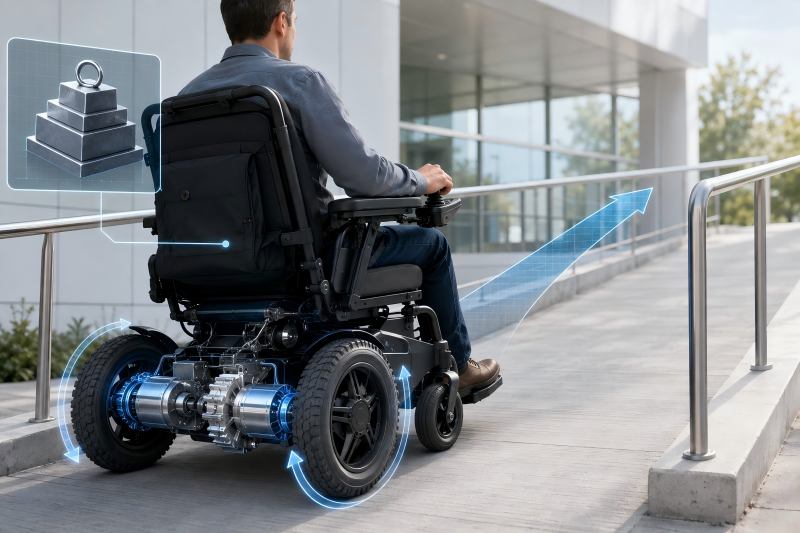
Start With Total Moving Weight, Not Just User Weight
If someone says, “The wheelchair needs to carry a 120 kg person, so what motor should I use?” I still do not have enough information.
The motor does not move only the user. It moves everything:
- User
- Wheelchair frame
- Batteries
- Motors and gearboxes
- Seat and accessories
- Medical equipment or luggage
For example, a wheelchair designed for a 120 kg user may have an actual moving mass of 160–180 kg after everything is installed.
That extra weight matters especially during acceleration and climbing.
A useful starting reference is shown below:
| User Weight | Typical Total Moving Weight | General Motor Demand |
| 50–80 kg | 90–120 kg | Light |
| 80–110 kg | 120–155 kg | Moderate |
| 110–140 kg | 155–190 kg | High |
| 140–180 kg | 190–240 kg | Heavy-duty |
| 180 kg+ | 240 kg+ | Specialized |
These ranges are not motor specifications. They simply help us understand the mechanical load before selecting the drive system.
Motor Power vs. Torque: What Really Affects Climbing Ability
This is probably the most important point in the whole discussion.
A wheelchair does not climb a ramp because it has “more watts.” It climbs because there is enough torque at the drive wheels.
You can have a relatively high-speed motor with impressive rated power and still get poor climbing performance if the reduction ratio is wrong.
For wheelchairs, I normally care much more about low-speed torque than maximum motor speed.
Imagine two 350 W motors.
Motor A uses a higher reduction ratio and produces strong wheel torque at low speed.
Motor B uses a lower reduction ratio and produces a higher top speed.
Both motors say 350 W on the label, but Motor A will usually feel much stronger when starting or climbing.
That is why motor selection should always consider:
Motor + gearbox + wheel diameter as one system.
How Load Capacity Changes Required Wheel Torque
On a perfectly flat floor at constant speed, a wheelchair does not need huge torque. The motor mainly needs to overcome rolling resistance and mechanical losses.
The situation changes quickly on a slope.
As total weight increases, the downhill gravitational force increases as well. The drive wheels need enough torque to push against it.
From an engineering point of view, required tractive force can be thought of roughly as:
Required force = rolling resistance + slope resistance + acceleration force
Then wheel torque depends on that force and the drive-wheel radius.
So three things immediately increase motor demand:
- Higher wheelchair weight
- Steeper slope
- Larger drive wheels
The third one sometimes surprises people.
Larger wheels improve obstacle clearance and provide a smoother ride. But for the same tractive force, a larger wheel also requires more axle torque.
For example, if we keep everything else unchanged, moving from a 250 mm drive wheel to a 350 mm wheel increases the torque requirement at the axle.
That does not automatically mean larger wheels are bad. It simply means the motor and gearbox need to be matched accordingly.
A Practical Power Range by Wheelchair Load
For early-stage design discussions, I usually use power ranges rather than one exact number.
For a dual-motor wheelchair, a rough starting reference might be:
| Total Moving Load | Typical Motor Power Per Side | Common Application |
| Below 120 kg | 150–250 W | Lightweight indoor wheelchair |
| 120–160 kg | 200–300 W | Standard electric wheelchair |
| 160–200 kg | 250–400 W | Indoor/outdoor wheelchair |
| 200–250 kg | 350–500 W | Heavy-duty wheelchair |
| Above 250 kg | 450 W+ | Bariatric or special-purpose wheelchair |
Again, I would never manufacture a motor based on this table alone.
Slope, wheel size, target speed, operating time, gearbox ratio, voltage, and thermal conditions still need to be checked.
But as an initial conversation between a wheelchair manufacturer and a motor supplier, these ranges are useful.
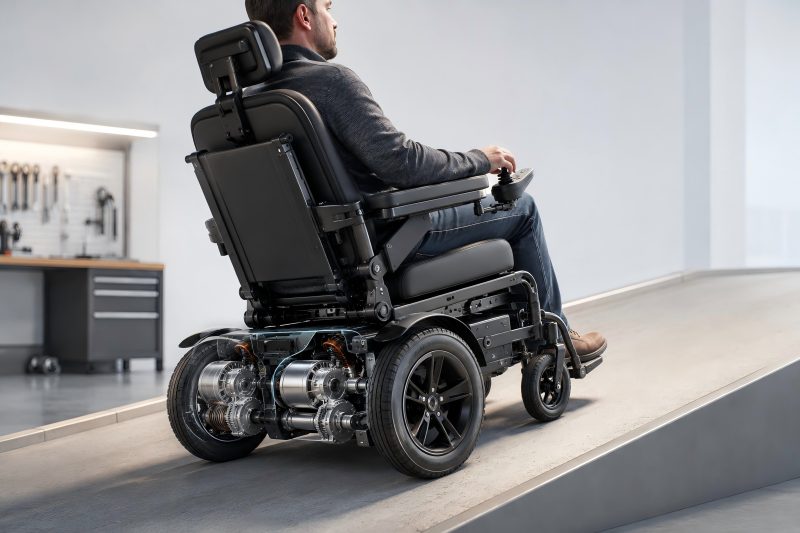
Do Not Size the Motor for Flat-Ground Cruising Only
Suppose a wheelchair travels on a smooth floor at 5 km/h and only needs around 120 W of mechanical output during normal cruising.
Does that mean a 120 W motor is enough?
Usually, no.
The toughest motor conditions happen somewhere else:
- Starting from rest
- Starting on a ramp
- Climbing continuously
- Crossing a threshold
- Turning at low speed
- Driving on carpet
- Traveling on rough ground
- Carrying maximum load
During these conditions, the motor may need several times more torque than it does during steady cruising.
This is why we distinguish between continuous torque and peak torque.
A wheelchair motor needs enough peak torque for short, difficult events, while its continuous rating must be high enough that normal operation does not cause excessive temperature rise.
If you size the motor only according to cruising power, the wheelchair may look fine during a short workshop test but feel weak in actual use.
Slope Requirement Can Change Everything
When customers ask us to develop a wheelchair motor, one of the first questions I would ask is:
What slope does the wheelchair need to handle at full load?
There is a big difference between a wheelchair expected to use gentle accessibility ramps and one designed for outdoor slopes.
Consider the same 180 kg total wheelchair system:
| Operating Condition | Motor Demand |
| Smooth indoor floor | Relatively low |
| Carpet | Moderate increase |
| 5° slope | Noticeably higher |
| 8° slope | High torque required |
| 10°+ slope | Requires careful drivetrain design |
| Starting on slope | Higher peak torque than continuous climbing |
The last line is important.
Sometimes a wheelchair can continue moving on a slope once it is already traveling, but it struggles to restart after stopping halfway up.
That usually means the system has enough running torque but insufficient startup torque or controller current capability.
So when testing motor sizing, do not test only “Can it climb?”
Also test:
Can it stop and restart on the slope at maximum load?
That is a much better engineering test.
Wheel Diameter and Gear Ratio Must Be Selected Together
I would not finalize motor power without knowing the drive-wheel diameter.
Suppose the motor runs at 3,000 rpm and the wheelchair wheel should rotate at only around 100 rpm during normal operation. Clearly, we need a gearbox.
A higher reduction ratio gives us:
- Lower wheel speed
- Higher output torque
- Better startup performance
- Better climbing ability
A lower reduction ratio gives us:
- Higher maximum speed
- Less torque multiplication
This is why simply changing gearbox ratio can completely change how the same motor behaves.
For many electric wheelchairs, this is actually where the real design work happens.
You are trying to balance three things:
speed, torque, and efficiency.
Push too far toward speed, and the wheelchair becomes weak at low speed.
Push too far toward torque, and the wheelchair may become unnecessarily slow while the motor operates away from its efficient range.
The correct ratio depends on the intended wheelchair.
Battery Voltage Also Affects Motor Selection
Wheelchairs commonly use low-voltage DC electrical systems. When choosing between different voltage platforms, we should think about current as well as power.
As a simple example:
A 500 W electrical system running from 24 V needs roughly twice the current of a 500 W system running from 48 V, ignoring losses for the moment.
Higher current means more consideration for:
- Controller capacity
- Cable size
- Connector heating
- Battery discharge capability
- Copper losses
Higher voltage is not always the better choice. For compact wheelchairs, a lower-voltage system may still be the practical choice because the battery, controller, charging system, and existing platform are already designed around it.
The important point is that motor power cannot be selected independently from the electrical system.
Motor Efficiency Becomes More Important as Load Increases
For a heavy wheelchair, I would not look only at whether the motor can produce enough torque.
I would also look at how efficiently it produces that torque.
Suppose two motors can both move a 220 kg wheelchair up the required ramp.
One operates near a healthy efficiency range. The other runs close to stall and pulls very high current.
Both may pass a short climbing test.
But after repeated climbing, the second motor is much more likely to become hot.
That heat eventually affects:
- Winding insulation
- Permanent magnets
- Gearbox lubricant
- Bearings
- Controller temperature
- Battery runtime
So a good motor match is not the smallest motor that can barely complete the test.
It is the motor that can complete the expected duty cycle with a reasonable thermal margin.
Leave Some Engineering Margin
I rarely like designing a wheelchair drivetrain that operates at 100% of its theoretical capability under normal maximum-load conditions.
Real life is less predictable than a calculation.
Users may carry extra items. Tire pressure changes. Bearings wear. Carpet creates more resistance. Outdoor temperatures rise. Ramp surfaces become rough.
That is why some design margin is useful.
However, there is another side to this.
Oversizing the motor too much is not automatically good engineering either.
A larger motor can mean:
- More weight
- Larger gearbox
- Higher cost
- Larger controller
- Higher peak current
- More difficult packaging
- Reduced folding portability
The goal is not “as much motor as possible.”
The goal is enough motor with sensible reserve capacity.
Standard, Heavy-Duty, and Folding Wheelchairs Need Different Priorities
The same load-matching rule does not apply equally to every wheelchair.
Standard Electric Wheelchair
For a standard rear-wheel-drive chair, I usually prioritize balanced torque, efficiency, noise, and long operating life.
A geared DC motor or BLDC geared motor is a common fit because the gearbox provides the low-speed torque the wheelchair needs.
Heavy-Duty Electric Wheelchair
Continuous torque and heat control become more critical here. A motor that works well for a 130 kg total system may overheat when moved directly into a 220 kg platform, even if it can initially move the chair.
For heavy-duty designs, I would pay close attention to motor current, gearbox loading, shaft strength, bearing load, and repeated slope operation.
Folding Electric Wheelchair
Now weight becomes a major constraint.
You cannot simply install a much larger motor every time load capacity increases because the whole purpose of the wheelchair is portability.
This is where compact BLDC or hub-motor solutions can become attractive.
The engineering challenge is achieving enough torque without making the wheelchair too heavy to fold and transport.
Information I Need Before Selecting a Wheelchair Motor
If a wheelchair manufacturer sends me only one sentence saying, “We need a 300 W wheelchair motor,” I would normally ask for more information.
Key motor specifications to consider include:
| Parameter | Why It Matters |
| Maximum user weight | Determines major load requirement |
| Total wheelchair weight | Gives actual moving mass |
| Maximum speed | Determines motor speed and gearing |
| Drive-wheel diameter | Directly affects axle torque |
| Maximum climbing angle | Determines climbing torque |
| Required starting ability | Determines peak torque |
| Battery voltage | Defines electrical platform |
| Operating duration | Affects thermal design |
| Indoor/outdoor use | Changes resistance and environment |
| Motor installation space | Limits motor and gearbox dimensions |
With these parameters, motor selection becomes much more meaningful.
Without them, choosing power is mostly guessing.
A Simple Example
Let us say we are designing a standard outdoor electric wheelchair.
The basic requirements are:
- User weight: 110 kg
- Wheelchair and battery: 50 kg
- Total moving weight: 160 kg
- Maximum speed: 6 km/h
- Moderate outdoor ramps
- Dual rear-wheel drive
- 24 V battery system
I would not immediately say, “Use two 250 W motors.”
First, I would estimate the wheel torque required on the target ramp. Then I would check the wheel diameter and calculate a reasonable gearbox ratio.
After that, I would select a motor whose normal operating point falls in an efficient part of its speed-torque range.
Finally, I would verify:
- Flat-ground current
- Maximum-load startup
- Ramp climbing
- Ramp restart
- Motor temperature rise
- Gearbox temperature
- Battery current
- Controller peak current
If those tests look healthy, then I know the motor is properly matched.
That process is much safer than selecting a motor only from its watt rating.
When matching motor power with wheelchair load capacity, do not start by asking how many watts you need.
Start by asking what the wheelchair actually needs to do.
A heavier wheelchair obviously needs more drive capability, but total load alone does not determine motor size. Slope, wheel diameter, target speed, gearbox ratio, battery voltage, acceleration, operating environment, and duty cycle all change the answer.
It is the motor that produces enough wheel torque when the wheelchair needs it, runs efficiently during normal driving, survives repeated high-load operation, and still fits the wheelchair’s weight, size, and cost targets.
That is the difference between choosing a motor by specification sheet and actually matching a motor to a wheelchair.