
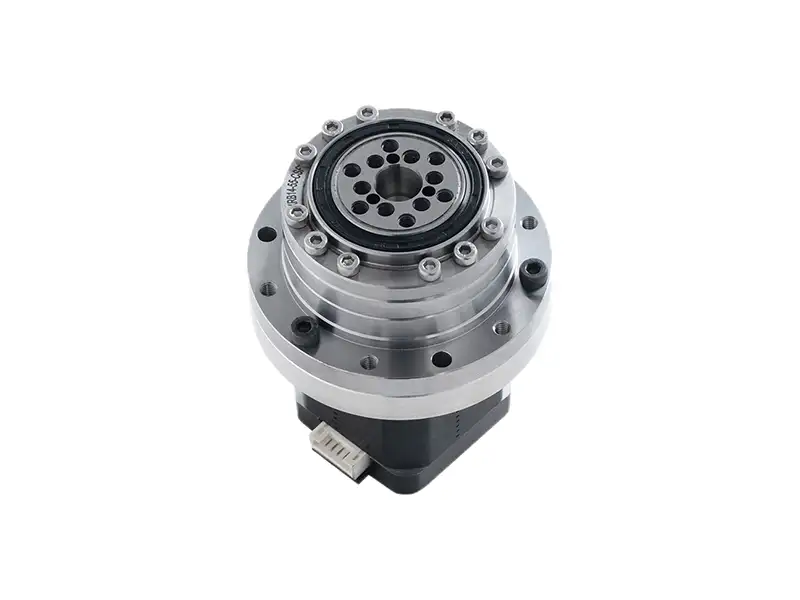
A harmonic gear motor is a compact, accurate, and high-torque motion transmission device. It combines an electric motor with a harmonic gear reducer to achieve high reduction ratio, low backlash, smooth operation, and precise positioning.
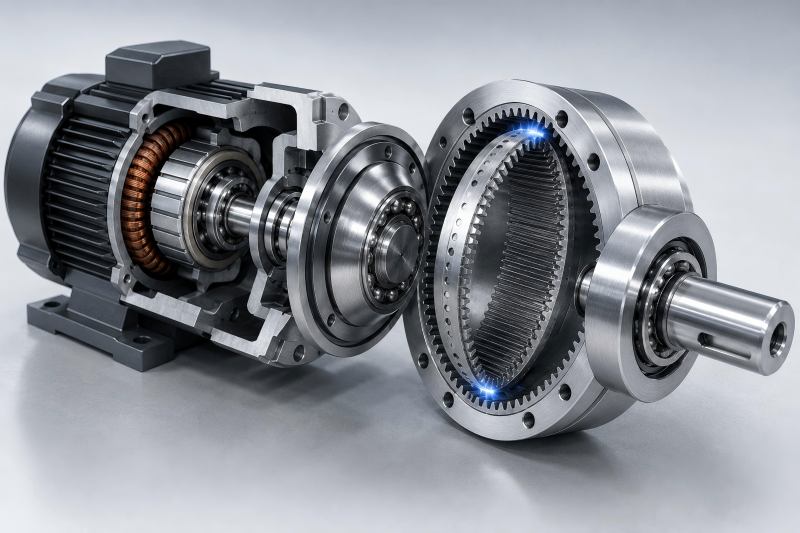
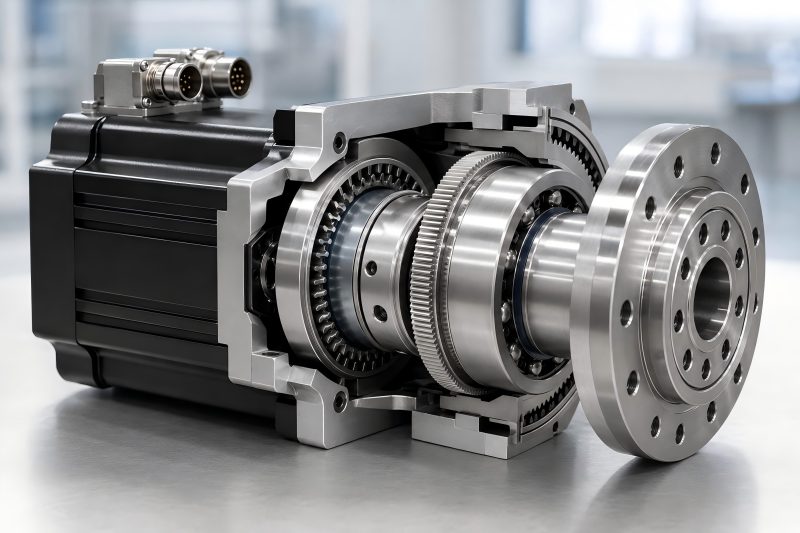
Its main structure includes the motor, wave generator, flex spline, circular spline, bearings, output shaft, housing, and optional encoder. By using elastic deformation and tooth difference, the harmonic gear motor can convert high-speed motor rotation into low-speed, high-torque output.
What Is a Harmonic Gear Motor?
A harmonic gear motor combines a motor and harmonic reducer to deliver precise low-speed rotation with increased torque output.
Harmonic gearing is different from traditional gear transmission. Instead of using only rigid gear engagement, it uses the elastic deformation of a flexible gear component. This allows many gear teeth to mesh at the same time, providing high precision and low backlash.
A harmonic gear motor is commonly used when a machine needs:
- High positioning accuracy
- Compact installation space
- High torque output
- Smooth rotation
- Low backlash
- Stable repeatability
Because of these advantages, it is often used in robotic joints, precision rotary tables, servo systems, medical robots, and aerospace mechanisms.
Main Structure of a Harmonic Gear Motor
A harmonic gear motor usually consists of two main parts: the electric motor and the harmonic gear reducer. The reducer mainly consists of a wave generator, flex spline, and circular spline.
| Component | Function |
| Electric Motor | Provides input rotation and power |
| Wave Generator | Creates elastic deformation in the flex spline |
| Flex Spline | Flexible gear that transmits motion |
| Circular Spline | Rigid internal gear that meshes with the flex spline |
| Output Shaft | Outputs slow, powerful rotation |
| Bearings | Ensure stable shaft rotation |
| Encoder | Provides position and speed feedback in servo systems |
| Housing | Protects internal parts and supports installation |
Electric Motor
The electric motor is the power source of the harmonic gear motor. Common options include BLDC, servo, stepper, and other motors. In high-precision applications, servo motors are commonly used because they offer accurate speed, torque, and position control.
The motor typically operates at high rotational speed. After passing through the harmonic reducer, the output speed becomes much lower, while the torque increases greatly.
Wave Generator
It connects to the motor shaft and uses an elliptical cam bearing. When the motor rotates, the wave generator rotates with it.
It reshapes the flex spline elliptically, forming two contact zones with the circular spline.
The wave generator is the key part that produces the “wave motion” in the harmonic gear system.
Flex Spline
The flex spline is a thin-walled flexible gear, usually shaped like a cup or ring. It has external teeth on its outer surface. Because it is elastic, it can be slightly deformed by the wave generator during operation.
The flex spline typically has slightly fewer teeth than the circular spline. This small difference in tooth number creates the reduction effect.
The quality of the flex spline is very important because it affects torque capacity, accuracy, fatigue life, and overall reliability.
Circular Spline
The circular spline is a rigid internal gear. It surrounds the flex spline and has internal teeth. In many designs, the circular spline is fixed to the housing.
Because the circular spline has slightly more teeth than the flex spline, relative motion is created when the wave generator rotates. This relative motion produces speed reduction and torque multiplication.
Working Principle of a Harmonic Gear Motor
A harmonic gear motor works through controlled flexing and differential gear tooth engagement.
First, the motor drives the wave generator to rotate. Since the wave generator has an elliptical shape, it forces the flex spline to deform into an ellipse.
Second, the flex spline teeth mesh with the circular spline at two opposite elliptical contact points.
Third, as the wave generator rotates, the meshing areas also move around the gear circumference. However, because the flex spline has fewer teeth than the circular spline, the flex spline rotates slowly in the opposite direction.
Fourth, this motion enables high reduction. The output shaft connected to the flex spline delivers low-speed, high-torque rotation.
For example:
| Circular Spline Teeth | Flex Spline Teeth | Tooth Difference | Result |
| 202 | 200 | 2 | High reduction ratio |
| 162 | 160 | 2 | Compact torque transmission |
| 102 | 100 | 2 | Precision speed reduction |
The smaller the tooth difference, the higher the reduction ratio can be. This is why harmonic gear motors can achieve large speed reduction in a compact structure.
Precision Through Low Backlash
Backlash refers to gear clearance that can reduce accuracy and cause unstable motion.
Multiple teeth mesh simultaneously, resulting in minimal backlash and higher positioning accuracy. Unlike traditional gears that may only have a few teeth in contact, harmonic gears distribute the load across a larger tooth contact area.
This structure improves:
- Positioning accuracy
- Repeatability
- Motion smoothness
- Load distribution
- Torsional stiffness
For robotic arms, semiconductor machines, and precision automation equipment, low backlash is one of the most important reasons to choose harmonic gear motors.
Key Features of Harmonic Gear Motors
High Reduction Ratio
Harmonic gear motors can provide high reduction ratios such as 30:1, 50:1, 80:1, 100:1, or even higher. This allows the motor to output strong torque at low speed without using a large multi-stage gearbox.
Compact Size
A harmonic reducer can achieve high torque and high reduction ratio in a small volume. This is especially useful for robotic joints, compact actuators, medical devices, and aerospace equipment where installation space is limited.
High Precision
Because of low backlash and stable tooth engagement, harmonic gear motors are suitable for precise positioning and repeated motion control.
High Torque Density
Torque density means how much torque the gear motor can provide relative to its size and weight. Harmonic gear motors offer high torque density, making them suitable for lightweight and compact machines.
Smooth Operation
The gradual meshing of gear teeth helps reduce vibration and improve motion smoothness. This is important for inspection equipment, optical devices, medical robots, and precision instruments.
Good Repeatability
Harmonic gear motors deliver consistent repeatable positioning, making them suitable for repetitive automated motion tasks.
Advantages of Harmonic Gear Motors
| Advantage | Description |
| High precision | Suitable for accurate motion control |
| Low backlash | Reduces positioning error |
| Compact structure | Saves installation space |
| High torque output | High torque in compact size |
| High reduction ratio | Reduces speed effectively |
| Smooth motion | Improves machine stability |
| Lightweight design | Useful for robots and aerospace systems |
| Good repeatability | Suitable for repeated positioning tasks |
These advantages make harmonic gear motors one of the best choices for high-end motion control systems.
Harmonic Gear Motor Challenges
Despite their advantages, harmonic gear motors are not suitable for every application.
First, they generally have a higher initial cost. Their components require high-precision machining and high-quality materials.
Second, the flex spline repeatedly bends during operation. If the gear motor is overloaded or used improperly, fatigue may occur over time.
Third, harmonic gear motors are not always the best option for applications with heavy shock loads. In such cases, a planetary gearbox or other heavy-duty reducer may be more suitable.
Fourth, lubrication and installation accuracy are very important. Poor lubrication, misalignment, or excessive load can shorten service life.
Harmonic Gear Motor vs Planetary Gear Motor
Harmonic gear motors and planetary gear motors are both widely used in automation and motion control. However, they are suitable for different applications.
| Item | Harmonic Gear Motor | Planetary Gear Motor |
| Precision | Very high | Medium to high |
| Backlash | Very low | Low to medium |
| Structure | Compact for high ratios | Compact, but may need multiple stages |
| Torque density | High | High |
| Shock resistance | Moderate | Usually better |
| Cost | Higher | Usually lower |
| Best for | Robotics, precision equipment, medical devices | General automation, conveyors, machinery |
If the application requires extremely low backlash, compact size, and high positioning accuracy, a harmonic gear motor is often the better choice. If the application requires lower cost, strong shock resistance, and general transmission performance, a planetary gear motor may be more suitable.
Common Applications of Harmonic Gear Motors
Industrial Robots
Harmonic gear motors are widely used in industrial robot joints. Robotic arms require precise movement, high torque, compact design, and stable repeatability. Harmonic gear motors help robots perform welding, assembly, material handling, inspection, and packaging tasks accurately.
Collaborative Robots
Collaborative robots, or cobots, need lightweight and compact joint modules. Harmonic gear motors help reduce the size and weight of robot joints while maintaining smooth and accurate motion. This allows cobots to work safely and efficiently near human operators.
Semiconductor Equipment
Semiconductor production requires extremely accurate motion control. Harmonic gear motors enable precise motion in wafer handling, inspection, positioning, and alignment systems. Their low backlash and high precision help improve production quality.
Medical Equipment
Medical equipment often requires smooth, quiet, and accurate movement. Harmonic gear motors enable compact, precise motion in surgical, rehabilitation, imaging, and lab automation systems.
Aerospace Systems
In aerospace applications, weight and space are very important. Harmonic gear motors support satellite, antenna, optical, and actuator systems with compact, high-torque performance.
CNC Machines
CNC machines and precision rotary tables require accurate angular positioning. Harmonic gear motors can be used in indexing tables, tool changers, rotary axes, and precision machining equipment.
Automation Equipment
In automation, harmonic gear motors drive precise pick-and-place, packaging, assembly, testing, and transfer operations. They help improve production speed and positioning accuracy.
Optical and Measuring Instruments
Cameras, telescopes, laser devices, and measuring instruments often require stable and accurate rotation. Harmonic gear motors provide smooth movement and low backlash, making them suitable for these precision systems.
How to Choose a Harmonic Gear Motor
When selecting a harmonic gear motor, several factors should be considered:
- Required output torque
- Rated speed and maximum speed
- Reduction ratio
- Backlash requirement
- Positioning accuracy
- Load inertia
- Duty cycle
- Installation space
- Operating temperature
- Service life requirement
- Encoder type
- Control system compatibility
- Lubrication method
- Environmental conditions
Choosing the correct model is very important. Undersized gear motors may overheat, wear faster, or fail under heavy loads. If the model is too large, it may increase cost and waste space.
Maintenance Tips for Harmonic Gear Motors
To keep a harmonic gear motor working reliably, users should follow proper maintenance practices:
- Avoid overload operation.
- Use the gear motor within rated torque and speed limits.
- Check lubrication according to the manufacturer’s instructions.
- Prevent dust, moisture, and contamination from entering the reducer.
- Avoid strong impact loads.
- Ensure correct installation and alignment.
- Monitor abnormal noise, vibration, and temperature rise.
- Inspect the motor and reducer regularly in demanding applications.
Good maintenance can extend service life and improve long-term performance.
Although harmonic gear motors are usually more expensive than ordinary gear motors and require careful selection and maintenance, they are one of the best solutions for applications that demand high precision, compact size, and reliable torque transmission.