
Copper fill factor is one of the details that separates a merely functional BLDC motor from a well-engineered one.
Using stator slot space effectively can reduce winding resistance, lower copper losses, control temperature rise, and improve continuous torque capability. But maximizing copper density without considering insulation, wire tension, end winding, impregnation, and manufacturing repeatability can create a different set of problems.
The better engineering target is therefore not maximum copper.
It is maximum useful copper within a stable manufacturing process.
What Copper Fill Factor Means in a BLDC Motor
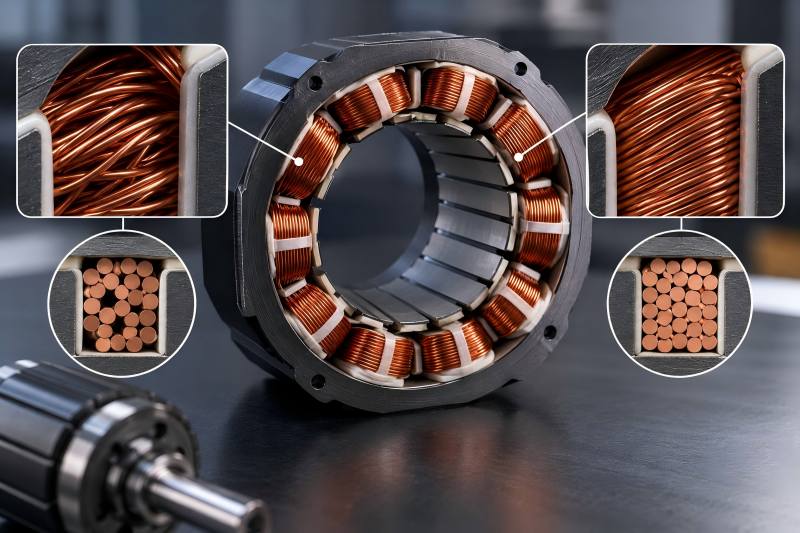
Each BLDC stator slot provides limited space for copper windings. Part of this space is occupied by copper wire, while another part is required for slot insulation, wire enamel, separation materials, and manufacturing clearance.
There will also be small voids between adjacent wires.
Copper fill factor describes how effectively this available slot area is utilized by the actual copper conductors.
A loosely arranged winding may leave considerable unused space between wires. A well-controlled winding can pack the conductors more efficiently and place more copper into essentially the same stator geometry.
This difference matters because the stator slot is valuable space. Once the motor diameter, stack length, slot geometry, and insulation system are fixed, the manufacturer cannot simply keep adding copper indefinitely.
The winding process must use the available slot space more efficiently.
| Winding Condition | Typical Characteristic | Practical Effect |
| Low copper utilization | Large gaps between wires | Higher winding resistance |
| Moderate fill | Controlled and repeatable winding | Balanced cost and performance |
| High controlled fill | Dense, organized conductors | Better copper utilization |
| Excessive packing | Wire deformation or insulation stress | Higher manufacturing risk |
| Inconsistent winding | Uneven slot-to-slot copper distribution | Performance variation |
The important word here is controlled. Higher copper density does not always mean better motor performance.
How Higher Copper Fill Improves Motor Efficiency
Copper losses are one of the main sources of heat inside a BLDC motor.
Whenever current passes through the stator winding, electrical resistance converts part of the input power into heat. If the winding can accommodate a greater effective copper cross-section, resistance can generally be reduced.
That means less electrical energy is wasted in the winding.
This becomes especially important in motors operating continuously under meaningful load. A small reduction in winding resistance may not look dramatic on a specification sheet, but over long operating periods it can influence both efficiency and thermal behavior.
Better copper utilization can therefore help a motor achieve:
- Lower winding resistance
- Reduced copper losses
- Lower operating temperature
- Better continuous-load capability
- Improved efficiency
- More usable torque from a limited motor volume
This is one reason two motors with similar external dimensions can perform differently under sustained load.
Their housings may look nearly identical, while the internal winding design and manufacturing quality are very different.
Copper Fill Factor and Motor Temperature
Efficiency and temperature are closely connected.
Heat generated inside the winding has to travel through several layers before reaching the motor housing and surrounding air. Depending on the motor construction, that thermal path may include copper conductors, enamel, impregnation resin, slot insulation, stator laminations, and housing interfaces.
Lower winding losses generate less heat, reducing the motor’s cooling demand. This can produce a meaningful improvement in continuous operation.
A motor that runs cooler may provide longer insulation life, better bearing conditions, more stable magnetic performance, and greater operating margin during overload or high ambient temperature conditions.
But copper quantity is only part of the thermal picture.
How the copper is arranged also matters.
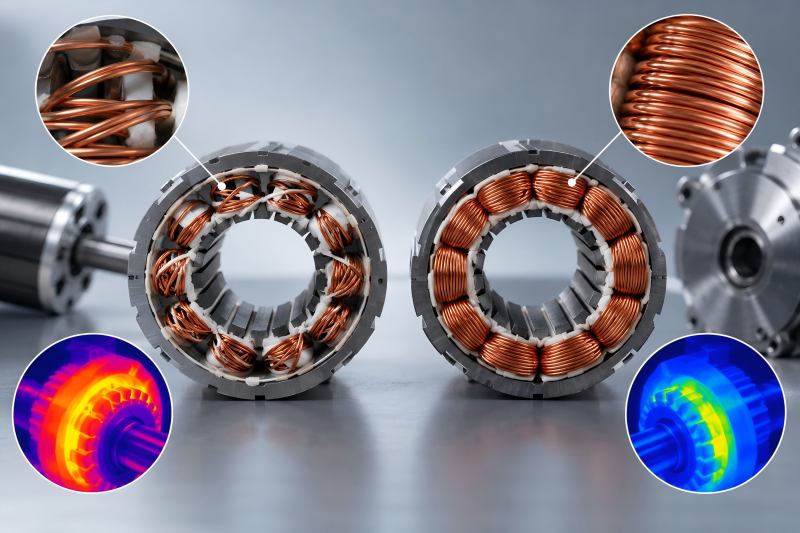
A poorly packed winding may contain irregular voids that make impregnation and heat transfer less predictable. A controlled winding structure creates more consistent contact between conductors and can support a more stable thermal path after impregnation.
This is why winding quality should be evaluated as both an electrical and a thermal issue.
High Fill Factor Does Not Automatically Mean a Better Motor
It is tempting to treat copper fill factor as a number that should simply be maximized.
In production, this approach can create problems.
If too much wire is forced into a stator slot, excessive mechanical pressure may damage the enamel coating. Conductors can cross, scrape against slot edges, become sharply bent, or place excessive pressure on insulation materials.
The result may be a motor with impressive copper density but poor manufacturing reliability.
Possible problems include:
| Excessive Packing Problem | Possible Result |
| Damaged wire enamel | Turn-to-turn short circuit risk |
| Excessive wire crossing | Irregular winding geometry |
| Insulation compression | Reduced dielectric reliability |
| Difficult insertion | Higher manufacturing defect rate |
| Poor impregnation access | Voids and inconsistent heat transfer |
| Large end winding | Extra resistance and wasted copper |
A good BLDC motor winding therefore requires an engineering compromise between copper density and manufacturability.
The goal is not simply to maximize copper fill factor. It should be the highest practical fill factor that can be produced repeatedly without compromising insulation or process stability.
Winding Quality Matters as Much as Copper Quantity
Two stators can contain similar amounts of copper and still perform differently.
The difference comes from how the wire is placed.
Good winding control keeps conductors organized, limits unnecessary crossing, controls tension, and maintains consistent coil geometry from one stator to another.
Poor winding control creates random gaps and uneven conductor distribution.
Wire tension is particularly important.
If tension is too low, conductors may not settle tightly into position. The winding becomes loose and occupies more space than necessary.
Excessive tension may stretch the wire or damage its insulation coating.
The best process maintains enough tension to create a compact winding without mechanically stressing the conductor.
This becomes increasingly difficult as slot openings become narrower and motor designs become more compact.
End Winding Is Often Overlooked
Not all copper contributes equally to motor performance.
The copper inside the active stator stack contributes directly to the electromagnetic operation of the motor. Copper extending beyond the ends of the stator forms the end winding.
End winding is necessary to connect the coils, but excessive end-turn length adds resistance without providing the same useful electromagnetic contribution as copper inside the active stack.
This means a motor can contain plenty of copper and still waste some of it through inefficient winding geometry.
A well-designed winding therefore tries to keep end turns compact while maintaining sufficient clearance and insulation reliability.
This is especially important in short-stack motors. When the stator stack is relatively short, excessive end winding can represent a significant portion of the total conductor length.
For compact BLDC motors, improving end-winding geometry can sometimes be just as important as increasing slot copper utilization.
Slot Geometry Changes What Is Possible
Copper fill factor cannot be separated from stator design.
Slot width, depth, opening size, tooth geometry, insulation thickness, wire diameter, and winding method all influence how much copper can realistically be placed into the stator.
A wide-open slot may be relatively easy to wind but can introduce electromagnetic design trade-offs. A narrow slot opening may benefit certain magnetic characteristics while making wire insertion much more difficult.
The motor designer and manufacturing engineer therefore need to work together.
Designing a slot purely from an electromagnetic perspective and expecting production to solve the winding problem later can result in unstable manufacturing.
A slightly less aggressive slot design that can be wound consistently may ultimately produce better motors than a theoretically optimized geometry that is difficult to manufacture.
Wire Diameter Also Changes the Result
Wire selection is another important factor.
Using thicker wire may reduce resistance, but fewer turns may fit into the slot. Using thinner wire can make winding easier in some geometries, but insulation occupies a larger proportion of the available area and the process may become more complicated.
Some designs use multiple parallel conductors rather than one large conductor.
This can improve winding flexibility and make certain slot geometries easier to fill, although it also increases process complexity. Wire routing and termination must remain controlled.
The correct wire configuration depends on the motor voltage, current, speed, winding topology, slot geometry, and production method.
There is no universal wire diameter that produces the best copper fill factor.
Winding Method Makes a Difference
Manufacturing technology places practical limits on copper utilization.
Different BLDC motor structures may use needle winding, flyer winding, concentrated winding, distributed winding, preformed coils, or other winding approaches.
Each process has different strengths.
For high-volume manufacturing, repeatability is often more valuable than achieving an extreme fill factor on a prototype.
A prototype technician may manually produce a very dense winding. If the same result cannot be reproduced reliably across thousands of stators, however, it is not a strong production solution.
A practical winding process should deliver:
| Manufacturing Target | Why It Matters |
| Stable wire tension | Consistent conductor placement |
| Controlled wire path | Fewer crossings and gaps |
| Repeatable coil shape | Consistent electrical performance |
| Protected slot edges | Reduced enamel damage |
| Compact end turns | Lower unnecessary resistance |
| Consistent impregnation | Better thermal and mechanical stability |
This is where motor manufacturing quality becomes visible in performance data.
Why Fill Factor Influences Torque Density
BLDC motor designers are constantly working within limited physical space.
Customers often want more torque from a smaller and lighter motor.
Increasing motor diameter or stack length is one way to gain performance, but it also increases size, material consumption, and weight. Better utilization of the existing stator slots offers another path.
When winding resistance is reduced and thermal performance is improved, the motor may be able to sustain higher current within an acceptable temperature range.
That can increase continuous torque capability without dramatically increasing motor size.
However, this should not be confused with simply forcing more current through the winding.
The entire thermal system must support the increased load, including stator laminations, housing, bearings, magnets, insulation, and cooling conditions.
Copper fill factor contributes to torque density, but it works as part of the complete motor design.

Copper Fill Factor and Continuous vs Peak Performance
Copper utilization becomes particularly important when evaluating continuous motor performance.
Many BLDC motors can produce impressive peak torque for a short period. The more difficult engineering problem is maintaining torque without allowing winding temperature to rise beyond acceptable limits.
For applications such as pumps, fans, robotics, industrial automation, conveyors, AGVs, and drive systems, continuous performance is often more important than a short peak rating.
A winding with lower resistance generates less heat at the same operating condition, providing more thermal margin for continuous operation.
Motor performance cannot be judged by rated power or peak torque alone. Winding resistance, temperature rise, duty cycle, cooling conditions, and continuous torque provide a much better picture of how the motor will behave in an actual machine.
Consistency Matters in Mass Production
The real test of winding quality is not whether one sample performs well.
It is whether hundreds or thousands of motors behave consistently.
If winding placement varies significantly between stators, resistance can vary. End-turn length may change. Impregnation quality may become inconsistent. Some motors may run hotter than others even though they carry the same model number.
This creates problems for both the motor manufacturer and the equipment builder.
A strong production process therefore controls winding parameters and checks electrical characteristics after winding.
Typical quality control may include winding resistance measurement, phase-to-phase resistance comparison, insulation testing, visual inspection, and final motor performance testing.
For demanding applications, temperature-rise testing under representative loads is also important.
Copper Fill Factor Should Be Evaluated as Part of the Whole Motor
Copper fill factor is useful, but it should never be treated as an isolated quality indicator.
A motor with excellent copper packing can still perform poorly if it has excessive iron losses, weak thermal contact, inappropriate magnets, poor bearings, badly selected laminations, or inefficient control.
Likewise, a motor with a slightly lower fill factor may perform extremely well if the entire electromagnetic and thermal system has been carefully optimized.
When evaluating a BLDC motor, it is more useful to look at the relationship between several factors:
Slot design → winding method → copper utilization → winding resistance → heat generation → heat dissipation → continuous torque capability
This chain is much closer to what actually determines motor performance.
For BLDC motor manufacturers, winding quality should be treated as part of the motor design rather than simply a production step. For buyers, it is a useful indicator of how seriously a supplier manages efficiency, thermal performance, and manufacturing consistency.
In a compact motor, every millimeter of stator slot space matters. The way that space is filled can ultimately determine how much useful performance the motor delivers—and how much of the input energy ends up as unwanted heat.