
A backdrivable BLDC actuator has a different design priority from a conventional geared motor.
In a typical drive system, the gearbox is mainly used to multiply torque and reduce speed. A higher gear ratio often appears attractive because it allows a smaller motor to produce more output torque. But once the actuator must also be easily driven from the output side, that logic changes.
For a backdrivable actuator, the gearbox is not simply a torque multiplier. It directly affects how much resistance the user or external load feels, how quickly the actuator responds, how well impact loads travel through the drivetrain, and how naturally the system interacts with its environment.
This is why choosing the gear ratio should start with the required actuator behavior rather than with the highest possible output torque.
What Backdrivability Actually Means
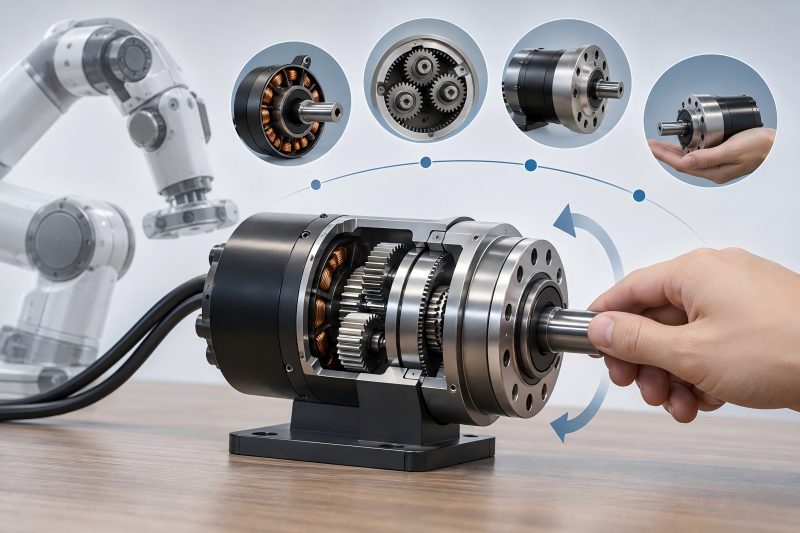
An actuator is backdrivable when an external force applied to its output can rotate the gearbox and motor backward without excessive resistance.
This matters in collaborative robots, exoskeletons, rehabilitation equipment, robotic joints, haptic systems, legged robots, and other mechanisms that physically interact with people or unpredictable environments.
Consider a robotic arm joint. When power is removed, a highly backdrivable joint can often be moved by hand with relatively little effort. A heavily geared joint may resist movement or feel almost locked.
The difference is not determined by motor torque alone. Gear ratio, gearbox efficiency, seal friction, bearing preload, lubricant behavior, motor cogging torque, and drivetrain construction all contribute to the resistance felt at the output.
Gear ratio, however, is one of the most influential design choices because increasing it tends to amplify several internal resistance effects at the actuator output.
Higher Gear Ratios Come With Trade-Offs
Suppose the BLDC motor does not provide enough torque directly. Adding a gearbox is the obvious solution.
Increasing the reduction ratio provides more output torque for the same motor torque. It can also allow the motor to operate at a higher speed, where many BLDC motors perform efficiently.
For conventional positioning equipment, that may be desirable.
For a backdrivable actuator, there is a cost.
As the reduction ratio rises, friction inside the motor and gearbox becomes increasingly noticeable from the output side. Motor cogging, bearing drag, seal friction, gear contact losses, and lubricant resistance all become part of the user’s experience.
A joint that feels smooth at a modest reduction ratio may become noticeably resistant when the ratio is increased.
The goal, therefore, is usually not to find the highest ratio the application can tolerate. It is to find the lowest practical ratio that still provides enough torque and acceptable motor operating conditions.
That distinction is important.
Start With the Required Output Behavior
Before choosing a gearbox ratio, define what the actuator must actually do at its output.
Useful starting parameters include:
| Requirement | Why It Matters |
| Continuous output torque | Determines normal operating load |
| Peak output torque | Covers acceleration, impacts and temporary overloads |
| Maximum output speed | Prevents excessive reduction |
| Typical operating speed | Helps place the motor in a useful operating range |
| Required backdrive force | Defines how easily the joint should move externally |
| Duty cycle | Affects motor and gearbox thermal loading |
| Positioning accuracy | Influences gearbox and backlash requirements |
| Interaction requirement | Determines how important low resistance is |
Continuous torque and peak torque should be treated separately.
A robotic joint might require relatively modest torque during normal movement but much higher torque for short acceleration events. Designing the entire gearbox around peak torque can lead to unnecessary reduction and poor backdrivability.
In many applications, it is better to allow the BLDC motor to handle short-duration current peaks rather than increasing the gearbox ratio solely to satisfy occasional peak loads.
Match the Ratio to the BLDC Motor
Once the output requirements are known, look at the motor.
A common mistake is choosing the gearbox first and then searching for a motor that works with it. For backdrivable systems, the motor and gearbox should be selected together.
A larger-diameter BLDC motor capable of producing more torque directly can often operate with a lower gear ratio. The actuator may become slightly larger or heavier, but the resulting joint can feel significantly more transparent.
This tradeoff is especially important in robotics.
For example, consider two possible designs:
| Design | Motor | Gear Ratio | Likely Behavior |
| A | Smaller, high-speed BLDC | High | Compact motor, higher reflected resistance |
| B | Larger, higher-torque BLDC | Low | Larger motor, better backdrivability |
| C | Torque-dense BLDC | Moderate | Balanced torque, size and backdrivability |
There is no universally correct choice.
If size and mass dominate the design, a higher-speed motor with more reduction may be reasonable. If physical interaction and force transparency matter more, a larger motor with less reduction is often the better engineering direction.
Low Gear Ratios Favor Backdrivability
For actuators designed specifically around backdrivability, relatively low reduction ratios are generally preferable.
As a practical starting point, designers may investigate ranges such as:
| Reduction Range | General Character |
| 1:1–5:1 | Very direct, highly backdrivable |
| 5:1–10:1 | Strong backdrivability with useful torque multiplication |
| 10:1–20:1 | Practical compromise for many robotic joints |
| 20:1–30:1 | Backdrivability increasingly dependent on gearbox quality |
| Above 30:1 | Requires careful evaluation if easy backdriving is important |
These are not hard limits.
A high-quality low-friction gearbox at 20:1 may backdrive more easily than a poorly designed gearbox at 10:1. Gear geometry, bearings, lubrication, seals, preload and manufacturing quality all matter.
Still, the general trend remains useful: lower reduction usually makes natural backdriving easier to achieve.
Gearbox Type Matters as Much as the Ratio
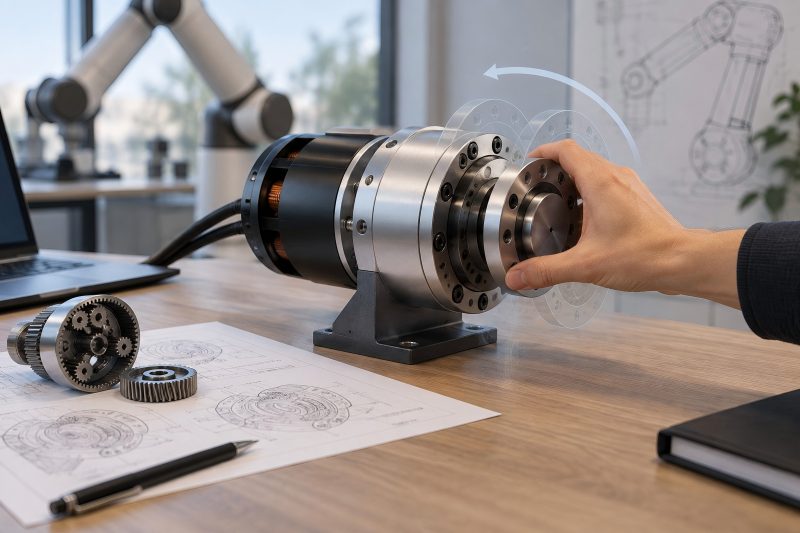
Two actuators with the same BLDC motor and the same nominal reduction ratio can behave very differently depending on gearbox architecture.
Planetary gearboxes are commonly used because they provide good torque density in a compact package. Low-ratio planetary stages can also offer reasonable backdrivability when designed with low friction.
Cycloidal systems can provide excellent torque capacity and stiffness, but their internal contact behavior and preload need careful consideration when low backdrive resistance is required.
Strain-wave gearboxes offer high ratios, compact dimensions and low backlash, making them popular in robotics. They may be less suitable when extremely low mechanical resistance is required.
For highly transparent actuators, simple single-stage or low-stage-count transmissions are attractive because every additional gear mesh, bearing and seal introduces another source of loss.
The gearbox should therefore be evaluated as a mechanical system rather than selected from ratio alone.
Do Not Ignore Gearbox Efficiency
Efficiency becomes particularly important when the actuator must transmit power in both directions.
A gearbox may perform well when the motor drives the load but feel considerably different when the load drives the motor.
For a backdrivable BLDC actuator, engineers should therefore pay attention to bidirectional mechanical behavior.
This is especially important at low speed.
Published efficiency values often describe favorable operating conditions. A robotic joint, however, may spend significant time moving slowly, reversing direction, holding position or making very small corrections.
Those conditions expose friction that may not be obvious from a headline efficiency figure.
When possible, evaluate the gearbox at the speeds and loads expected in the real application.
Consider the Motor’s Cogging Torque
The BLDC motor itself can limit backdrivability.
Permanent magnets interacting with the stator slots create cogging torque even when the motor is not actively producing commanded torque. Rotating the shaft by hand may therefore produce a noticeable series of torque pulses.
With a low-ratio transmission, this effect may remain small at the output.
As the reduction ratio increases, the user may begin to feel the motor’s internal torque ripple more clearly through the joint.
Motor construction consequently matters.
For applications requiring very smooth passive motion, a motor designed for low cogging and smooth torque production can be worth more than simply optimizing the gearbox.
This is one reason frameless BLDC motors and large-diameter torque motors are frequently attractive for advanced robotic actuators.
Think About Reflected Inertia
Backdrivability is not only about friction.
The external load also has to accelerate the motor rotor and internal transmission components when driving the actuator backward.
With greater reduction, motor-side inertia becomes increasingly significant at the output.
The practical result is that an actuator may not feel particularly sticky when moved slowly, yet still feel heavy or resistant during rapid external motion.
That distinction matters for dynamic systems.
A rehabilitation joint moved slowly by a patient has different requirements from a quadruped robot experiencing rapid foot impacts. Both may need backdrivability, but their inertia requirements are not identical.
Lower gear ratios can significantly reduce reflected inertia and improve actuator responsiveness.
Check Motor Speed at the Other Extreme
Choosing a very low gear ratio can create another problem: motor speed.
If the actuator needs high output speed, the motor must rotate fast enough to provide it through the selected reduction.
This is normally manageable with BLDC motors, which often operate efficiently at relatively high rotational speeds. However, there are still limits imposed by rotor construction, bearings, winding design, voltage, controller capability and thermal performance.
The ratio therefore has to satisfy both sides of the operating envelope:
Low enough for good backdrivability, but high enough to keep motor torque and speed within practical limits.
This is where the best ratio usually emerges.
Thermal Performance Can Set the Minimum Ratio
It is possible to choose a gear ratio that looks excellent mechanically but creates a thermal problem.
A very low ratio requires the motor to produce more torque directly. Higher motor torque generally requires more current, which increases winding losses and heat generation.
A motor might comfortably produce the required peak torque for a few seconds but overheat if asked to maintain a similar load continuously.
This means continuous torque is often more important than peak torque when determining how low the gear ratio can realistically go.
If the actuator repeatedly overheats during normal operation, increasing the ratio slightly may be more sensible than dramatically increasing motor size or cooling complexity.
Backdrivability and Holding Torque Are Different Goals
Some applications need the actuator to remain in position without consuming much power.
That requirement conflicts with easy backdrivability.
A low-ratio backdrivable actuator usually requires active motor torque to resist external loads. Once power is removed, the joint may move.
A high-ratio or self-locking transmission behaves differently. It can resist external movement mechanically, but that same characteristic makes it unsuitable for applications requiring natural passive motion.
Designers should decide early whether the actuator should be:
- Easy to move when unpowered
- Stiff only under active control
- Mechanically resistant to external motion
- Capable of safely holding a load without electrical power
Trying to obtain all four characteristics from the gearbox alone usually leads to compromises.
If load holding is essential but backdrivability is also required during operation, a separate brake may be a better solution than using excessive gear reduction.
Do Not Choose the Ratio From Rated Torque Alone
Gearbox catalogs encourage designers to focus on rated output torque. That figure matters, but it does not fully reflect actuator performance.
For a backdrivable BLDC actuator, the better evaluation includes:
| Factor | What to Check |
| Output torque | Continuous and peak requirements |
| Output speed | Maximum and normal operation |
| Backdrive torque | Resistance when externally driven |
| Efficiency | Especially at low speed |
| Reflected inertia | Dynamic response to external motion |
| Backlash | Positioning and control behavior |
| Torsional stiffness | Response under changing load |
| Thermal behavior | Motor and gearbox temperatures |
| Noise | Gear mesh and motor behavior |
| Durability | Life under repeated bidirectional loads |
A gearbox that provides impressive rated torque but creates excessive drag is not a good gearbox for a backdrivable actuator.
A Practical Selection Approach
In practice, I would begin with the lowest reduction ratio that appears capable of meeting continuous output torque.
Then check whether the BLDC motor can handle peak torque without exceeding reasonable current and thermal limits. After that, verify maximum speed and motor operating speed.
Only then should the gearbox itself be evaluated for efficiency, backlash, stiffness and reverse-driving resistance.
If several ratios remain possible, prototype the most promising options.
For example, if 8:1, 12:1 and 16:1 all appear technically feasible, testing those three configurations can reveal much more than selecting 16:1 simply because it provides the largest torque margin.
Measure or observe:
- Hand backdrive resistance
- Low-speed smoothness
- Starting resistance
- Direction reversal
- Motor temperature
- Gearbox temperature
- Peak current
- Torque response
- Impact behavior
- Position-control stability
For a backdrivable actuator, how the mechanism feels when externally driven is a real engineering parameter, not a subjective afterthought.