
Direct-drive cutting motors provide a simple, quiet, and efficient solution for many modern mower robots. They are especially well matched to lightweight pivoting blades and residential machines where battery runtime, low noise, and limited maintenance are important.
Geared cutting motors offer stronger blade torque, more layout flexibility, and better support for large or heavy cutting mechanisms. Their advantages are most valuable when torque demand cannot be met efficiently by a compact direct-drive motor.
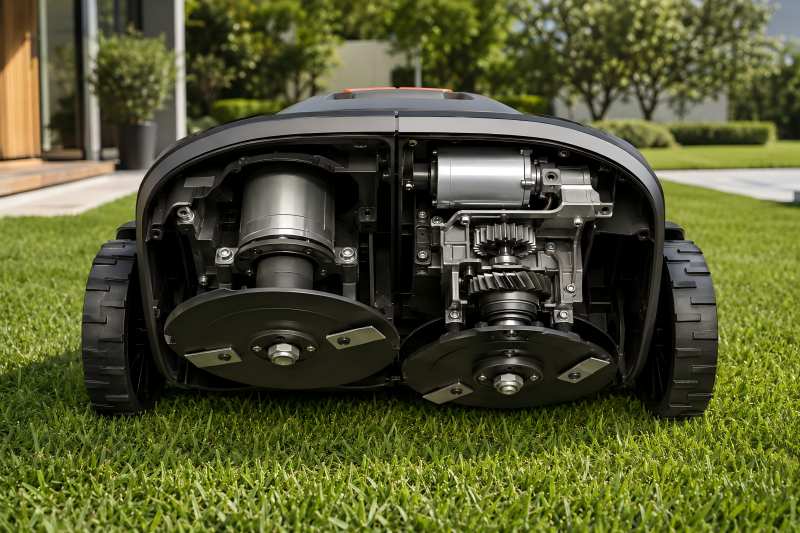
Basic Difference Between the Two Systems
In a direct-drive design, the blade speed is almost equal to the motor speed. If the cutting disc needs to rotate at 3,000 rpm, the motor must also operate near 3,000 rpm.
A gearbox transfers motor power to the blade. For example, a motor running at 6,000 rpm with a 2:1 reduction ratio drives the blade at approximately 3,000 rpm while increasing the output torque.
| Design Factor | Direct-Drive Motor | Geared Cutting Motor |
| Power transmission | Motor shaft directly drives blade | Gearbox transfers power to blade |
| Motor operating speed | Similar to blade speed | Usually higher than blade speed |
| Output torque | Determined mainly by motor size | Increased through gear reduction |
| Mechanical complexity | Low | Moderate to high |
| Noise sources | Motor, bearings, blade airflow | Motor, bearings, gears, blade airflow |
| Maintenance demand | Generally lower | Gearbox may require additional attention |
| Packaging flexibility | Motor aligned with blade axis | Motor position can be adjusted |
| Best suited for | Compact, quiet, efficient designs | High-torque or constrained layouts |
The gearbox changes the relationship between motor speed and blade torque, but it does not create additional power. It converts higher speed and lower torque into lower speed and higher torque while introducing some transmission loss.
Direct-Drive Motors Provide a Simpler Power Path
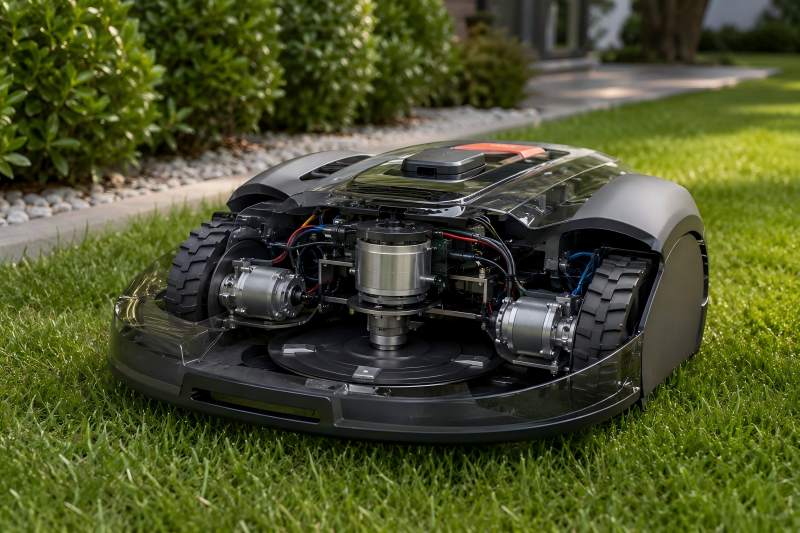
A direct-drive cutting motor eliminates intermediate gears, belts, and additional shafts. The blade carrier is mounted directly to the motor shaft or connected through a simple hub.
This short transmission path reduces the number of components that can wear, loosen, or create mechanical noise. It also improves responsiveness because the motor’s torque reaches the cutting disc without passing through gear teeth.
The main components usually include:
- Brushless DC motor
- Motor shaft
- Shaft bearings
- Blade disc or blade hub
- Sealing components
- Motor controller
- Protective housing
This arrangement is particularly suitable for robotic mowers using lightweight pivoting blades. These blades require relatively high rotational speed but usually do not need the same torque as a large rigid steel blade.
However, direct drive places the entire cutting load on the motor shaft and bearings. Impacts from stones, roots, branches, and uneven ground can be transferred directly into the motor structure. Shaft diameter, bearing spacing, blade-disc balance, and impact protection therefore require careful design.
Geared Motors Increase Torque at the Blade
A gearbox lets the motor spin faster while reducing the blade’s rotational speed. The reduction process increases the torque available at the gearbox output.
The simplified relationship can be expressed as:
Output torque ≈ Motor torque × Gear ratio × Gearbox efficiency
Suppose a motor produces 0.35 N·m of torque at 6,000 rpm. With a 2.5:1 reduction ratio and an estimated gearbox efficiency of 85%, the theoretical output torque is:
0.35 × 2.5 × 0.85 = 0.74 N·m
The blade speed would be approximately:
6,000 ÷ 2.5 = 2,400 rpm
This configuration can help a mower cut through denser vegetation without requiring a physically larger motor. It may also allow the motor to be positioned beside the cutting axis rather than directly above it.
The disadvantage is that every additional transmission component introduces friction, backlash, noise, assembly tolerance, and potential wear. Gearbox performance must therefore be evaluated over the complete service life rather than only during initial testing.
Torque Requirements Depend on the Cutting Mechanism
The choice between direct drive and geared drive should begin with the cutting system rather than the motor catalog. A small disc carrying three pivoting razor blades behaves differently from a large rigid blade or a multi-disc cutting deck.
Lightweight pivoting blades rely heavily on blade-tip speed. When they contact grass, they swing outward under centrifugal force and cut with relatively low resistance. A direct-drive motor is often sufficient because continuous torque demand remains moderate.
Rigid blades have greater mass and may cut thicker material in a single pass. They can create higher startup inertia and stronger torque fluctuations when grass becomes dense. A geared motor may provide more stable cutting speed under these conditions.
| Cutting System | Typical Blade Speed Range | Estimated Continuous Torque Need | Suitable Motor Direction |
| Small pivoting-blade disc | 2,500–3,500 rpm | 0.15–0.45 N·m | Usually direct drive |
| Medium cutting disc | 2,000–3,000 rpm | 0.30–0.80 N·m | Either design |
| Large rigid blade | 1,500–2,800 rpm | 0.60–1.50 N·m | Often geared |
| Multi-disc cutting deck | 2,000–3,500 rpm per disc | Depends on disc quantity | Multiple direct drives or centralized geared system |
| Brush or vegetation cutter | 1,000–2,500 rpm | 1.00 N·m or higher | Geared system often preferred |
These values are design examples rather than fixed industry limits. Actual torque depends on cutting width, blade shape, grass condition, mowing height, forward speed, and blade sharpness.
Direct Drive Usually Improves Energy Efficiency
Battery capacity directly affects mower weight, operating time, and charging frequency. Cutting-system efficiency is therefore a major design consideration.
A direct-drive motor avoids gear-meshing loss. Energy moves from the electrical windings through the rotor and shaft to the blade with relatively few mechanical interfaces. When the motor is correctly matched to the required speed and torque, system efficiency can be high.
A gearbox introduces sliding and rolling contact between gears, bearings, shafts, and lubricant. A compact gearbox may operate efficiently, but even a small percentage of loss becomes meaningful during several hours of daily mowing.
Consider a cutting system requiring 80 W of mechanical blade power.
| Item | Direct-Drive Example | Geared Example |
| Required blade power | 80 W | 80 W |
| Mechanical transmission efficiency | 97% | 85% |
| Motor efficiency | 86% | 88% |
| Estimated electrical input | 96 W | 107 W |
| Energy used in three hours | 288 Wh | 321 Wh |
The geared motor in this example uses approximately 33 Wh more energy over three hours. That difference could require a larger battery or reduce mowing coverage per charge.
The result does not mean direct drive is always more efficient in practice. An undersized direct-drive motor operating near overload may consume more power than a geared motor operating near its efficient speed range. The complete operating map matters more than the motor’s peak efficiency figure.
Geared Systems Offer More Packaging Flexibility
Robotic mower housings are becoming lower and more compact. Designers must fit the battery, wheel motors, cutting assembly, sensors, control board, charging contacts, and sealing structure into a limited space.
A direct-drive motor normally sits on the cutting axis. Its height affects ground clearance and the space available above the blade deck. A short axial motor may solve this issue, but custom low-profile motors can increase development cost.
A geared system allows the motor to be offset from the blade axis. Spur gears, bevel gears, planetary gears, or belt reductions can redirect power within the chassis.
This flexibility can support:
- Lower mower body height
- Adjustable cutting-deck placement
- Larger blade bearings
- Improved motor protection
- Better separation from moisture and debris
- Shared drive for multiple cutting discs
Packaging freedom is valuable, but it should not be gained by creating an overly complicated transmission. A layout that saves 20 mm of height but adds several gears, shafts, and seals may create more production and reliability problems than it solves.
Noise Is Not Determined by the Motor Alone
Robotic lawnmowers often operate for long periods near homes, offices, schools, or public areas. Noise quality can therefore be as important as total sound level.
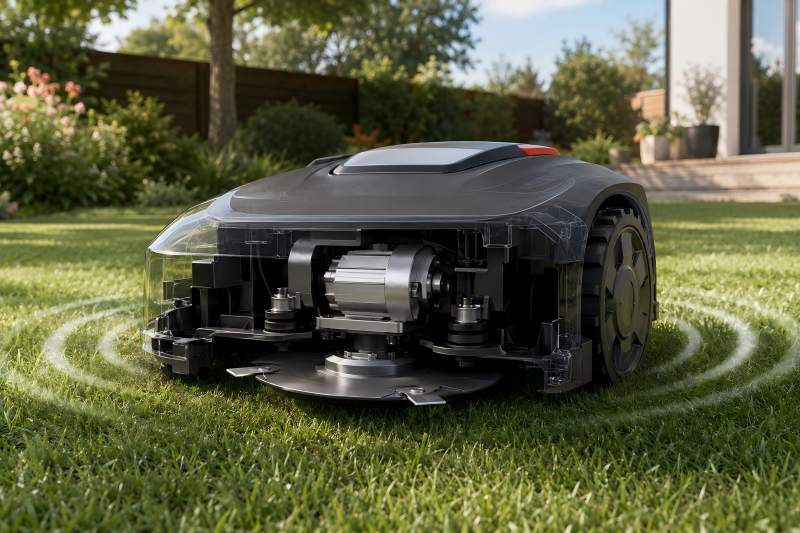
Direct-drive systems generally have fewer mechanical noise sources. They avoid gear-meshing frequencies and gearbox resonance. The main remaining sources are electromagnetic motor noise, bearing noise, blade impact, blade imbalance, and airflow around the cutting disc.
Geared systems can produce tonal noise that changes with motor speed and gear-tooth count. Small dimensional errors, insufficient lubrication, tooth wear, or housing resonance may make the sound more noticeable even when the measured sound pressure is not extremely high.
A low-noise geared system is still possible. It requires suitable gear geometry, accurate shaft alignment, controlled backlash, stable lubrication, and a housing that does not amplify vibration.
For residential mower robots, direct drive often provides an easier path to acceptable noise. For heavy-duty machines, the additional noise of a gearbox may be acceptable when stronger torque is required.
Impact Loads Affect Reliability
Cutting blades may strike stones, buried objects, roots, sprinkler heads, or thick branches. These impacts create sudden torque peaks far above the normal cutting load.
In a direct-drive system, the shock can pass directly into the shaft, rotor, bearings, and motor mounting structure. A bent shaft or damaged bearing may cause blade imbalance and vibration.
A geared system can isolate the motor from some blade loads, but the gearbox becomes part of the impact path. Gear teeth, output shafts, keys, and couplings must withstand repeated shock loads. A single severe collision may chip a tooth or permanently increase backlash.
Protection methods include:
- Pivoting blades that fold during impact
- Slip clutches
- Flexible couplings
- Torque-limiting control software
- Rapid current detection
- Replaceable blade hubs
- Reinforced output bearings
- Controlled blade acceleration
Motor-current monitoring is especially useful. A sudden current rise can indicate a blade blockage or collision. The controller can stop or reverse the motor before prolonged stall current overheats the windings.
Thermal Behavior Changes Under Heavy Grass
Grass resistance is not constant. Wet grass, tall weeds, accumulated clippings, and low cutting height can substantially increase motor load.
Direct-drive motors must produce the required blade torque without the help of mechanical reduction. A compact motor may experience higher winding current and temperature when the blade slows repeatedly.
A geared motor can maintain stronger output torque with a smaller high-speed motor, but gearbox friction also generates heat. Lubricant viscosity may change with temperature, while sealed mower housings can limit heat dissipation.
Thermal testing should include more than operation in short, dry grass. Useful test conditions include:
- Dry, regularly maintained lawn
- Wet grass after rainfall
- Tall grass at maximum forward speed
- Repeated starts with grass around the blade
- Low cutting-height operation
- Partially blocked blade deck
- High ambient temperature
- Extended mowing on slopes
The more variable the lawn condition, the more important continuous torque and thermal margin become.
Motor Control Favors Direct Drive
Brushless direct-drive motors can be controlled precisely through electronic speed regulation. The controller can increase current when the blade encounters resistance and reduce power when cutting demand is low.
This allows the mower to use different operating modes. It may run quietly at reduced speed on light grass and increase speed when current or speed feedback indicates heavier load.
Geared motors can use the same control strategy, but gearbox inertia, backlash, and friction may reduce responsiveness. The motor controller also cannot directly measure what happens at the blade unless the transmission characteristics are well understood.
A practical cutting system may use:
- Soft-start acceleration
- Closed-loop speed control
- Stall detection
- Automatic blade reversal
- Load-based speed adjustment
- Overcurrent protection
- Temperature derating
- Emergency braking
A direct-drive system makes the relationship between motor feedback and blade behavior more predictable.
Maintenance and Service Life
Direct-drive cutting motors generally require fewer service parts. With sealed bearings and a protected shaft interface, the assembly can operate with minimal maintenance.
Geared systems may require long-life grease, stronger sealing, and more detailed inspection. Gear wear can gradually increase noise and backlash before complete failure occurs.
Potential service concerns include:
| Component | Direct Drive | Geared Drive |
| Motor bearings | Primary wear component | Motor and gearbox bearings |
| Lubrication | Usually internal bearing grease | Bearings plus gear lubricant |
| Shaft alignment | Motor-to-blade alignment | Multiple shaft alignments |
| Backlash | Minimal | Can increase with wear |
| Seal quantity | Lower | Often higher |
| Replacement complexity | Usually simpler | Gearbox may require matched parts |
For consumer mower robots, a cutting unit that can be replaced as one sealed module may be more practical than a repairable gearbox. Commercial machines may justify serviceable bearings, gears, and output shafts because they operate for more hours and face higher loads.
Cost Should Be Evaluated at System Level
A direct-drive motor may appear more expensive if it requires a larger diameter, stronger bearings, or a custom low-profile structure. A geared motor may use a smaller standard motor but adds the cost of gears, shafts, lubrication, seals, housing features, and assembly.
The lowest motor price does not always create the lowest cutting-system cost.
The complete cost calculation should consider:
- Motor price
- Gearbox and transmission parts
- Blade hub and output bearing
- Controller requirements
- Housing and sealing
- Assembly time
- Noise-control measures
- Testing and quality inspection
- Warranty risk
- Replacement procedure
For high-volume residential mowers, component reduction often provides a strong advantage. Direct drive can simplify assembly and reduce tolerance accumulation. For specialized machines with high torque requirements, a gearbox may prevent the need for a much larger motor and battery.
The final decision should be based on blade-load measurements rather than general motor ratings. A direct-drive motor that repeatedly enters overload is not an efficient solution, while a gearbox added to a light-duty cutting disc creates unnecessary complexity. The best design balances torque, blade speed, energy use, noise, impact resistance, packaging, and long-term service requirements.