
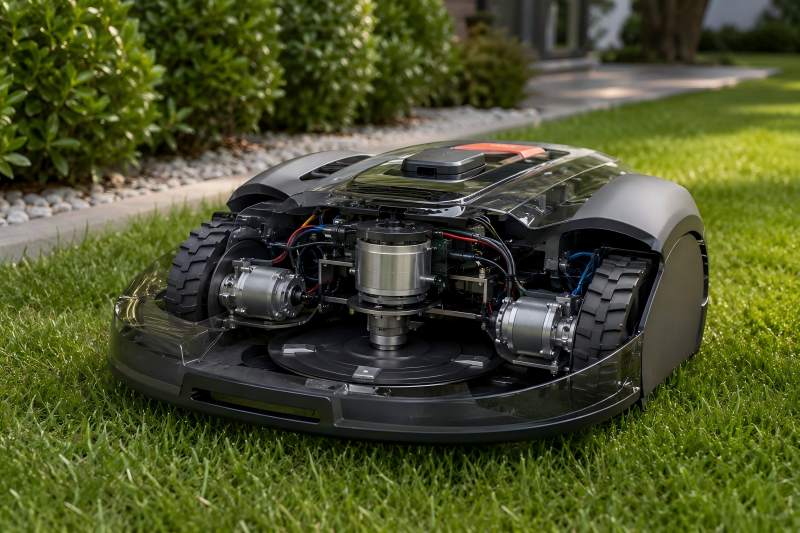
A robotic lawnmower typically needs three motors: one cutting motor and two independent wheel-drive motors. This three-motor configuration is widely used because it provides separate control of blade rotation, forward movement, reverse movement, and turning.
Typical Motor Configurations
| Robotic Lawnmower Design | Cutting Motors | Drive Motors | Auxiliary Motors | Typical Total |
| Basic compact mower | 1 | 1–2 | 0 | 2–3 |
| Standard residential mower | 1 | 2 | 0 | 3 |
| Dual-blade mower | 2 | 2 | 0 | 4 |
| All-wheel-drive mower | 1 | 4 | 0 | 5 |
| Advanced mower with powered height adjustment | 1–2 | 2–4 | 1 | 4–7 |
| Commercial multi-disc mower | 2–3 | 2–4 | 0–2 | 4–9 |
For most residential robotic lawnmowers, three motors offer the best balance between mobility, cutting performance, energy consumption, mechanical complexity, and production cost.
Why Most Robotic Lawnmowers Use Three Motors
A standard robotic mower usually contains:
- One motor for driving the cutting disc or blade
- One motor for the left wheel
- One motor for the right wheel
The two wheel motors operate independently. By changing their speed and direction, the mower can move straight, follow a curved path, reverse, or turn almost within its own body length.
For example, when both wheel motors rotate forward at the same speed, the mower moves straight. When the left wheel turns more slowly than the right wheel, the machine turns left. Opposite wheel rotation allows the mower to turn sharply within a very small area.
This setup removes the need for separate mechanical steering. A conventional steering axle would require linkages, joints, additional space, and more moving parts. Independent motor control is usually more suitable for a small autonomous machine that frequently changes direction.
The cutting motor operates separately because blade speed must remain stable even when wheel speed changes. The mower may slow down near a boundary, stop to avoid an obstacle, or turn on a slope, but the cutting disc may still need to maintain its target rotational speed.
Separating the cutting and drive systems therefore improves control accuracy and system flexibility.
The Cutting Motor
The cutting motor drives the blade, cutting disc, or blade carrier installed under the mower. Its main function is to maintain sufficient rotational speed to cut grass cleanly without excessive vibration, noise, or energy consumption.
Most robotic lawnmowers use one cutting motor. This is usually enough for small and medium-sized lawns because robotic mowers cut grass frequently rather than removing a large amount in one pass.
A traditional walk-behind mower may need to cut tall grass after several days or weeks of growth. A robotic mower often operates several times per week and removes only a small amount from the grass tips. This reduces the torque required from the cutting system.
The motor must still handle changing loads caused by:
- Thick grass
- Wet grass
- Small branches
- Grass buildup around the cutting disc
- Uneven cutting height
- Sudden contact with dense vegetation
A suitable cutting motor should not be selected only according to its no-load speed. The motor’s continuous torque, peak torque, thermal performance, shaft design, bearing support, and controller response are also important.
When Two Cutting Motors Are Used
Some robotic lawnmowers use two cutting motors instead of one. Each motor may drive a separate cutting disc.
A dual-motor cutting system can provide:
- A wider cutting path
- Better coverage under a large mower body
- More even load distribution
- Reduced blade-disc diameter
- Greater flexibility in chassis design
However, adding another cutting motor also increases power consumption, controller requirements, wiring, waterproofing points, and maintenance complexity.
Two small cutting motors are not automatically more efficient than one larger motor. The complete cutting structure must be evaluated. Blade diameter, blade quantity, disc speed, overlap area, grass density, and airflow under the chassis all affect actual performance.
A dual-disc system is most useful when the mower needs a wide cutting path without using one very large cutting disc.
The Wheel-Drive Motors
Most robotic lawnmowers use two drive motors, with one connected to each powered wheel. These motors normally work through reduction gears to provide the required wheel torque at relatively low speed.
The drive motors are responsible for:
- Forward and reverse travel
- Speed adjustment
- Direction changes
- Boundary following
- Obstacle avoidance
- Slope climbing
- Position correction
- Docking alignment
Independent wheel motors are especially important because robotic lawnmowers rarely travel in long, perfectly straight lines. They constantly adjust their path according to boundary signals, mapping data, wheel feedback, camera information, or obstacle sensors.
The motors may make hundreds of small speed corrections during one mowing cycle. Stable low-speed operation can therefore be more valuable than a high maximum speed.
A mower that moves quickly but cannot make controlled corrections may leave uncut areas, damage lawn edges, or struggle to enter its charging station.
Can a Robotic Lawnmower Use Only One Drive Motor?
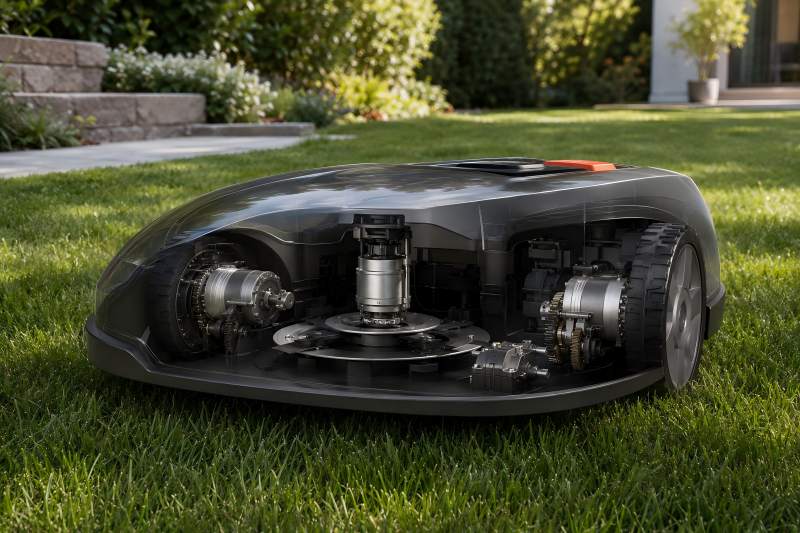
A simple mower can theoretically use one motor to drive both wheels through a shared axle or transmission. Steering could then be handled by a mechanical mechanism or another actuator.
This design may reduce the number of main traction motors, but it creates other challenges. A differential, clutch, steering linkage, or steering actuator may still be required. The total system may not be simpler after these parts are included.
A shared drive motor also makes it more difficult to control the left and right wheel speeds independently. This limits turning flexibility and makes precise navigation more difficult.
For these reasons, a single drive motor is mainly suitable for basic machines with limited steering requirements. It is less suitable for autonomous mowers that must work around trees, flower beds, narrow passages, garden furniture, and irregular boundaries.
Why Some Mowers Need Four Drive Motors
Robotic lawnmowers designed for steep or uneven terrain may use four-wheel drive. In these machines, each wheel may have its own motor, producing a total of four drive motors.
After adding one cutting motor, the mower may contain at least five motors.
Four-wheel-drive systems can improve:
- Traction on slopes
- Movement over soft ground
- Stability on uneven lawns
- Recovery from shallow holes
- Control on wet grass
- Weight distribution
- Turning performance on rough surfaces
However, motor quantity alone does not guarantee good slope capability. Tire pattern, wheel diameter, mower weight, center of gravity, ground clearance, and control software are equally important.
Four underpowered wheel motors may perform worse than two correctly sized motors with suitable tires and weight distribution.
The additional motors also consume space and require more electronic control channels. Because wheel motors must coordinate with one another, inaccurate speed matching can cause tire scrubbing, energy loss, or unstable movement.
A four-motor drive system is therefore justified when the terrain requires it, not simply because a higher motor count sounds more advanced.
Auxiliary Motors
Advanced robotic lawnmowers may include small motors or actuators for functions that are not directly related to cutting or wheel movement.
Cutting-Height Adjustment
Some models allow the cutting height to be adjusted electronically. A small geared motor or linear actuator raises or lowers the cutting assembly.
This feature allows the mower to change cutting height through an app, control panel, or automatic program. It may also support different height settings for different lawn zones.
The adjustment motor operates only for short periods, so its power requirement is normally much lower than that of the cutting or drive motors.
Steering Actuators
Most robotic mowers steer through differential wheel speeds, but larger or specialized machines may use a separate steering actuator. This can be found in designs with steerable front wheels or more conventional vehicle geometry.
Such a design may improve high-speed path control, but it introduces additional components and possible failure points.
Cleaning or Blade-Positioning Systems
Commercial or specialized robotic mowers may contain powered cleaning brushes, blade-folding mechanisms, adjustable decks, or discharge-control systems. Each powered function may add another small motor.
Add these features only when they offer clear benefits. Every additional motor increases sealing requirements, electrical connections, control logic, and service needs.
Factors That Determine the Required Motor Number
The number of motors should be decided from the mower’s operating requirements rather than copied from another machine.
Cutting Width
A wider mower may need multiple cutting discs to cover the full area beneath the chassis. This can increase the number of cutting motors.
One large disc is mechanically simple, but it may require more space and create higher rotating inertia. Multiple smaller discs can improve packaging flexibility but require more components.
Terrain
Flat residential lawns can usually be handled with two powered wheels. Steep slopes, loose soil, wet surfaces, and uneven ground may justify four-wheel drive.
Turning Method
Differential steering normally requires two independently controlled drive motors. Mechanical steering may use one traction motor plus one steering actuator, but this arrangement has different control and maintenance requirements.
Required Maneuverability
A mower operating in narrow passages needs precise wheel control. Two independent drive motors allow the machine to turn tightly and make small position corrections.
Battery Capacity
Every motor draws energy from the battery. Increasing the motor count can reduce operating time unless the battery, controller strategy, and mechanical efficiency are adjusted accordingly.
More motors do not always mean proportionally higher consumption because each motor may carry less load. Nevertheless, standby losses, controller losses, gearbox friction, and additional weight must be considered.
Reliability Target
A simpler three-motor structure may be easier to seal, manufacture, test, and maintain. A more complex mower may deliver better performance, but it also contains more connectors, bearings, gears, cables, drivers, and possible failure points.
Three Motors Are Usually the Practical Starting Point
For a general residential robotic lawnmower, the following configuration is a practical starting point:
- One brushless cutting motor
- Two independently controlled geared wheel motors
- No auxiliary motor unless a powered adjustment function is required
This structure provides enough control for normal lawns while keeping the system relatively compact.
The design can then be expanded according to actual requirements. A wider cutting deck may add a second cutting motor. A steep-slope model may add two more wheel motors. Automatic cutting-height control may add a small actuator.
Starting with the simplest configuration that satisfies the required functions usually produces a more reliable design than adding motors before the mechanical and control requirements are fully understood.