
Most modern robotic lawnmowers use brushless DC motors. A typical machine uses one high-speed BLDC motor for the cutting system and two geared motors for the drive wheels. Additional small geared motors may be used for height adjustment or auxiliary mechanisms.
The cutting motor is selected mainly for speed, stable loaded performance, efficiency, and low vibration. The wheel motors are selected mainly for torque, gearbox ratio, slope capability, and precise movement control.
BLDC motors are widely favored for their efficiency, durability, precise control, and compact design. Nevertheless, the motor type alone does not determine the mower’s performance.
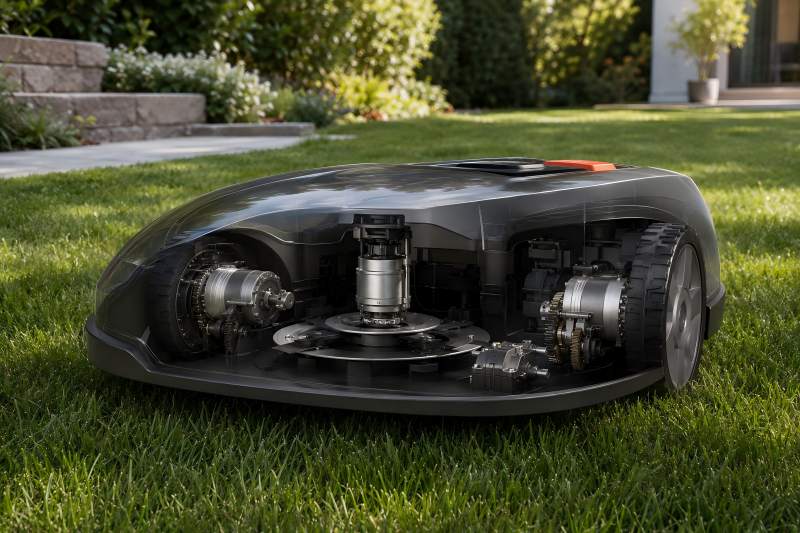
Main Motors Used in a Robotic Lawnmower
Most robotic lawnmowers contain two main motor groups:
- Cutting motors that rotate the blade disc or cutting blades
- Drive motors that power the wheels and control movement
Some machines also use smaller motors or actuators for cutting-height adjustment, steering mechanisms, cleaning systems, or movable protective covers.
| Motor Position | Main Function | Typical Motor Type | Main Requirement |
| Cutting system | Rotates blades or cutting disc | BLDC motor | High speed and stable power |
| Left drive wheel | Moves and turns the mower | Geared DC or BLDC motor | High torque and precise control |
| Right drive wheel | Moves and turns the mower | Geared DC or BLDC motor | High torque and precise control |
| Height adjustment | Raises or lowers cutting assembly | Small geared motor or actuator | Position accuracy |
| Auxiliary mechanism | Controls covers, brushes, or attachments | Small DC motor | Compact size and simple control |
The cutting and wheel motors are usually controlled independently. This allows the mower to regulate blade speed according to grass conditions while changing wheel speed according to navigation requirements.
Brushless DC Motors
Robotic lawnmowers commonly use BLDC motors with electronic rather than mechanical commutation. Electronic switching controls the motor instead.
This design provides several advantages for outdoor autonomous equipment.
- Lower mechanical wear
- Longer operating life
- Higher energy efficiency
- Reduced electrical noise
- Better speed control
- Lower maintenance requirements
- Improved power-to-weight ratio
A robotic lawnmower may operate several hours per day and repeatedly start, stop, accelerate, reverse, and turn. These operating conditions make durability and efficiency especially important.
Without brushes, the motor avoids performance loss associated with brush wear. However, a BLDC motor requires a suitable electronic controller, rotor-position detection method, and motor-control strategy. The complete drive system is therefore more complex than a basic brushed motor system.
Cutting Motors
The cutting motor drives the blade disc, rotating bar, or individual blade system. It usually operates at a considerably higher speed than the wheel motors.
Its main job is to maintain enough blade-tip speed to cut grass cleanly. Motor power requirements vary with several factors:
- Blade diameter
- Number of blades
- Blade mass
- Cutting width
- Grass density
- Grass moisture
- Cutting height
- Mower travel speed
- Blade-disc design
A light cutting disc fitted with small pivoting blades requires less starting torque than a heavy solid blade. However, it may still need a high rotational speed to achieve an acceptable cutting result.
For this reason, robotic lawnmower cutting motors are usually designed around a balance of speed, torque, efficiency, vibration, and noise.
Why BLDC Motors Suit Cutting Systems
A BLDC motor is well suited to blade operation because it can provide stable high-speed rotation in a compact package. The controller can also adjust motor speed when the blade encounters thicker grass.
For example, the mower may run the cutting motor at a moderate speed under light load to save energy. When current consumption rises because of dense grass, the controller can increase torque or adjust travel speed.
This type of responsive control can improve cutting consistency without operating the motor at maximum power continuously.
The motor should not be selected only according to its no-load speed. A motor that reaches a high speed without a blade may slow excessively when it encounters grass. Its continuous torque, peak torque, thermal capacity, and controller current limit must also be checked.
Wheel Drive Motors
Wheel motors move the robotic lawnmower across the lawn. Most designs use one motor for the left drive wheel and another for the right drive wheel.
By changing the speed and direction of these two motors independently, the mower can:
- Move forward
- Reverse
- Turn gradually
- Rotate within a small area
- Follow a boundary
- Correct its direction
- Avoid obstacles
Wheel motors generally operate at lower speeds than cutting motors but require higher torque. Gearboxes reduce motor speed while increasing output torque.
Geared DC Motors
A geared DC motor pairs an electric motor with a reduction gearbox. The motor may be brushed or brushless, but BLDC versions are increasingly preferred in machines requiring longer operating life.
The gearbox allows a compact motor to produce enough wheel torque for:
- Starting on grass
- Climbing slopes
- Crossing uneven surfaces
- Turning on soft soil
- Moving through dense vegetation
- Recovering from small obstacles
The required torque is influenced by the mower’s weight, wheel diameter, slope angle, ground resistance, and acceleration requirement.
A wheel motor selected only for flat, dry grass may struggle on wet slopes. On the other hand, an oversized motor can increase cost, weight, and power consumption without providing a meaningful benefit.
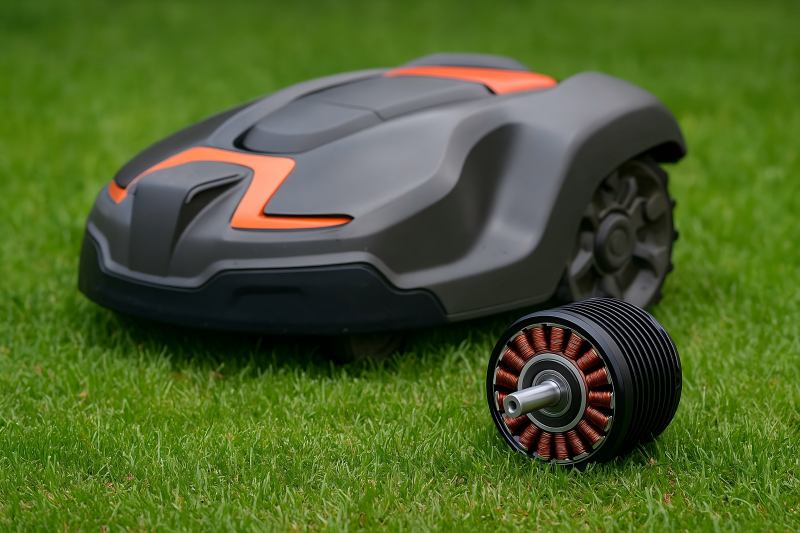
Brushed Motors vs Brushless Motors
Brushed DC motors can still be used in lower-cost robotic lawnmowers. They are simple to control and usually have a lower initial cost.
However, their brushes gradually wear during operation. Brush contact can also produce electrical noise, friction, heat, and efficiency losses.
| Feature | Brushed DC Motor | Brushless DC Motor |
| Initial cost | Generally lower | Generally higher |
| Control system | Simpler | More advanced |
| Maintenance | Brush replacement may be required | Usually low |
| Service life | Limited by brush wear | Generally longer |
| Efficiency | Moderate | Higher |
| Speed control | Acceptable | More precise |
| Electrical noise | Higher | Lower |
| Suitability for frequent operation | Moderate | Strong |
| Typical application | Entry-level machines | Mid-range and premium machines |
For a robotic lawnmower expected to operate regularly over several seasons, a BLDC motor usually provides a stronger overall solution. The higher component and controller cost can be justified by improved efficiency, reduced maintenance, and longer service life.
Brushed motors may still be practical where operating hours are limited and the product must meet a strict cost target.
Motor Voltage
Robotic lawnmower motors are powered by rechargeable battery systems. Common mower platforms may use battery voltages such as 18 V, 20 V, 24 V, or higher, depending on the product design.
A higher-voltage system can deliver the same power with lower current. Lower current may reduce cable losses, connector heating, and controller stress. However, voltage alone does not determine motor quality or mower performance.
The motor winding, controller, battery, gearbox, and protection system must be designed as one platform.
For example, installing a 24 V motor in a machine originally designed around a lower-voltage battery does not automatically improve torque. The controller may not support the voltage, and the motor winding may not match the intended speed.
Motor selection should therefore begin with the complete electrical architecture rather than an isolated voltage figure.
Torque, Speed, and Power Requirements
Torque and speed play different roles in a robotic lawnmower.
The cutting motor generally requires higher speed because the blades must move quickly enough to cut grass. The wheel motors require lower speed but higher output torque because they must move the entire machine.
Motor power can be understood as the relationship between torque and rotational speed. A high-speed motor with very low torque may not maintain blade speed under load. A high-torque wheel motor with the wrong gear ratio may move the mower too slowly.
The design process should consider:
- Continuous operating torque
- Short-duration peak torque
- No-load speed
- Loaded speed
- Gear reduction ratio
- Starting current
- Stall current
- Controller current limit
- Continuous power
- Thermal rise
Peak torque is especially important during startup, slope climbing, turning, and blade impact. Continuous torque is more important when evaluating temperature rise and long-term reliability.
Motor Control and Feedback
Robotic lawnmowers require more precise motor control than ordinary push mowers. The control system must coordinate movement with sensors, navigation software, boundary detection, and obstacle avoidance.
Wheel motors may use Hall sensors or encoders to measure rotational speed and position. This feedback helps the mower estimate travel distance and maintain a controlled path.
The controller can compare the commanded wheel speed with the actual wheel speed. A difference may indicate:
- Wheel slip
- A blocked wheel
- Uneven terrain
- Excessive grass resistance
- A mechanical fault
Cutting motors can also be monitored through current, speed, or temperature signals. A sudden current increase may indicate tangled grass, a damaged blade, or a blocked cutting disc.
Feedback does not only improve performance. It also supports fault detection and motor protection.
Motor Efficiency and Battery Runtime
Motor efficiency has a direct effect on battery runtime. Energy lost inside the motor becomes heat instead of useful mechanical output.
However, selecting the most efficient motor at one operating point is not enough. A robotic lawnmower operates under changing conditions. Wheel loads change with terrain, while cutting loads change with grass height and density.
The most suitable motor should operate efficiently across the mower’s typical working range.
A well-designed system may improve runtime through:
- Efficient BLDC motors
- Suitable gear ratios
- Lightweight cutting components
- Low-resistance bearings
- Adaptive blade-speed control
- Smooth acceleration
- Reduced unnecessary turning
- Proper wheel sizing
Motor efficiency should therefore be considered together with mechanical design and control software.
Noise and Vibration
Residential robotic lawnmowers often operate close to homes, gardens, offices, or public spaces. Low noise is therefore an important design target.
Motor noise may come from electromagnetic forces, bearings, gearbox contact, structural resonance, or controller switching. In many cases, the blade system and grass impact produce more noise than the motor itself.
A quiet motor can still create noticeable sound if it is mounted to a flexible housing that amplifies vibration.
Noise reduction may require:
- Balanced rotors
- Accurate blade discs
- Low-vibration bearings
- Optimized magnetic design
- Suitable controller switching
- Rigid motor mounts
- Vibration-isolating components
- Well-designed gear teeth
The motor and mower structure should be evaluated as a complete vibration system.
Outdoor Protection Requirements
Robotic lawnmower motors operate in an environment containing moisture, dust, grass particles, fertilizer residue, and temperature changes. The motor must therefore be protected against contamination and corrosion.
Important design considerations include:
- Sealed bearings
- Protected cable exits
- Corrosion-resistant shafts
- Coated electrical components
- Reliable connectors
- Moisture-resistant insulation
- Drainage around the motor housing
- Controlled ventilation where required
A fully sealed motor may appear ideal, but sealing also affects heat dissipation. If heat cannot escape, the winding temperature may rise during heavy cutting or slope operation.
The correct solution is not simply to maximize sealing. The motor must achieve a practical balance between environmental protection and thermal control.
Wheel motors should be evaluated using the most difficult expected starting and climbing conditions. Cutting motors should be tested with the actual blade assembly and realistic grass loads.
Testing only the motor on a laboratory bench may hide problems caused by the gearbox, housing, blade imbalance, wheel slip, or restricted airflow.