
A harmonic drive is a high-precision reducer based on strain wave gearing. It uses a wave generator, flex spline, and circular spline to achieve high reduction ratio, compact size, and low backlash. It is suitable for engineers who need a flexible transmission component for custom motion systems.
A harmonic gear motor is a complete drive unit that combines a motor with a harmonic reducer. It may also include an encoder, brake, bearings, housing, and even integrated drive electronics. It is suitable for applications that need compact structure, easier installation, high torque, and accurate motion control.
What Is a Harmonic Drive?
A harmonic drive is a type of precision gear reducer based on strain wave gearing. It transfers motion through controlled flexing of a metal component. Unlike traditional gear systems, which rely on rigid gear engagement, a harmonic drive uses a flexible gear component that changes shape during operation.
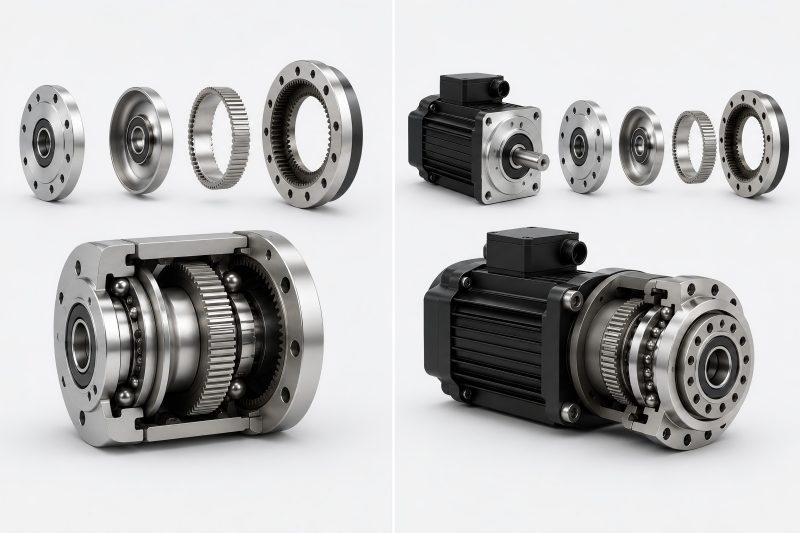
A typical harmonic drive has three main parts:
| Component | Function |
| Wave Generator | Creates elliptical deformation and acts as the input part |
| Flex Spline | Flexible gear that deforms and usually acts as the output |
| Circular Spline | Rigid internal gear that meshes with the flex spline |
According to Harmonic Drive’s technical explanation, the wave generator is typically connected to the motor shaft, the flex spline is a thin cylindrical cup with external teeth, and the circular spline is a rigid ring with internal teeth. The circular spline usually has two more teeth than the flex spline.
The biggest advantages of a harmonic drive are high precision, compact size, low or zero backlash, high reduction ratio, and excellent repeatability. Harmonic Drive also explains that the gear mechanism consists of only three basic parts and can provide high reduction ratios in a compact and lightweight package.
What Is a Harmonic Gear Motor?
A harmonic gear motor integrates an electric motor with a harmonic reducer. The motor provides power and speed, while the harmonic drive reduces the speed and increases the output torque.
In many applications, a harmonic gear motor may include:
- Brushless DC motor or servo motor
- Harmonic drive reducer
- Encoder or feedback sensor
- Brake, optional
- Output bearing
- Housing
- Drive electronics, optional
For example, Harmonic Drive’s integrated actuator products combine high-precision harmonic gearing with a brushless servomotor, brake, magnetic absolute encoders, and integrated servo drive options. This shows that a harmonic gear motor is not only a gear mechanism, but a more complete drive solution.
It converts motor power into precise, controlled mechanical motion. It is designed for applications that need accurate motion, compact installation, high torque, and stable operation.
Main Difference Between Harmonic Drive and Harmonic Gear Motor
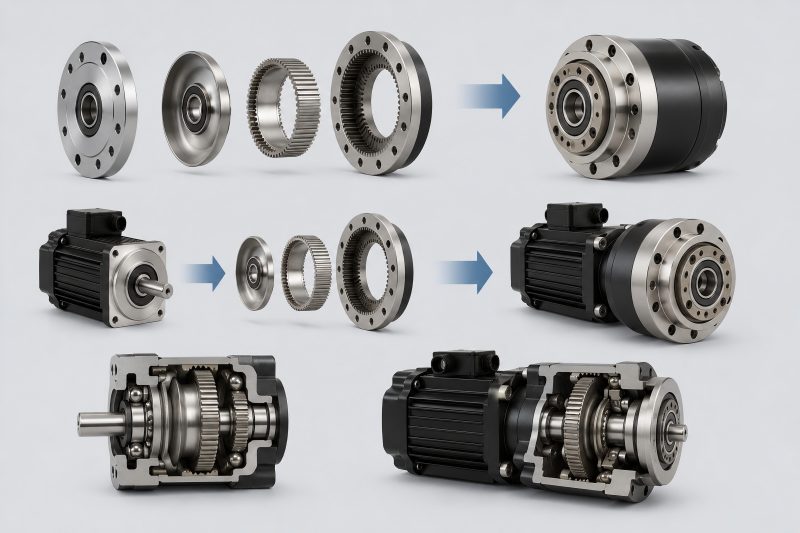
The most important difference is that a harmonic drive is a gear reducer, while a harmonic gear motor is a motorized gear drive system.
| Item | Harmonic Drive | Harmonic Gear Motor |
| Basic meaning | Precision strain wave gear reducer | Motor combined with harmonic reducer |
| Main function | Reduces speed and increases torque | Provides powered low-speed, high-torque output |
| Includes motor? | No, usually not | Yes |
| Includes gearbox? | Yes | Yes |
| Power source | Requires external motor | Built-in motor |
| Control ability | Depends on external motor and controller | Can be integrated with encoder and servo control |
| Installation | Needs motor matching and assembly | Easier to install as one unit |
| Best for | Machine builders who want flexible design | Users who need a ready-to-use drive solution |
A harmonic drive is like the precision transmission core. A harmonic gear motor is like a complete actuator module built around that core.
Working Principle Comparison
The working principle of the harmonic drive is based on controlled flexing and tooth difference.
First, the motor rotates the wave generator. The wave generator has an elliptical shape, so it forces the flex spline to deform into an ellipse.
Second, the flex spline meshes with the circular spline at two opposite elliptical points.
Third, as the wave generator rotates, the meshing areas move around the gear circumference. Because the flex spline has fewer teeth than the circular spline, the flex spline moves slowly in the opposite direction.
Fourth, this creates a high reduction ratio. Harmonic Drive explains that each full rotation of the wave generator moves the flex spline by two teeth relative to the circular spline, and the teeth remain engaged along the major axis, giving the gearhead zero backlash behavior.
A harmonic gear motor uses the same reducer principle, but it adds the motor as the input power source. Its operation can be summarized as:
Motor rotation → wave generator motion → flex spline deformation → gear reduction → low-speed high-torque output
So, the harmonic drive provides the reduction mechanism, while the harmonic gear motor provides the complete powered motion.
Structure Difference
Harmonic Drive Structure
A harmonic drive usually includes only the gear reducer parts:
- Wave generator
- Flex spline
- Circular spline
- Bearings
- Housing
- Output flange
It does not normally include the motor, encoder, brake, or controller. These components should be chosen based on specific application requirements.
Harmonic Gear Motor Structure
A harmonic gear motor usually includes:
- Motor
- Harmonic reducer
- Output shaft or flange
- Encoder
- Bearing system
- Brake, optional
- Housing
- Cable connector
- Drive module, optional
Harmonic Drive SE describes servo actuators as complete solutions that combine compact servo motors, precision gears, and output bearings, with closed-loop position feedback for precise movement. This is very close to what many users mean when they talk about a harmonic gear motor or harmonic actuator.
Design Flexibility
A harmonic drive gives engineers more design freedom. They can choose the motor, encoder, brake, controller, mounting method, and output structure separately. This is useful for custom machines where space, torque, control method, and mechanical interface must be optimized.
A harmonic gear motor is more convenient. Since the motor and reducer are already matched, users can reduce design time and simplify installation. This is especially useful for robot joints, compact automation modules, and standard motion platforms.
If your engineering team wants full customization, a harmonic drive may be better. If your project needs fast integration and easier selection, a harmonic gear motor may be more suitable.
Performance Difference
In terms of transmission accuracy, both can offer excellent performance because they use the same harmonic gear principle. However, the final system performance depends on different factors.
For a harmonic drive, performance depends on:
- Reducer precision
- Motor quality
- Assembly accuracy
- Encoder resolution
- Controller tuning
- Load condition
For a harmonic gear motor, performance depends on:
- Motor-reducer matching
- Built-in encoder accuracy
- Bearing rigidity
- Servo control quality
- Thermal design
- Integrated structure
A well-designed harmonic gear motor can provide excellent positioning accuracy because the motor, gear, feedback system, and bearings are matched as one unit.
Cost Difference
A harmonic drive is usually cheaper than a complete harmonic gear motor because it is only the reducer. However, the final system cost may increase after adding the motor, encoder, brake, controller, mounting parts, and assembly labor.
A harmonic gear motor has a higher unit price, but it can reduce engineering time, installation risk, and component matching problems. For small-batch production or high-end equipment, this convenience can be valuable.
Therefore, the cheaper choice is not always the better choice. Evaluate the full system cost, not just the reducer price.
Application Difference
Common Applications of Harmonic Drives
Harmonic drives are often used in systems where engineers want to design their own motorized assembly. Common applications include:
- Robot joints
- CNC rotary tables
- Precision indexing mechanisms
- Optical positioning platforms
- Aerospace actuators
- Semiconductor equipment
- Custom automation machines
Common Applications of Harmonic Gear Motors
Harmonic gear motors are more suitable for complete motion modules. Common applications include:
- Collaborative robot joints
- Medical robots
- AGV steering modules
- Electric grippers
- Servo rotary actuators
- Inspection equipment
- Packaging machines
- Precision laboratory automation
Harmonic Drive SE lists applications such as machine tools, optical machines, industrial robots, automation and handling, and packaging machines for its servo products.
Which One Should You Choose?
You should choose a harmonic drive if:
- You already have a selected motor.
- You need a custom mechanical design.
- You want flexibility in encoder and controller selection.
- Your equipment has special mounting requirements.
- Your engineering team can handle motor-reducer matching.
You should choose a harmonic gear motor if:
- You need a ready-to-use drive unit.
- You want easier installation.
- You need compact motor-reducer integration.
- You require encoder feedback and servo control.
- You want to reduce design and assembly time.
- You are building robot joints or compact actuators.
Common Selection Mistakes
One common mistake is buying only a harmonic drive when the project actually needs a complete motorized actuator. In this case, the buyer still needs to select and install a motor, encoder, controller, and mounting structure.
Another mistake is choosing a harmonic gear motor without checking torque, speed, duty cycle, backlash, and control compatibility. Even if the gear motor is compact and precise, it must still match the real load condition.
A third mistake is focusing only on reduction ratio. In actual applications, output torque, rated speed, inertia matching, bearing load, positioning accuracy, and heat dissipation are also important.
In simple terms, the harmonic drive is the gear reduction core, while the harmonic gear motor is the complete powered motion solution. For custom machine design, a harmonic drive may be the better choice. For fast integration and compact precision motion, a harmonic gear motor is often more practical.