
Worm gear motors are used for high-torque applications because they provide strong torque output, high reduction ratios, compact structure, quiet operation, and stable low-speed control. Their 90-degree layout saves space in compact machine designs.
They are especially useful in conveyors, lifting systems, automatic gates, actuators, packaging machines, and industrial automation equipment. While they may have lower efficiency than some other gear motor types, their torque performance and load-holding ability make them a reliable choice for many heavy-duty applications.
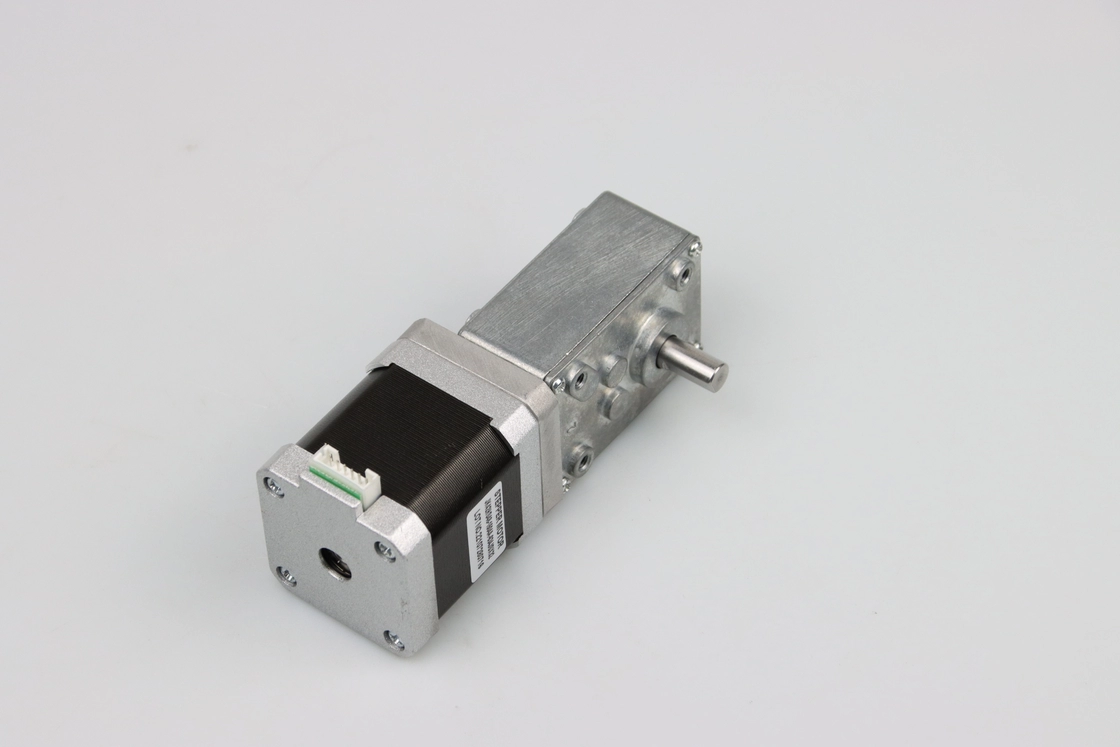
What Is a Worm Gear Motor?
A worm gear motor integrates a motor and worm gearbox. The gearbox includes two main parts:
| Component | Function |
| Worm Shaft | A screw-like gear connected to the motor shaft |
| Worm Wheel | A gear wheel rotated by the worm shaft. |
| Motor | Provides rotational power |
| Gearbox Housing | Supports the gear set and protects internal parts |
As the motor turns the worm shaft, it powers the worm wheel. Because of the sliding contact and gear geometry, the output speed is reduced while the torque is increased.
Why Worm Gear Motors Deliver High Torque
High Reduction Ratio
One major reason worm gear motors are used for high-torque applications is their ability to provide a high reduction ratio in a small gearbox.
A high reduction ratio means the motor speed is greatly reduced before reaching the output shaft. As speed decreases, output torque increases. For example, a motor running at high RPM can be converted into slow, powerful rotation through a worm gearbox.
| Gear Ratio | Output Speed | Torque Effect | Typical Use |
| 10:1 | Higher speed | Moderate torque increase | Light conveyors, small machines |
| 30:1 | Medium-low speed | Higher torque | Packaging equipment, feeders |
| 60:1 | Low speed | Strong torque | Lifting devices, gates |
| 100:1+ | Very low speed | Very high torque | Heavy-duty positioning systems |
This makes worm gear motors especially useful when the machine needs slow movement with strong driving force.
Compact Design for Limited Space
Many machines require high torque but do not have enough space for a large motor or bulky gearbox. Worm gear motors solve this problem by delivering large torque output in a compact structure.
The worm gear structure transmits power between shafts positioned at right angles. This right-angle design helps save installation space and makes machine layout more flexible.
Common applications include:
- Automated gates
- Conveyor systems
- Lifting platforms
- Packaging machinery
- Food processing equipment
- Medical equipment
- Small industrial automation systems
For equipment designers, this compact structure reduces the need for oversized drive components.
Strong Load-Holding Ability
Another important advantage of worm gear motors is their load-holding capability. In some designs, the worm gearbox can resist reverse motion from the output side. This is often called a self-locking effect.
This feature is useful for applications where the load must stay in position after the motor stops, such as:
- Hoists
- Elevators
- Adjustable tables
- Solar tracking systems
- Security gates
- Valve actuators
However, self-locking depends on gear ratio, lead angle, friction, lubrication, and load conditions. For safety-critical lifting systems, an additional brake is still recommended.
Smooth and Quiet Operation
Worm gear motors are also popular because they run smoothly and quietly. The worm and wheel engage through sliding contact instead of direct impact between gear teeth. This helps reduce vibration and noise.
This is valuable in applications such as:
| Application | Why Quiet Operation Matters |
| Medical beds | Improves patient comfort |
| Automatic doors | Reduces operating noise |
| Office equipment | Maintains a quiet environment |
| Food machinery | Supports smoother operation |
| Packaging lines | Reduces machine vibration |
For high-torque equipment used indoors or near workers, quiet operation can be a major advantage.
Stable Low-Speed Control
High-torque applications often require controlled low-speed movement. Worm gear motors are well suited for this because they reduce speed mechanically while increasing torque.
This is important when machines need:
- Slow lifting
- Accurate positioning
- Controlled feeding
- Stable conveyor movement
- Smooth opening and closing
- Heavy-load rotation
Instead of relying only on electronic speed control, the worm gearbox provides mechanical speed reduction. This helps the motor operate more efficiently under load.
Durability Under Heavy Load
Worm gear motors are often built with strong gearbox housings, hardened shafts, bronze or alloy worm wheels, and durable bearings. These parts help the gear motor withstand heavy loads and repeated operation.
For industrial use, durability depends on several factors:
| Factor | Why It Matters |
| Gear material | Affects wear resistance and load capacity |
| Lubrication | Reduces friction and heat |
| Gear ratio | Influences torque and efficiency |
| Bearing quality | Supports stable shaft rotation |
| Housing strength | Protects the gearbox under load |
| Duty cycle | Decides continuous operation capability. |
A properly selected worm gear motor can provide reliable performance in demanding working environments.
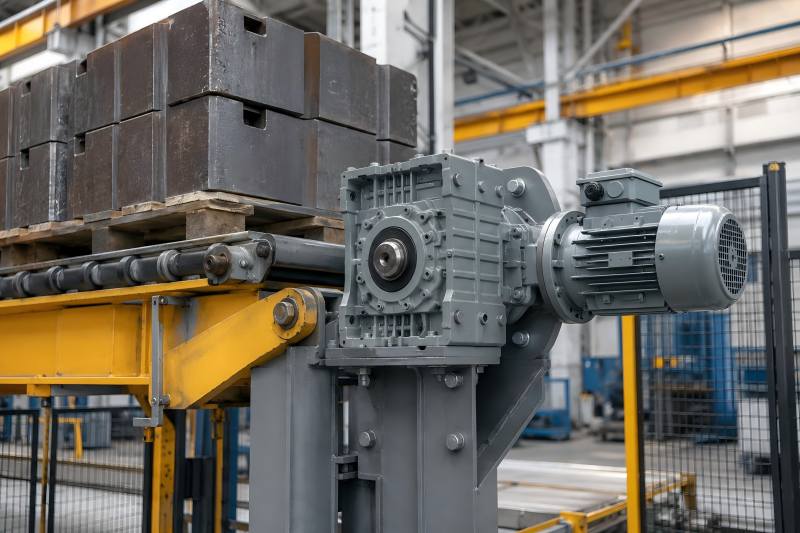
Where Worm Gear Motors Are Commonly Used
Worm gear motors are used across many industries because they combine torque, compact size, and motion control.
Conveyor Systems
Conveyors often need steady low-speed movement and strong pulling force. Worm gear motors can drive belts, rollers, and chain conveyors with stable torque output.
Lifting Equipment
Worm gear motors are used in lifting tables, small hoists, adjustable platforms, and electric actuators. Their torque output helps move heavy loads safely and smoothly.
Packaging Machines
Packaging equipment often needs controlled movement for feeding, sealing, labeling, and positioning. Worm gear motors provide reliable low-speed control.
Automatic Doors and Gates
Gates and doors require strong starting torque and stable movement. Worm gear motors help open and close heavy structures smoothly.
Valve and Actuator Systems
Industrial valves often need slow, powerful rotation. Worm gear motors are suitable for opening, closing, and positioning valve systems.
Worm Gear Motor vs Other Gear Motors
Worm gear motors are not always the most efficient choice, but they are often preferred when high torque, compact size, and holding ability are more important than maximum efficiency.
| Gear Motor Type | Main Advantage | Best For |
| Worm Gear Motor | High torque, compact size, load holding | Lifting, gates, conveyors |
| Spur Gear Motor | Simple structure, high efficiency | General speed reduction |
| Planetary Gear Motor | High precision, high torque density | Robotics, servo systems |
| Helical Gear Motor | Smooth operation, better efficiency | Industrial continuous drives |
| Bevel Gear Motor | Right-angle transmission | Space-limited machinery |
For high-torque and low-speed applications, worm gear motors are often a cost-effective and practical solution.
Limitations of Worm Gear Motors
Although worm gear motors have many benefits, they also have some limitations.
The main disadvantage is efficiency loss. Because worm gears use sliding contact, they generate more friction and heat than some other gear types. This means they may be less efficient than planetary or helical gear motors.
Other points to consider include:
- Proper lubrication is important.
- Heat dissipation must be considered.
- Efficiency decreases at very high reduction ratios.
- Continuous-duty applications may require careful motor sizing.
- Self-locking should not replace a safety brake in critical systems.
Choosing the right gear ratio, motor power, gearbox material, and duty cycle can help avoid these problems.
How to Select a Worm Gear Motor for High-Torque Applications
Choosing a worm gear motor requires evaluating load, speed, duty cycle, installation, and working conditions—not only motor power.
Key selection factors include:
- Required output torque
- Output speed
- Gear ratio
- Load type
- Duty cycle
- Installation direction
- Working temperature
- Noise requirements
- Voltage and control method
- Safety requirements
For example, a conveyor may need continuous operation, while a gate motor may need intermittent operation with strong starting torque. These applications require different motor and gearbox designs.