
Planetary gear motors are essential drive components in modern automation equipment. They support a wide range of automation applications, including:
- Conveyor systems
- Robotic arms
- Packaging machinery
- Automated assembly lines
- CNC automation systems
- AGVs and mobile robots
- Lifting systems
- Rotary tables
- Linear motion systems
- Inspection equipment
Their key value lies in the combination of compact structure, high torque density, stable transmission, and precise motion control. These advantages allow automation equipment to operate more smoothly, handle loads more reliably, and achieve better positioning accuracy.
For equipment manufacturers, choosing the right planetary gear motor can help improve:
- Machine efficiency
- Motion accuracy
- Load capacity
- Operating stability
- Long-term reliability
Why Planetary Gear Motors Are Used in Automation Equipment
Automation equipment often needs controlled motion rather than simple rotation. Machines may need to move a conveyor, position a robotic arm, lift a platform, rotate a turntable, or drive a linear actuator. In these applications, the motor must deliver the right speed, torque, and positioning accuracy.
Planetary gear motors are commonly used because they can reduce motor speed while increasing torque. This allows the machine to move heavier loads with smoother and more stable motion.
Key Benefits in Automation
| Benefit | Value for Automation Equipment |
| High torque output | Helps drive heavy loads, lifting units, and indexing mechanisms |
| Compact size | Ideal for equipment with compact installation requirements. |
| Low backlash option | Supports accurate positioning and repeatable movement |
| High efficiency | Reduces energy loss and improves drive performance |
| Stable transmission | Helps equipment run smoothly during continuous operation |
| Strong load capacity | Suitable for frequent start-stop and shock-load conditions |
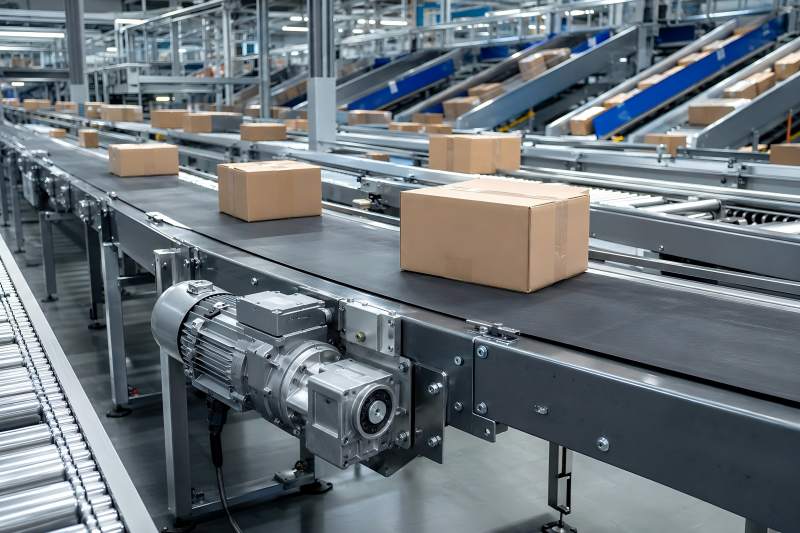
Conveyor Systems
In automation equipment, planetary gear motors are commonly used to drive conveyor systems. They are used in packaging lines, assembly lines, sorting systems, food processing equipment, logistics conveyors, and warehouse automation systems.
In conveyor applications, the gear motor must provide stable speed, sufficient torque, and continuous operation. A planetary gear motor can reduce motor speed to match conveyor requirements while increasing output torque to move products smoothly.
Typical Conveyor Applications
- Belt conveyors
- Roller conveyors
- Chain conveyors
- Sorting conveyors
- Packaging transfer lines
- Pallet handling systems
Planetary gear motors are especially useful when the conveyor must handle heavier products or operate in limited space. Their compact structure allows easy installation inside equipment frames or near drive rollers.
Robotic Arms and Manipulators
Robotic arms require accurate, repeatable, and smooth motion. Planetary gear motors are commonly used in robot joints, grippers, rotary axes, and small industrial manipulators.
In robotic applications, the motor must deliver precise torque and position control. Low-backlash planetary gearboxes help reduce positioning error, making the robot movement more accurate.
Common Uses in Robotics
- Joint rotation
- Wrist movement
- Gripper actuation
- Rotary end-effectors
- Pick-and-place systems
- Collaborative robot accessories
For robotic arms, compact size is also important. Planetary gear motors provide high torque in a small package, helping reduce the total weight of the robot structure.
Packaging Machinery
Packaging machinery often requires repeated, high-speed, and accurate motion. Planetary gear motors are widely used in filling machines, labeling machines, sealing machines, carton forming machines, wrapping machines, and coding equipment.
In packaging automation, different motion units must work together accurately. For example, a conveyor moves products forward, a positioning unit stops them at the right place, and a sealing or labeling module completes the packaging step. Planetary gear motors help control these movements with stable speed and repeatable positioning.
Application Examples in Packaging Equipment
| Packaging Equipment | Planetary Gear Motor Function |
| Labeling machine | Controls label feeding and product positioning |
| Filling machine | Drives indexing, bottle positioning, or rotary filling tables |
| Cartoning machine | Controls carton feeding, folding, and pushing mechanisms |
| Sealing machine | Drives rollers, belts, or pressing units |
| Wrapping machine | Supports film feeding, rotary wrapping, and synchronized movement |
Planetary gear motors are valuable in packaging machinery because they help reduce vibration, improve motion stability, and support accurate production cycles.
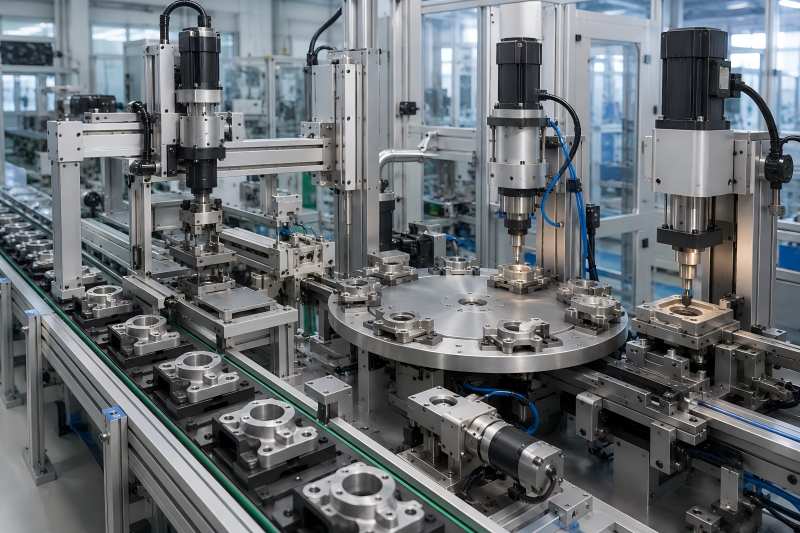
Automated Assembly Lines
Automated assembly lines use many motion systems, including conveyors, rotary stations, pressing devices, screw-driving units, lifting systems, and product transfer mechanisms. Planetary gear motors are used to drive these units with controlled torque and speed.
In assembly equipment, repeatability is important. Every product must move to the correct position, and each operation must be completed with consistent force and timing. Planetary gear motors help provide stable output for repeated production cycles.
Common Assembly Line Applications
- Product indexing
- Rotary positioning
- Screw-driving units
- Pressing mechanisms
- Clamping systems
- Material transfer modules
- Workpiece positioning tables
When combined with servo motors or stepper motors, planetary gearboxes can improve positioning accuracy and load capacity in automated assembly systems.
CNC and Machine Tool Automation
Planetary gear motors are also used in CNC auxiliary systems, machine tool automation, and precision motion equipment. While high-precision ball screws and servo systems are common in CNC machines, planetary gear motors are often used for feeding units, tool changers, rotary tables, and auxiliary positioning devices.
In these applications, the gearbox must provide high stiffness, low backlash, and stable torque transmission. A suitable planetary gear motor helps improve machining repeatability and equipment response.
Typical Machine Tool Applications
- Automatic tool changers
- Rotary indexing tables
- Workpiece clamping systems
- Feeding mechanisms
- Auxiliary axis drives
- Loading and unloading systems
Low-backlash planetary gear motors are preferred when the equipment requires accurate angular positioning or repeated motion control.
Automated Guided Vehicles and Mobile Robots
Automated guided vehicles, autonomous mobile robots, and warehouse robots need compact and efficient drive solutions. Planetary gear motors are often used in wheel drive systems, steering modules, lifting mechanisms, and positioning units.
In AGV and AMR applications, the drive motor must provide strong torque for starting, climbing, turning, and carrying loads. Planetary gear motors offer high torque output while keeping the drive system compact.
Common AGV and AMR Uses
- Wheel drive
- Steering drive
- Lifting platforms
- Fork movement
- Load transfer systems
- Docking and positioning modules
Because mobile robots often operate for long hours, motor efficiency and durability are also important. A well-selected planetary gear motor can help improve battery usage and reduce maintenance needs.
Material Handling and Lifting Equipment
Planetary gear motors are commonly used in automated lifting and material handling equipment. These systems need high torque, smooth movement, and reliable braking performance.
Applications include automated storage systems, lifting platforms, hoists, palletizers, stackers, and vertical transfer units. The gear motor must move loads safely and maintain stable output during repeated lifting cycles.
Application Areas
- Vertical lifting modules
- Automated storage and retrieval systems
- Palletizing equipment
- Stacking machines
- Transfer carts
- Load positioning platforms
For lifting applications, the gear motor is often used with brakes, encoders, or servo control systems to improve safety and positioning accuracy.
Indexing Tables and Rotary Positioning Systems
Indexing tables require accurate angular movement. They are used in assembly machines, inspection equipment, welding systems, filling machines, and automated testing platforms.
A planetary gear motor can drive the rotary table to stop at specific positions with controlled speed and torque. Low backlash is important because it helps reduce positioning deviation after each rotation.
Common Rotary Applications
- Rotary indexing tables
- Turntables
- Welding positioners
- Inspection stations
- Filling and capping rotary platforms
- Multi-station assembly machines
For these systems, the gear ratio, backlash level, and output torque should be carefully selected according to the load inertia and required positioning accuracy.
Linear Motion Systems
Although planetary gear motors produce rotary motion, they are widely used in linear motion systems when combined with ball screws, lead screws, rack and pinion systems, or belt drives.
In automation equipment, many movements are linear, including pushing, lifting, sliding, pressing, and positioning. Planetary gear motors provide controlled rotary power, which is converted into linear motion by mechanical transmission components.
Linear Motion Examples
| Linear Motion System | Role of Planetary Gear Motor |
| Ball screw actuator | Provides precise rotary input for linear positioning |
| Lead screw mechanism | Drives low-speed pushing or lifting movement |
| Rack and pinion system | Converts rotation into long-distance linear travel |
| Belt-driven linear module | Controls high-speed sliding movement |
| Electric actuator | Provides compact drive power for push-pull motion |
Planetary gear motors are useful in linear systems that need higher thrust, lower speed, and more stable positioning.
Inspection and Testing Equipment
Inspection and testing machines often require controlled movement, accurate positioning, and smooth speed adjustment. Planetary gear motors are used in vision inspection systems, testing platforms, measuring machines, and quality control equipment.
In these applications, products may need to rotate, move forward, stop at inspection points, or be positioned under sensors and cameras. Planetary gear motors help achieve stable and repeatable movement.
Common Inspection Applications
- Camera positioning systems
- Rotary inspection platforms
- Product testing fixtures
- Sensor positioning units
- Automated measuring equipment
- Quality control conveyors
Low vibration and stable output are important in inspection equipment because unstable movement can affect measurement accuracy.
Planetary Gear Motor Selection for Automation Equipment
Choosing the right planetary gear motor depends on the machine structure, load condition, speed requirement, accuracy requirement, and operating environment.
Main Selection Factors
| Selection Factor | Why It Matters |
| Output torque | Determines whether the motor can move the load reliably |
| Gear ratio | Affects output speed and torque multiplication |
| Backlash | Influences positioning accuracy and repeatability |
| Motor type | Servo, stepper, brushless DC, or AC motor affects control performance |
| Load inertia | Impacts acceleration, deceleration, and stability |
| Duty cycle | Determines whether the motor can handle continuous or intermittent operation |
| Installation space | Compact equipment may require smaller gearbox designs |
| Operating environment | Dust, humidity, temperature, and vibration affect durability |
For high-precision automation, servo planetary gear motors are often preferred. For cost-sensitive positioning systems, stepper planetary gear motors may be suitable. For continuous drive applications, brushless DC or AC planetary gear motors can be selected according to speed and control requirements.