
Gear ratio determines how motor speed is reduced and how torque is increased. A suitable gear ratio helps the drive system achieve stable speed, sufficient torque, smooth motion, and reliable service life.
A well-matched planetary gear motor can improve equipment performance, reduce energy loss, extend service life, and support more stable machine operation.
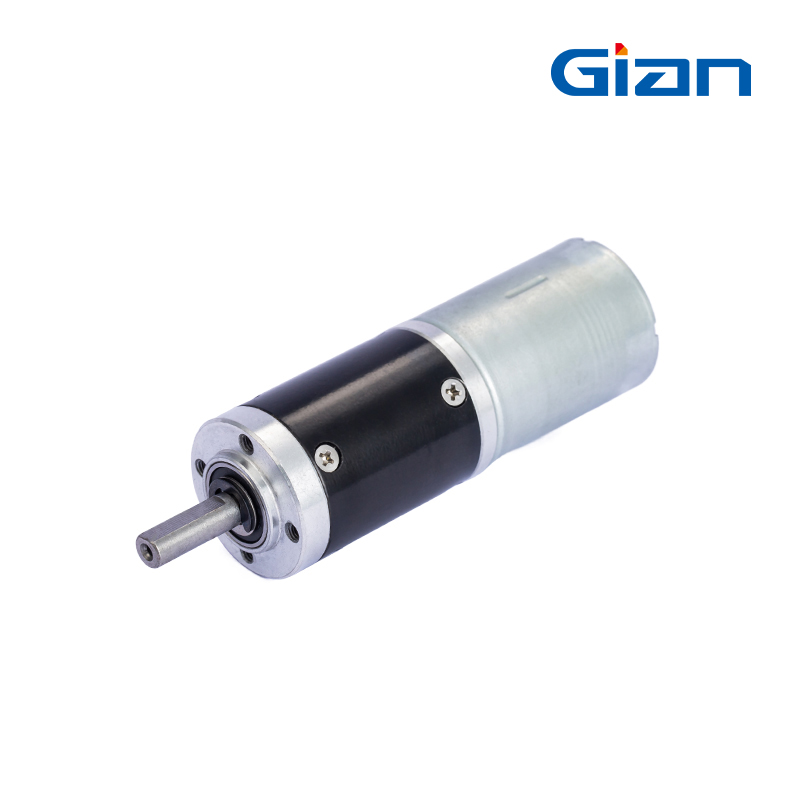
What Is Gear Ratio in a Planetary Gear Motor?
The gear ratio describes the speed reduction relationship between the motor input and gearbox output.
In basic terms, it represents the number of motor revolutions required for one output shaft revolution.
For example:
A 10:1 gear ratio means the motor turns 10 times to drive the output shaft through one full rotation.
Basic Formula
| Item | Formula | Meaning |
| Output Speed | Motor Speed ÷ Gear Ratio | Determines final working speed |
| Output Torque | Motor Torque × Gear Ratio × Efficiency | Determines load-driving capacity |
| Gear Ratio | Motor Speed ÷ Output Speed | Shows the reduction level |
With a 3000 rpm motor and 30:1 gearbox, theoretical output speed is calculated as follows.
3000 ÷ 30 = 100 rpm
In real applications, the output torque also needs to consider gearbox efficiency, load condition, duty cycle, and mechanical losses.
How Planetary Gear Ratio Works
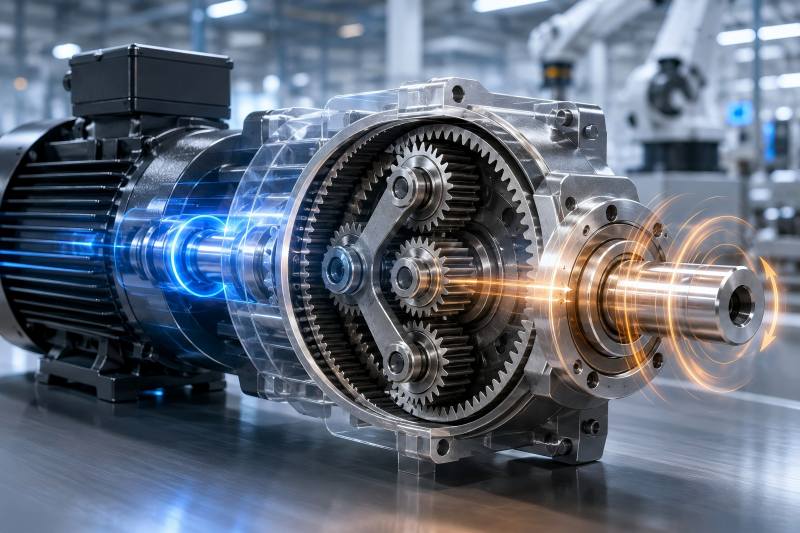
Motor power drives the sun gear, while planet gears transmit rotation to the carrier. The ring gear surrounds the planet gears and supports compact torque transmission.
Multiple planet gears distribute the load evenly, allowing planetary gearboxes to deliver strong torque in a compact size for space-limited, high-force applications.
Gear ratio depends on sun gear and ring gear tooth counts, plus the number of reduction stages.
Why Gear Ratio Matters in Planetary Gear Motors
Gear ratio affects torque, speed, and performance. It changes how the entire drive system performs.
A higher gear ratio usually means:
- Lower output speed
- Higher output torque
- Better load-driving ability
- Slower acceleration response
- Potentially higher backlash accumulation
- More gearbox stages in some designs
A lower gear ratio usually means:
- Higher output speed
- Lower output torque
- Faster response
- Better efficiency in many cases
- Less reduction capacity
Choosing the wrong ratio can cause poor performance even if the motor itself looks powerful enough.
Gear Ratio vs Speed
The most direct effect of gear ratio is output speed reduction.
If the motor speed stays the same, a higher gear ratio produces a lower output speed.
| Motor Speed | Gear Ratio | Approx. Output Speed | Suitable Use |
| 3000 rpm | 5:1 | 600 rpm | Fast movement, light load |
| 3000 rpm | 10:1 | 300 rpm | General automation |
| 3000 rpm | 30:1 | 100 rpm | Medium speed, higher torque |
| 3000 rpm | 50:1 | 60 rpm | Heavy load, slower motion |
| 3000 rpm | 100:1 | 30 rpm | High torque, low-speed output |
For high-speed applications, such as small conveyor drives or light-duty actuators, a lower ratio may be enough.
For slow and powerful motion, such as lifting, indexing, clamping, or rotary positioning, a higher ratio is usually required.
Gear Ratio vs Torque
Gear ratio also increases output torque.
When the ratio increases, the gearbox multiplies the motor’s torque. This allows a smaller motor to drive a heavier load.
A 1 Nm motor with a 20:1 gearbox at 90% efficiency produces:
Output Torque = 1 × 20 × 0.9 = 18 Nm
A higher ratio is not always the best choice for every application. Very high ratios may reduce efficiency, increase gearbox size, increase backlash, and limit output speed.
The correct ratio should balance torque, speed, precision, efficiency, and cost.
Common Gear Ratio Ranges in Planetary Gear Motors
Planetary gear motors offer multiple reduction ratio choices. Common ratios include 3:1, 5:1, 10:1, 20:1, 30:1, 50:1, 100:1, and higher.
Different applications require different ratio ranges.
| Gear Ratio Range | Main Feature | Common Applications |
| 3:1–10:1 | Higher speed, moderate torque | Light automation, small conveyors, rotary drives |
| 10:1–30:1 | Balanced speed and torque | Packaging machines, smart equipment, medical devices |
| 30:1–100:1 | Higher torque, lower speed | Lifting systems, indexing tables, heavy-duty actuators |
| 100:1+ | Very low speed, high torque | Special machinery, slow positioning, heavy load systems |
For most industrial applications, ratios between 10:1 and 50:1 are commonly used because they provide a practical balance between output speed and torque.
Single-Stage vs Multi-Stage Planetary Gearboxes
Planetary gearboxes can be built with one or multiple gear stages.
A single-stage planetary gearbox usually provides a lower gear ratio and higher efficiency. A multi-stage planetary gearbox combines several reduction stages to achieve a higher total ratio.
For example:
A first stage of 5:1 and a second stage of 4:1 produce a total ratio of:
5 × 4 = 20:1
Multi-stage designs are useful when high torque and low speed are needed, but they may also increase gearbox length, cost, and mechanical losses.
How to Choose the Right Gear Ratio
Choosing the right planetary gear motor ratio should start from the actual application requirement, not only from the motor catalog.
Define output speed, torque load, duty cycle, space limits, precision needs, and operating conditions before selection.
Define the Required Output Speed
Start by identifying the final speed your equipment needs.
For example:
- Conveyor roller speed
- Rotary table speed
- Actuator movement speed
- Packaging machine cycle speed
- Robot joint rotation speed
Once the required output speed is known, you can calculate the approximate gear ratio.
Gear Ratio = Motor Rated Speed ÷ Required Output Speed
Example: 3000 rpm motor, 150 rpm output needed.
3000 ÷ 150 = 20
A 20:1 gearbox may be suitable as a starting point.
Calculate the Required Output Torque
After speed, torque is the next key factor.
The gearbox must deliver stable torque for safe load movement. Torque demand depends on load weight, friction, acceleration, working angle, and external resistance.
For B2B equipment design, it is recommended to include a safety factor. If the calculated load torque is 10 Nm, choosing a gearbox that can support 15–20 Nm may provide better reliability.
However, the selected gearbox must not exceed its rated output torque, peak torque, or radial load capacity.
Consider Gearbox Efficiency
Planetary gearboxes are generally efficient, but efficiency still decreases slightly when more stages are added.
A single-stage gearbox may have higher efficiency than a multi-stage gearbox. If energy consumption, heat generation, or battery life is important, gearbox efficiency should be checked carefully.
This is especially important for:
- Battery-powered equipment
- Medical devices
- Smart furniture systems
- Mobile robots
- Compact automation modules
Check Backlash Requirements
Backlash is gear clearance that impacts precision and stability. For simple speed reduction or load driving, standard backlash may be acceptable.
For precision applications, a low-backlash planetary gearbox is preferred.
Typical applications requiring lower backlash include:
- Servo motor systems
- Robot joints
- CNC auxiliary axes
- Automated inspection equipment
- Precision rotary tables
A higher gear ratio with multiple stages may increase total backlash, so the ratio should be selected together with the precision requirement.
Match the Gear Ratio with the Motor Type
Planetary gearboxes can be combined with different motor types, including DC motors, brushless DC motors, stepper motors, and servo motors.
Different motors have different speed-torque characteristics.
For example:
A brushless DC motor may run at higher speed and benefit from a higher reduction ratio to produce stable output torque.
A stepper motor may need a gearbox to increase torque and improve load holding, but too high a ratio may reduce response speed.
A servo motor often requires a planetary gearbox for torque multiplication, inertia matching, and precise positioning.
Consider Load Type and Duty Cycle
The same gear ratio may perform differently under different load conditions.
A light-duty intermittent application may use a smaller gearbox. A continuous heavy-load application requires stronger torque capacity, better heat dissipation, and a more durable gear design.
You should consider:
- Continuous or intermittent operation
- Frequent start-stop cycles
- Shock load or smooth load
- Horizontal or vertical movement
- Required service life
- Working temperature and environment
For lifting or vertical load applications, a higher safety margin is usually needed.
Common Selection Mistakes
Many gear motor problems come from incorrect ratio selection.
Choosing Only by Torque
Some buyers only focus on torque and choose a very high ratio. This may reduce output speed too much and affect machine efficiency.
Ignoring Efficiency Loss
Higher ratios usually need multi-stage gearbox designs. More stages can increase friction and heat, especially in compact gear motors.
Ignoring Backlash
For positioning applications, torque is not enough. Backlash must also be considered.
Choosing an Oversized Gearbox
A larger gearbox may increase cost, weight, and installation difficulty. The optimal model is the one that fits your application.
Ignoring Actual Working Conditions
Catalog data is usually based on standard test conditions. Real applications may involve dust, vibration, impact load, high temperature, or long working hours.
Gear Ratio Selection Guide by Application
| Application | Suggested Ratio Range | Key Selection Focus |
| Conveyor drive | 5:1–30:1 | Speed stability, torque, continuous operation |
| Robotic joint | 20:1–100:1 | Torque density, backlash, precision |
| Packaging machine | 10:1–50:1 | Cycle speed, reliability, compact size |
| Medical equipment | 10:1–60:1 | Low noise, smooth motion, safety |
| Smart furniture | 20:1–100:1 | Quiet operation, load capacity, compact design |
| Rotary table | 30:1–100:1 | Positioning accuracy, output torque |
| Linear actuator system | 20:1–100:1 | Lifting force, self-locking design, durability |
These ranges are only general references. The final selection should be based on detailed torque calculation, speed requirement, and gearbox specifications.
Choosing a Gear Ratio
Suppose an automation device uses a motor with a rated speed of 3000 rpm. Desired output speed is 100 rpm.
The ratio can be calculated as:
3000 ÷ 100 = 30
So, a 30:1 planetary gearbox may be considered.
Next, assume the required output torque is 12 Nm. If the gearbox efficiency is 90%, the required motor torque is:
12 ÷ 30 ÷ 0.9 = 0.44 Nm
In this case, the motor should provide at least 0.44 Nm rated torque, and the gearbox should support at least 12 Nm output torque. A safety factor should also be added depending on the duty cycle and load type.
If the application has frequent start-stop motion, shock load, or vertical lifting, a higher torque margin may be necessary.