
A planetary gear motor should be selected according to torque, speed, ratio, load type, duty cycle, and precision requirements. The most suitable model is not always the one with the highest torque or highest power.
For industrial equipment, automation systems, robotics, conveyors, and precision machinery, proper planetary gear motor selection can improve motion stability, reduce maintenance, extend service life, and lower long-term operating cost.
What Is a Planetary Gear Motor?
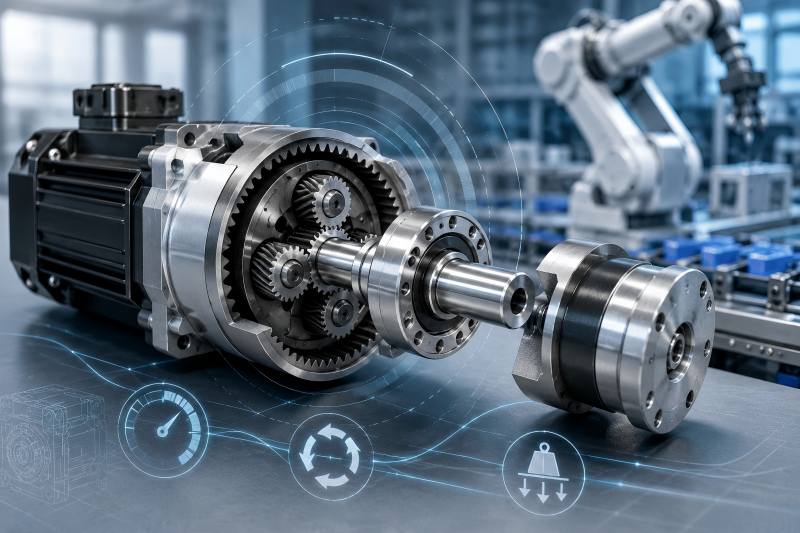
The gearbox uses a sun gear, planet gears, ring gear, and carrier to reduce motor speed while increasing output torque.
Compared with ordinary gear motors, planetary gear motors offer:
- Higher torque density
- Compact structure
- Better load distribution
- Higher transmission efficiency
- Good positioning accuracy
- Stronger resistance to shock loads
Because of these advantages, planetary gear motors are widely used in automation equipment, robotics, conveyors, packaging machines, medical devices, smart furniture, AGV systems, and industrial machinery.
Key Parameters for Planetary Gear Motor Selection
Before selecting a planetary gear motor, you need to define several key operating parameters.
| Parameter | What It Means | Why It Matters |
| Rated Torque | Continuous output torque during normal operation | Prevents overload and overheating |
| Peak Torque | Short-time maximum torque | Handles startup, acceleration, and shock load |
| Output Speed | Final shaft speed after reduction | Determines machine working speed |
| Gear Ratio | Speed reduction ratio of the gearbox | Affects torque, speed, and control accuracy |
| Load Type | Inertia, friction, gravity, or impact load | Influences required torque margin |
| Duty Cycle | Continuous or intermittent operation | Affects heat generation and service life |
| Backlash | Clearance between gear teeth | Important for positioning accuracy |
| Efficiency | Power transmission efficiency | Impacts energy loss and torque output |
| Mounting Type | Flange, shaft, right-angle, or custom mounting | Ensures mechanical compatibility |
A good selection should balance all these factors instead of focusing only on motor power.
Torque Selection: How Much Torque Do You Need?
If the output torque is too low, the motor may stall, overheat, or fail to move the load. If the torque is too high, the system may become oversized, expensive, and inefficient.
Basic Torque Formula
For rotating applications, torque can be estimated using:
Torque = Force × Radius
For example, if a conveyor roller requires 100 N of force and the roller radius is 0.05 m:
Torque = 100 × 0.05 = 5 N·m
However, this is only the basic load torque. In real applications, you also need to consider acceleration torque, friction, shock load, and safety margin.
Recommended Torque Safety Factor
| Application Type | Load Condition | Recommended Safety Factor |
| Light-duty automation | Stable load, low vibration | 1.2–1.5× |
| Conveyor system | Medium friction and continuous running | 1.5–2.0× |
| Packaging machine | Frequent start-stop motion | 1.8–2.5× |
| Robotics joint | High precision and dynamic load | 2.0–3.0× |
| Lifting mechanism | Gravity load and safety risk | 2.5–4.0× |
| Heavy industrial equipment | Shock load or impact load | 3.0–5.0× |
For example, if your calculated load torque is 8 N·m and the machine is a packaging system with frequent start-stop movement, you may choose a safety factor of 2.0.
Required rated torque = 8 × 2.0 = 16 N·m
In this case, a planetary gear motor with at least 16 N·m rated output torque would be recommended.
Speed Selection: Matching Output Speed to the Machine
A motor usually runs at high speed, while the equipment often needs lower speed and higher torque. The planetary gearbox reduces motor speed to the required output speed.
Basic Speed Formula
Output Speed = Motor Speed ÷ Gear Ratio
For example, if the motor speed is 3000 rpm and the gearbox ratio is 30:1:
Output Speed = 3000 ÷ 30 = 100 rpm
This means the final output shaft speed is 100 rpm.
Common Output Speed Ranges
| Application | Typical Output Speed Range |
| Robotic joint | 5–100 rpm |
| Conveyor drive | 20–300 rpm |
| Packaging equipment | 50–500 rpm |
| Medical device actuator | 10–200 rpm |
| AGV wheel drive | 100–600 rpm |
| Industrial turntable | 1–60 rpm |
| Smart furniture adjustment | 5–150 rpm |
When selecting speed, avoid choosing only based on maximum speed. You should also consider acceleration, stopping time, load inertia, and control response.
For servo planetary gear motors, lower output speed often improves positioning control. For DC planetary gear motors, speed stability depends on motor type, load change, voltage, and controller performance.
Gear Ratio Selection: Balance Torque and Speed
The gear ratio directly affects output torque and speed. A higher ratio gives higher torque but lower speed. A lower ratio gives higher speed but lower torque.
Torque and Ratio Relationship
In simple terms:
Output Torque ≈ Motor Torque × Gear Ratio × Gearbox Efficiency
For example:
- Motor torque: 0.5 N·m
- Gear ratio: 20:1
- Gearbox efficiency: 90%
Output Torque = 0.5 × 20 × 0.9 = 9 N·m
This means the gearbox increases torque from 0.5 N·m to about 9 N·m.
Example Ratio Selection Data
| Motor Speed | Gear Ratio | Output Speed | Estimated Torque Increase |
| 3000 rpm | 5:1 | 600 rpm | About 4.5× |
| 3000 rpm | 10:1 | 300 rpm | About 9× |
| 3000 rpm | 20:1 | 150 rpm | About 18× |
| 3000 rpm | 50:1 | 60 rpm | About 45× |
| 3000 rpm | 100:1 | 30 rpm | About 85–90× |
The actual torque depends on gearbox efficiency, motor performance, gear stage, lubrication, and thermal limits.
For high-ratio applications, you should also check gearbox backlash, efficiency loss, noise, and output bearing load.
Load Type: Understand the Real Working Condition
Different loads place different stress on the planetary gear motor. A stable conveyor load is very different from a robotic arm, lifting device, or impact-driven machine.
Inertia Load
Inertia load appears when the motor needs to accelerate or decelerate a rotating mass. This is common in robotic arms, rotary tables, reels, and indexing equipment.
High inertia may require a higher peak torque and stronger gearbox.
Friction Load
Friction load is common in conveyors, sliding mechanisms, linear actuators, and material handling systems. The torque requirement may increase if the machine has poor lubrication, heavy contact surfaces, or high belt tension.
Gravity Load
Gravity load appears in lifting, tilting, and vertical movement systems. These applications require careful torque calculation and safety protection.
For lifting systems, holding torque, brake options, and self-locking behavior should be considered.
Shock Load
Shock load occurs when the machine experiences impact, sudden load change, jamming, or frequent reversing. Heavy-duty planetary gear motors should be selected with a higher service factor.
Radial Load and Axial Load
Besides torque, the gearbox shaft must also withstand external forces.
Radial load acts perpendicular to the output shaft. It commonly appears when using pulleys, belts, gears, or sprockets.
Axial load acts along the shaft direction. It may appear in screw drive systems, thrust applications, or certain coupling structures.
If radial or axial load is too high, the output bearing may wear quickly. In these cases, you should check the gearbox bearing capacity, shaft diameter, and mounting structure.
For high radial load applications, it is often better to use an external bearing support instead of letting the gearbox shaft carry all the load.
Duty Cycle and Thermal Performance
A planetary gear motor used for continuous operation must be selected differently from one used only for short intermittent movement.
For example:
- A conveyor running 8 hours per day needs stable thermal performance.
- A medical adjustment device may only run for a few seconds each cycle.
- A robotic joint may require frequent acceleration and deceleration.
- A packaging machine may run continuously with repeated start-stop motion.
Long operation time increases motor temperature. If the motor works near its maximum torque for a long time, overheating may occur.
For continuous-duty applications, choose a motor with enough rated torque margin, good heat dissipation, and suitable insulation class.
Backlash and Precision Requirements
Backlash is the small gap between gear teeth. It affects motion accuracy, especially in servo systems and positioning applications.
Low backlash planetary gear motors are commonly used in:
- Robotics
- CNC equipment
- Semiconductor equipment
- Precision turntables
- Inspection machines
- Automated positioning systems
For general conveyors or simple drive systems, standard backlash may be acceptable. For high-precision control, a low-backlash or precision planetary gearbox is recommended.
Typical backlash ranges may include:
- Standard planetary gearbox: 10–20 arcmin
- Precision planetary gearbox: 3–8 arcmin
- High-precision planetary gearbox: below 3 arcmin
The lower the backlash, the higher the machining accuracy and cost.
Practical Selection Process
A clear selection process can reduce mistakes.
First, define the application. Identify whether the planetary gear motor will drive a conveyor, robotic joint, actuator, wheel, pump, turntable, or lifting system.
Second, calculate the required output speed. This helps determine the gearbox ratio.
Third, calculate the load torque. Include friction, inertia, gravity, and acceleration requirements.
Fourth, apply a safety factor. Use a higher margin for shock loads, lifting systems, and frequent start-stop applications.
Fifth, select the gear ratio. Make sure the ratio provides both the required speed and torque.
Sixth, check shaft load. Confirm radial load and axial load are within gearbox limits.
Seventh, review duty cycle. Make sure the motor can operate without overheating.
Finally, verify mechanical compatibility. Check mounting dimensions, shaft type, voltage, encoder, brake, controller, and environmental protection level.
Common Selection Mistakes
Many planetary gear motor failures come from incorrect selection rather than poor product quality.
Common mistakes include:
- Selecting only by motor power
- Ignoring peak torque
- Using too small a safety factor
- Choosing a ratio that makes the output speed too low
- Ignoring radial load on the output shaft
- Not checking duty cycle and temperature rise
- Using standard backlash for precision positioning
- Ignoring shock load in start-stop applications
- Oversizing the gearbox and increasing unnecessary cost
A reliable selection should always be based on real load conditions, not only catalog torque.
Example Selection Case
Suppose a packaging machine requires an output speed of 100 rpm. The motor speed is 3000 rpm.
Gear ratio = 3000 ÷ 100 = 30:1
The calculated load torque is 6 N·m. Because the machine has frequent start-stop motion, a safety factor of 2.0 is selected.
Required rated torque = 6 × 2.0 = 12 N·m
Therefore, the recommended planetary gear motor should provide:
- Gear ratio: about 30:1
- Output speed: about 100 rpm
- Rated torque: at least 12 N·m
- Higher peak torque for acceleration
- Suitable duty cycle for repeated operation
- Acceptable backlash for machine accuracy
If the machine needs precise indexing, a low-backlash planetary gearbox should be selected.