
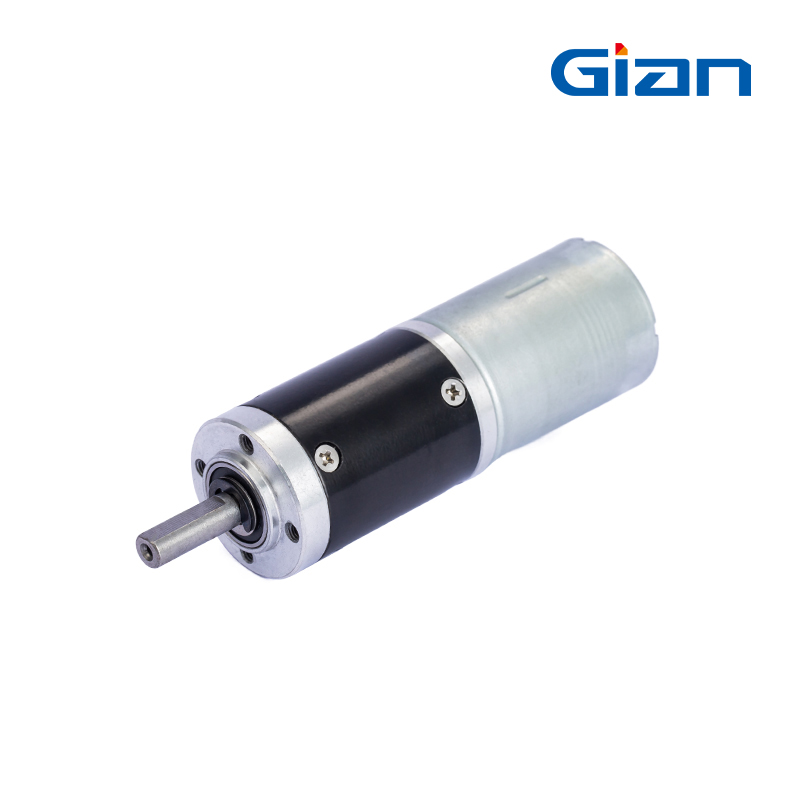
Planetary gear motors provide rotational power, while the planetary gearbox reduces speed and increases torque through a compact gear arrangement. This structure allows planetary gear motors to deliver high torque, stable output, and efficient power transmission in a small space.
They are widely used in robotics, automation equipment, medical devices, packaging machines, smart furniture, electric vehicles, and precision motion systems because they can provide strong output torque without requiring a large motor size.
What Is a Planetary Gear Motor?
A planetary gear motor integrates two key components to deliver controlled speed and higher torque:
- Electric motor
The motor generates rotational motion. - Planetary gearbox
The gearbox adjusts speed and torque before output.
The term “planetary” comes from the way the gears move. In the gearbox, several small gears rotate around a central gear, similar to planets moving around the sun.
Main Components of a Planetary Gear Motor
| Component | Function | How It Works |
| Motor | Provides input power | Converts electrical energy into rotary motion |
| Sun Gear | Central driving gear | Usually connected to the motor shaft |
| Planet Gears | Transfer power | Orbit the sun gear and distribute load. |
| Ring Gear | Outer internal gear | Meshes externally with the planet gears. |
| Planet Carrier | Holds planet gears | Transfers combined motion to the output shaft |
| Output Shaft | Delivers final motion | Sends reduced speed and increased torque to the machine |
Basic Working Principle
Planetary gear motors reduce speed while increasing torque for stronger, controlled output.
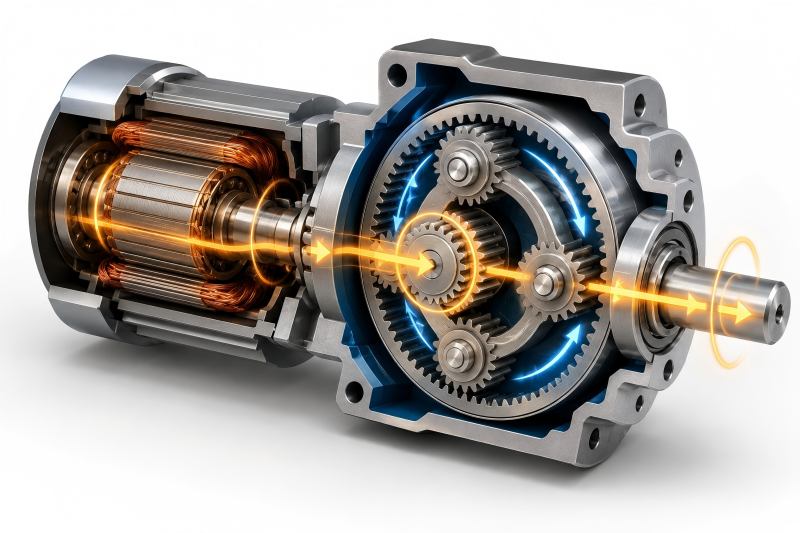
When the motor runs, it rotates the sun gear. The sun gear drives multiple planet gears around it. Planet gears engage the ring gear. As the planet gears move, they rotate the planet carrier, which becomes the final output part.
In most planetary gear motors:
- The motor drives the sun gear.
- The ring gear stays stationary.
- The planet carrier delivers the output.
This arrangement reduces the high speed of the motor and converts it into a slower, stronger output.
Step-by-Step Working Process
| Step | Process | Result |
| 1 | The electric motor starts rotating | Motor shaft provides high-speed input |
| 2 | The motor shaft drives the sun gear | Central gear begins rotation |
| 3 | The sun gear drives the planet gears | Multiple gears rotate and distribute load |
| 4 | Planet gears roll inside the ring gear | Speed is reduced through gear engagement |
| 5 | Planet carrier rotates | Combined gear motion becomes output |
| 6 | Output shaft delivers power | Lower speed and higher torque are produced |
Why Does Speed Decrease?
The motor shaft usually rotates at a high speed. However, many machines do not need high speed. They need controlled movement and stronger torque.
The planetary gearbox reduces speed through gear ratio. With a 10:1 ratio, ten motor rotations produce one output rotation.
This means:
- Output speed becomes lower.
- The output torque becomes higher.
- Motion becomes easier to control.
Example of Speed Reduction
| Motor Speed | Gear Ratio | Output Speed |
| 3000 rpm | 3:1 | 1000 rpm |
| 3000 rpm | 5:1 | 600 rpm |
| 3000 rpm | 10:1 | 300 rpm |
| 3000 rpm | 20:1 | 150 rpm |
| 3000 rpm | 50:1 | 60 rpm |
A higher gear ratio gives lower output speed and higher torque.
Why Does Torque Increase?
Torque provides turning force, while speed reduction helps the planetary gearbox deliver stronger output. The mechanical power is transferred through gear engagement, and the output shaft receives stronger rotational force.
For example, if a motor has limited torque, adding a planetary gearbox allows it to drive heavier loads at lower speed.
This makes planetary gear motors suitable for:
- Robotic joints
- Electric actuators
- Conveyor systems
- Packaging equipment
- Medical lifting systems
- Automatic doors
- Smart home devices
Load Sharing in Planetary Gear Motors
One important advantage of planetary gear motors is load sharing.
In a simple gear system, one gear pair often carries most of the load. Multiple planet gears distribute the load simultaneously. This makes the structure stronger and more compact.
For example, if a gearbox has three planet gears, the transmission force is distributed across three contact points. This helps improve torque capacity and durability.
| Gear Structure | Load Distribution | Performance Effect |
| Spur Gearbox | Load mainly passes through one gear pair | Simple structure, limited torque density |
| Worm Gearbox | Sliding contact carries load | High reduction, lower efficiency |
| Planetary Gearbox | Multiple planet gears share load | High torque, compact size, stable output |
Single-Stage and Multi-Stage Planetary Gearboxes
A planetary gear motor may use one or more planetary gear stages.
A single-stage gearbox uses one complete planetary gear set. It usually provides a moderate reduction ratio.
A multi-stage planetary gearbox connects several planetary stages together. Each stage reduces speed further and increases torque.
| Gearbox Type | Typical Ratio Range | Main Feature |
| Single-Stage Planetary Gearbox | 3:1 to 10:1 | Compact, efficient, moderate torque increase |
| Two-Stage Planetary Gearbox | 15:1 to 100:1 | Higher torque, lower output speed |
| Three-Stage Planetary Gearbox | 100:1 and above | Very low speed, very high torque |
Multi-stage designs are used when the application requires slower movement, stronger force, or more precise positioning.
Power Flow Inside a Planetary Gear Motor
The power flow can be understood in a simple path:
Electricity → Motor Rotation → Sun Gear → Planet Gears → Planet Carrier → Output Shaft
Each component serves a function.
- The motor generates rotation.
- The sun gear receives that speed.
- The planet gears transfer and reduce motion.
- The carrier collects the motion.
- The output shaft delivers usable torque.
This compact power flow allows the planetary gear motor to provide strong performance without a large gearbox body.
How Gear Ratio Is Created
The gear ratio depends mainly on the number of teeth on the sun gear and ring gear.
In a common fixed-ring planetary gearbox, the reduction ratio can be calculated approximately as:
Gear Ratio = 1 + Ring Gear Teeth / Sun Gear Teeth
For example:
| Sun Gear Teeth | Ring Gear Teeth | Approx. Ratio |
| 20 | 40 | 3:1 |
| 20 | 60 | 4:1 |
| 20 | 80 | 5:1 |
| 15 | 75 | 6:1 |
This simplified example shows how tooth count influences speed and torque.
Why Planetary Gear Motors Are Compact
Planetary gear motors are compact because the gears are arranged around the same central axis.
The sun gear, planet gears, carrier, and output shaft are usually coaxial. Input and output shafts can align on the same axis. Compared with many traditional gearboxes, planetary gearboxes can transmit higher torque within a smaller diameter.
Typical examples include:
- Robot arms
- Medical pumps
- Electric grippers
- Smart furniture actuators
- Small AGV drive wheels
- Precision automation modules
Efficiency of Planetary Gear Motors
Planetary gear motors usually have good transmission efficiency because gear contact is mainly rolling contact. The efficiency depends on gear design, number of stages, lubrication, bearing quality, load, and manufacturing precision.
| Gearbox Design | Typical Efficiency Feature |
| Single-stage planetary gearbox | Higher efficiency, fewer gear contacts |
| Multi-stage planetary gearbox | Slightly lower efficiency, higher reduction ratio |
| Precision planetary gearbox | Better alignment, smoother operation |
| Poorly lubricated gearbox | More friction, heat, and wear |
A well-designed planetary gear motor can provide stable torque output with relatively low energy loss.
Backlash and Precision
Backlash is the small gap between gear teeth. In motion control applications, lower backlash means better positioning accuracy.
Planetary gear motors can be designed with low backlash, making them suitable for precision systems. However, not all planetary gear motors are the same. Standard planetary gear motors focus on torque and cost, while precision planetary gear motors focus on accuracy and repeatability.
| Application Requirement | Recommended Gear Motor Type |
| General torque transmission | Standard planetary gear motor |
| Servo positioning | Low-backlash planetary gear motor |
| Robotic joint movement | High-precision planetary gear motor |
| Cost-sensitive automation | Standard or economy planetary gear motor |
| Medical or laboratory equipment | Compact precision planetary gear motor |
Planetary Gear Motor Working Advantages
The working principle of planetary gear motors brings several practical advantages.
High Torque Density
Several planet gears distribute load, enabling higher torque in a compact gearbox.
Compact Structure
The coaxial design saves installation space and makes the motor easier to integrate into machines.
Smooth Transmission
Several gears mesh at the same time, helping create stable output and smoother rotation.
High Reduction Ratio
Multi-stage planetary gearboxes can achieve large speed reduction while maintaining compact dimensions.
Good Efficiency
Compared with worm gear systems, planetary gear motors usually provide better transmission efficiency.
Flexible Motor Matching
Planetary gearboxes can be paired with DC motors, BLDC motors, stepper motors, servo motors, and AC motors.
Common Motor Types Used with Planetary Gearboxes
| Motor Type | Planetary Gear Motor Feature | Common Applications |
| DC Motor | Simple control, cost-effective | Small devices, actuators, toys, tools |
| BLDC Motor | High efficiency, long service life | Robotics, medical devices, automation |
| Stepper Motor | Precise step movement | 3D printers, positioning systems, instruments |
| Servo Motor | High accuracy and dynamic control | CNC machines, robotics, packaging machines |
| AC Motor | Strong industrial performance | Conveyors, heavy equipment, machinery |
How Planetary Gear Motors Work in Real Applications
In robotics, the planetary gear motor reduces motor speed and increases torque so the robot joint can move smoothly and carry load.
In packaging machines, it helps control conveyor movement, feeding systems, and indexing mechanisms.
In medical equipment, it provides compact and stable motion for pumps, beds, lifting systems, and diagnostic devices.
In smart furniture, it allows smooth lifting, reclining, and positioning with controlled force.
In industrial automation, it helps machines achieve accurate speed control, stable torque output, and reliable long-term operation.
Planetary gear motors work by using a planetary gearbox to reduce motor speed and increase output torque. Because several planet gears share the load, the system can deliver high torque in a compact structure.
This working principle makes planetary gear motors ideal for applications that require compact size, high torque, smooth operation, and reliable power transmission. For B2B buyers, understanding how planetary gear motors work can help with selecting the right motor type, gear ratio, torque range, precision level, and gearbox structure for different industrial and automation applications.