
Axial and radial flux motors differ mainly in flux direction, structure, and torque density. In radial flux motors, the flux flows perpendicular to the shaft, creating a cylindrical structure that is mature, reliable, and easy to manufacture.
Axial flux motors are ideal for applications that need compact size, lightweight design, and high torque density. They are especially attractive for electric vehicles, drones, robotics, aerospace systems, and direct-drive machines.
Radial flux motors are better for applications that need proven reliability, lower cost, easier cooling, and mass-production stability. They remain the dominant choice for industrial motors, EV traction motors, appliances, pumps, fans, compressors, and automation systems.
The final choice should depend on performance goals, installation space, cooling requirements, cost, and production feasibility. For standard applications, radial flux motors are often the practical choice. For compact and high-performance systems, axial flux motors can offer strong technical advantages.
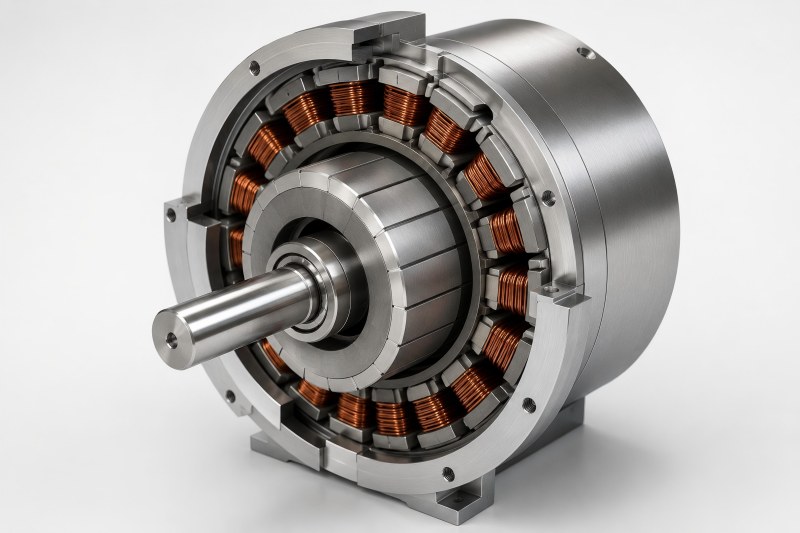
What Is a Radial Flux Motor?
In this design, the magnetic flux travels radially, meaning it moves from the rotor to the stator, or from the stator to the rotor, along the radius of the motor.
The magnetic field flows inward or outward, with the rotor usually inside the cylindrical stator. This design is widely used in industrial, servo, traction, and brushless motors.
Radial flux motors are popular because they are mechanically strong, easy to scale, and suitable for mass production. Their cylindrical structure is familiar to manufacturers, and the production process for stator laminations, windings, rotor assembly, and housing is highly mature.
A typical radial flux motor includes:
- Stator core
- Stator windings
- Rotor core
- Permanent magnets or rotor conductors
- Shaft
- Bearings
- Housing
- Cooling system
Because radial flux motors have a long history and mature production technology, they are often the first choice for standard industrial applications.
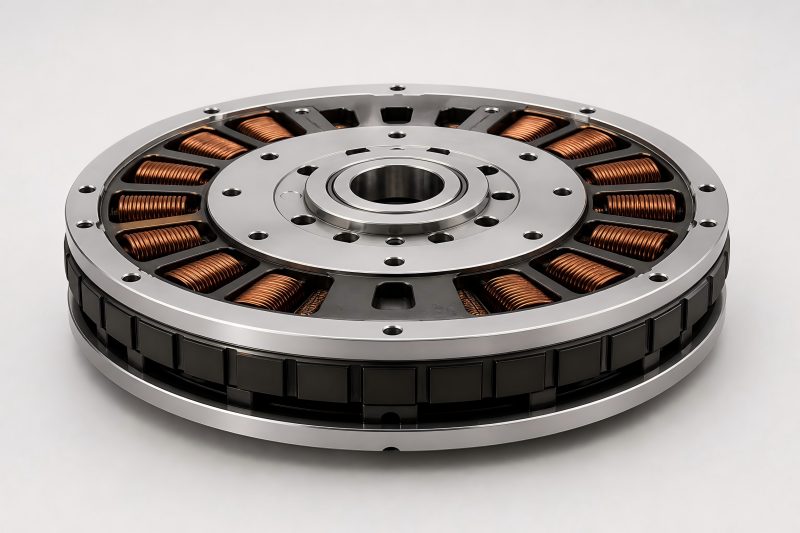
What Is an Axial Flux Motor?
An axial flux motor’s magnetic flux runs parallel to the shaft. Instead of moving radially from inside to outside, the magnetic field moves along the axial direction.
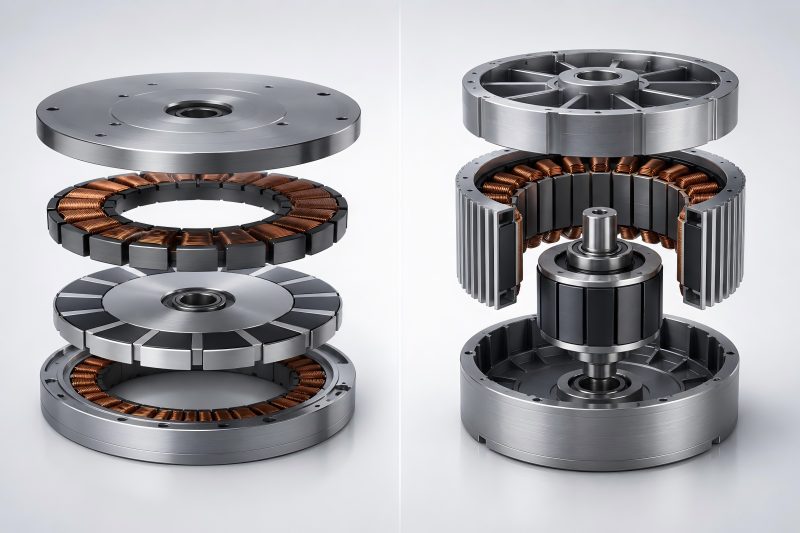
This gives the axial flux motor a flat, disc-shaped structure. The stator and rotor are arranged face-to-face, similar to stacked plates. Axial flux motors are also called disc or pancake motors.
Axial flux motors usually have a shorter axial length and a larger diameter compared with radial flux motors. The larger effective radius helps improve torque output, making axial flux motors attractive for electric vehicles, motorcycles, drones, robotics, aerospace systems, and direct-drive applications.
Common axial flux motor structures include:
- Single rotor and single stator
- Dual rotor and single stator
- Single rotor and dual stator
- Multi-disc axial flux structure
The dual-rotor single-stator design is especially popular because it can improve torque density and make better use of magnetic flux. They require high precision in air gap control, magnet placement, thermal management, and mechanical balancing.
Axial Flux Motor vs Radial Flux Motor: Basic Comparison
| Comparison Item | Axial Flux Motor | Radial Flux Motor |
| Magnetic flux direction | Parallel to the shaft | Perpendicular to the shaft |
| Motor shape | Flat, disc-like structure | Cylindrical structure |
| Torque density | Usually higher | Moderate to high |
| Power density | High in compact designs | Stable and scalable |
| Axial length | Shorter | Longer |
| Diameter | Usually larger | Usually smaller |
| Cooling difficulty | More challenging | Easier and more mature |
| Manufacturing complexity | Higher | Lower |
| Air gap control | Requires high precision | Easier to control |
| Cost | Usually higher | Usually lower |
| Maturity | Emerging and developing | Highly mature |
| Typical applications | EVs, drones, robotics, aerospace, direct-drive systems | Industrial motors, pumps, fans, compressors, EVs, appliances |
Magnetic Flux Direction
In radial flux motors, flux flows between rotor and stator. This means the magnetic field crosses the air gap in a direction perpendicular to the motor shaft. The cylindrical structure supports this flux path naturally.
In axial flux motors, flux runs parallel to the shaft. The rotor and stator are arranged face-to-face, so the magnetic field passes through the air gap in the axial direction.
This difference affects almost every aspect of the motor, including shape, torque production, winding design, cooling method, mechanical structure, and manufacturing process.
Radial flux motors are easier to design and manufacture because the magnetic path is well understood and widely used. Axial flux motors can achieve higher torque density, but the magnetic circuit is more sensitive to air gap variation and assembly accuracy.
Motor Shape and Structure
Radial flux motors usually have a long cylindrical shape. The rotor sits inside; longer motors deliver more power. This makes radial flux motors easy to scale for different power ratings.
Axial flux motors have a flat disc-like shape. The rotor and stator face each other, and the motor diameter plays an important role in torque output. Because torque is related to the effective radius, axial flux motors can produce high torque with a relatively short axial length.
This structural difference makes axial flux motors useful when space in the axial direction is limited. For example, in electric vehicle wheel hubs, compact traction systems, drones, and robotic joints, a shorter motor can help reduce system size and weight.
However, the larger diameter of axial flux motors may not fit all machine layouts. If the installation space is narrow in diameter but allows more length, a radial flux motor may be more suitable.
Torque Density
Torque density is one of the biggest advantages of axial flux motors.
Because axial flux motors often use a larger effective radius, they can generate higher torque for the same motor volume or weight. In many designs, the active magnetic area is larger, and the disc structure allows more efficient torque generation.
This is why axial flux motors are attractive for electric vehicles, electric motorcycles, aerospace systems, and compact high-performance machines. They can help reduce motor weight while maintaining strong torque output.
Radial flux motors can also achieve high torque, especially with advanced permanent magnet designs, optimized stator slots, high-grade electrical steel, and liquid cooling. However, for applications where compactness and lightweight performance are critical, axial flux motors may offer a better torque-to-weight ratio.
That said, torque density depends on the actual motor design. Magnet quality, stator core material, winding method, cooling design, air gap accuracy, and controller performance all affect the final result.
Power Density
Axial flux motors offer high power density in compact designs. Their disc structure can reduce the motor’s axial length and improve packaging flexibility. This is valuable in electric vehicles, aircraft propulsion systems, and mobile robots.
Radial flux motors, however, are easier to scale for continuous power. By increasing stack length, improving cooling, and optimizing winding design, radial flux motors can provide stable power output across a wide range of applications.
In high-volume industrial applications, radial flux motors still dominate because they are easier to produce and easier to cool. In performance-driven applications where weight and space matter more, axial flux motors may provide better power density.
Cooling and Thermal Management
Excessive heat can reduce efficiency, damage insulation, weaken magnets, and shorten motor life.
Radial flux motors usually have a mature cooling structure. Heat from the stator windings can be transferred to the housing through the stator core. Air cooling, water jacket cooling, oil cooling, and forced ventilation are commonly used.
Axial flux motors can be more difficult to cool because of their flat structure and compact layout. In some designs, the stator is located between two rotors, making heat dissipation more challenging. The windings may be enclosed in a limited space, and the cooling path may not be as direct as in radial flux motors.
Advanced axial flux motors may use liquid cooling, oil cooling, direct winding cooling, or special stator materials to improve thermal performance. However, they may increase complexity and cost.
For applications requiring long continuous operation under heavy load, thermal management must be carefully evaluated before choosing an axial flux motor.
Manufacturing Complexity
Radial flux motors are easier to manufacture because the production process is mature. Stator laminations can be stamped and stacked efficiently. Winding insertion, rotor assembly, magnet mounting, shaft installation, and housing assembly are well established.
Axial flux motors require precise air gap control, increasing manufacturing difficulty. Even small errors in flatness, alignment, or assembly can affect performance, noise, vibration, and reliability.
Axial flux motors may also require special lamination designs, soft magnetic composite materials, segmented stators, or advanced winding methods. Magnet installation can be more difficult because the magnetic attraction between rotor and stator is strong.
Axial flux motors often cost more in low-volume production. Radial flux motors are usually more cost-effective for mass production.
Efficiency
Axial flux motors can reduce some losses due to their compact magnetic path and high torque density. Their short end windings may also help reduce copper loss in certain designs. This can improve efficiency, especially in applications requiring high torque at low speed.
Radial flux motors are also highly efficient, especially modern permanent magnet synchronous motors and optimized induction motors. Their mature design methods allow engineers to reduce iron loss, copper loss, eddy current loss, and mechanical loss.
In practice, efficiency depends less on the motor category and more on detailed design. Important factors include:
- Electrical steel grade
- Magnet material
- Lamination thickness
- Slot design
- Winding fill factor
- Cooling performance
- Air gap accuracy
- Operating speed range
- Motor controller strategy
A well-designed radial flux motor can outperform a poorly designed axial flux motor, and vice versa.
Cost
Cost is another important difference.
Radial flux motors are generally more economical because they use mature manufacturing equipment, standard materials, and established supply chains. Many suppliers can produce radial flux motors in large quantities, which helps reduce cost.
Axial flux motors are often more expensive because of higher design complexity, tighter tolerances, special materials, and lower production maturity. The need for advanced cooling and precise assembly can also increase cost.
However, in some applications, axial flux motors may reduce total system cost. For example, if an axial flux motor can eliminate a gearbox, reduce vehicle weight, improve efficiency, or simplify the drive system, the higher motor cost may be acceptable.
Therefore, the cost comparison should not only consider motor price. It should also include system-level value, such as weight reduction, efficiency improvement, installation space, cooling requirements, and maintenance cost.
Advantages and Limitations of Axial Flux Motors
| Item | Advantages | Limitations |
| Torque performance | High torque density and strong low-speed torque | Performance depends heavily on precise air gap control |
| Size and weight | Short axial length and lightweight potential | Larger diameter may not fit all installations |
| Efficiency | Potential for high efficiency and short end windings | Thermal issues may reduce continuous performance |
| Design flexibility | Suitable for direct-drive and compact systems | More complex electromagnetic and mechanical design |
| Manufacturing | Suitable for advanced high-performance applications | Higher production difficulty and cost |
| Applications | EVs, aerospace, robotics, drones, special machinery | Less mature supply chain than radial flux motors |
Advantages and Limitations of Radial Flux Motors
Radial flux motors remain the dominant choice because they are reliable, mature, and easy to integrate. Their cylindrical shape fits many standard mechanical systems, and their production process is highly developed.
Main advantages of radial flux motors include stable performance, lower manufacturing cost, easier cooling, strong mechanical structure, and broad supplier availability. They can be designed for low-power appliances, medium-power industrial machines, and high-power EV traction systems.
Radial flux motors may need more length, reducing compactness in space-limited applications. Their torque density may also be lower compared with advanced axial flux designs.
For many standard applications, these limitations are not serious. That is why radial flux motors are still widely used in pumps, fans, compressors, machine tools, conveyors, elevators, generators, and electric vehicles.
Applications of Axial Flux Motors
Axial flux motors are especially suitable for applications that require compact size, high torque density, and lightweight construction.
Electric Vehicles
Axial flux motors suit electric cars, motorcycles, and commercial EV platforms. Their compact shape allows flexible packaging. They may be installed near the wheel, integrated into the drivetrain, or used in high-performance traction systems.
Drones and Aerospace
Weight is extremely important in drones and electric aircraft. Axial flux motors can provide high power density and reduce total propulsion system weight. Their flat shape can also fit certain aircraft and UAV designs better than long cylindrical motors.
Robotics
Robotic joints require compact, high-torque motors with precise response. Axial flux motors can be useful in humanoid robots, collaborative robots, mobile robots, and exoskeleton systems.
Wind Turbines
Some axial flux motors are used as generators in small wind turbines. Their direct-drive capability can reduce mechanical transmission complexity.
Industrial Direct-Drive Systems
Axial flux motors may be used where direct-drive torque is required in a compact space, such as rotary tables, special automation equipment, and compact machinery.
Applications of Radial Flux Motors
Industrial Equipment
Pumps, fans, blowers, compressors, conveyors, machine tools, mixers, and production equipment commonly use radial flux motors.
Electric Vehicles
Many EV traction motors use radial flux PMSM designs. They offer high efficiency, strong power output, and mature mass-production capability.
Home Appliances
Washing machines, air conditioners, refrigerators, vacuum cleaners, and power tools often use radial flux motors because they are cost-effective and reliable.
Servo and Automation Systems
Radial flux servo motors are widely used in CNC machines, robots, packaging equipment, textile machines, and automation systems.
Generators
Radial flux structures are common in generators because they are mechanically strong and easy to scale for different power levels.
How to Choose Between Axial Flux and Radial Flux Motors
Choosing between axial flux and radial flux motors depends on the project’s performance requirements, installation space, cost target, production volume, and cooling conditions.
An axial flux motor may be better if the application requires high torque density, lightweight design, short axial length, and compact packaging. It is suitable for advanced EVs, drones, aerospace systems, robotics, and direct-drive equipment.
A radial flux motor may be better if the application requires mature technology, lower cost, stable continuous operation, easy cooling, and reliable mass production. It is suitable for industrial machines, standard EV platforms, pumps, fans, compressors, appliances, and general automation systems.
A motor should be selected based on system-level requirements, not only motor structure.
Important selection factors include:
- Required torque and speed
- Continuous power demand
- Peak power demand
- Available axial length
- Available motor diameter
- Cooling method
- Efficiency target
- Cost budget
- Production volume
- Reliability requirements
- Controller compatibility
- Maintenance conditions
For high-performance applications, engineers should compare both motor options through electromagnetic simulation, thermal analysis, mechanical analysis, and prototype testing.
Future Development Trends
Axial flux motors are expected to grow in applications where high torque density and lightweight design are important. Improvements in soft magnetic composites, advanced cooling, automated assembly, and magnet technology may reduce manufacturing cost and improve reliability.
Radial flux motors will continue to dominate the mainstream market because of their mature supply chain, stable performance, and broad application base. They will also continue to improve through better electrical steel, optimized rotor design, hairpin windings, oil cooling, and advanced control algorithms.
In the future, both motor types will coexist. Axial flux motors may become more common in premium EVs, electric aircraft, robotics, and compact high-performance systems.