
From automotive transmissions to robotics, aerospace systems, and industrial machinery, these gear systems deliver high torque, excellent load distribution, and remarkable durability within a relatively small footprint.
What Is a Planetary Gear System?
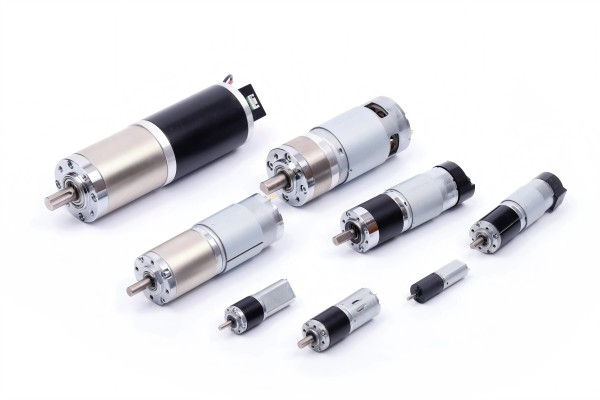
A planetary gear motor uses multiple gears rotating around a central gear, enabling compact design and high torque output.
Unlike traditional gear systems, where gears are typically arranged in parallel or series, planetary gear systems utilize a coaxial layout.
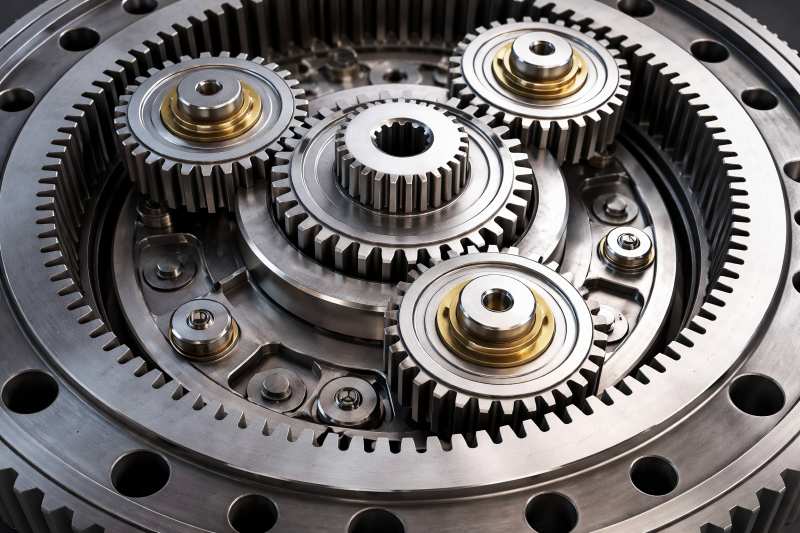
At its core, a planetary gear system has three essential elements:
- a central driving gear referred to as the sun gear
- several gears that orbit it, known as planet gears
- An outer gear with internal teeth, called the ring gear
These elements operate together via a rotating carrier that supports and positions the planet gears. Depending on which component is fixed, driven, or used as output, the system can produce different speed and torque ratios.
Key Components of a Planetary Gear System
Each component is vital to overall function, enabling smooth and efficient power transmission.
Sun Gear
The sun gear transfers rotational energy to the surrounding planet gears. Its size and number of teeth directly influence the gear ratio and performance.
Planet Gears
Multiple planet gears are used to distribute load evenly, which enhances durability and reduces wear.
Ring Gear
The ring gear encircles the entire system and contains internal teeth. It meshes with the planet gears and often serves as either a fixed component or an output element.
Planet Carrier
The carrier holds and positions the planet gears, serving as either input or output depending on configuration.
How Planetary Gear Systems Work
Planetary gear systems operate through relative motion of components, enabling different outputs by fixing one part and driving another.
With the ring fixed, the sun drives a slower, high-torque carrier; with the carrier fixed, the ring rotates faster.
This adaptability allows planetary gear systems to deliver multiple gear ratios without altering the core structure.
Types of Planetary Gear Configurations
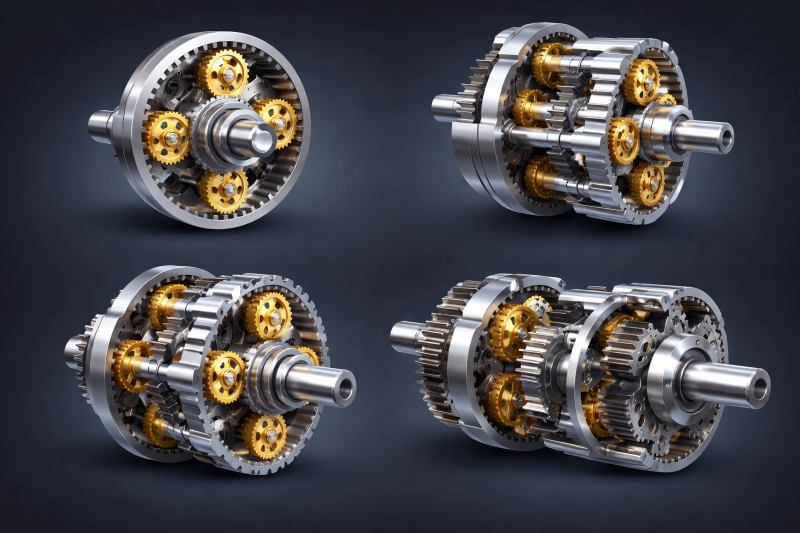
Simple Planetary Gear System
This is the simplest configuration, featuring a single sun gear, ring gear, and planet set, typically applied in systems with low to medium torque requirements.
Compound Planetary Gear System
Compound systems include multiple sets of planet gears or additional gear stages. These are used when higher gear ratios or greater torque output is required.
Multi-Stage Planetary Gear System
By combining several planetary gear sets in series, multi-stage systems can achieve extremely high reduction ratios while maintaining compact dimensions.
Differential Planetary Gear System
These systems allow different outputs from a single input, commonly used in automotive differentials to enable wheels to rotate at different speeds.
Advantages of Planetary Gear Systems
Planetary gear systems offer numerous benefits that make them superior to many traditional gear arrangements in demanding applications.
High Torque Density
Delivers high torque within a compact footprint. The load is shared among multiple planet gears, allowing the system to handle heavy loads efficiently.
Compact Design
Because all components are aligned on a single axis, planetary gear systems require less space compared to conventional gearboxes. Perfect for space-constrained applications.
High Efficiency
The load distribution across multiple gears reduces friction and energy loss. As a result, planetary gear systems typically achieve high efficiency levels.
Versatility
Different configurations can be achieved without significant structural changes, making planetary gear systems highly adaptable.
Disadvantages and Limitations
Complex Design
The structure is more complex than traditional gear systems, requiring precise engineering and manufacturing.
Higher Cost
Due to the complexity and precision required, planetary gear systems are generally more expensive to produce.
Maintenance Difficulty
Servicing and repairing these systems can be more challenging because of their compact and integrated design.
Heat Management
High power density can lead to increased heat generation, requiring proper lubrication and cooling systems.
Comparison with Traditional Gear Systems
To better understand the value of planetary gear systems, it is helpful to compare them with conventional gear arrangements.
Planetary vs Traditional Gear System
| Feature | Planetary Gear System | Traditional Gear System |
| Design Structure | Coaxial, compact | Parallel or series arrangement |
| Load Distribution | Shared across multiple gears | Concentrated on fewer gears |
| Torque Capacity | High | Moderate |
| Efficiency | High | Moderate |
| Size | Compact | Larger |
| Complexity | High | Low |
| Cost | Higher | Lower |
From this comparison, it is clear that planetary gear systems excel in performance and compactness, though they require more advanced design and higher investment.
Design Considerations
Gear Ratio Requirements
In most industrial planetary gearboxes, single-stage reduction ratios typically range from 3:1 to 10:1, while multi-stage systems can achieve ratios exceeding 100:1.
Higher ratios increase torque but slightly lower efficiency. For example, a single-stage system may reach 97% efficiency, while a three-stage system may drop to around 90–94%, depending on quality and lubrication.
Material Selection
Material choice directly impacts strength, wear resistance, and service life. Common materials include hardened alloy steels such as 20CrMnTi or 18CrNiMo7-6, which offer excellent fatigue resistance.
In heavy-duty applications, gears are often surface-hardened to 58–62 HRC (Rockwell hardness), significantly improving wear resistance. Proper heat treatment extends gear life by 30–50% over untreated materials.
Lubrication
Lubrication plays a critical role in reducing friction and heat generation. High-performance planetary gear systems typically operate with efficiencies above 95%, but poor lubrication can reduce efficiency by 5–10% and accelerate wear.
Industrial gearboxes often use oil bath or forced lubrication systems, maintaining operating temperatures between 60°C and 85°C. Exceeding 90°C can degrade lubricant properties and shorten component life.
Load Distribution
In a system with three planet gears, each gear ideally carries about 33% of the total load. With four gears, this drops to 25% per gear, improving durability.
However, due to manufacturing tolerances, real-world load sharing efficiency is typically around 90–95%, meaning some gears may carry slightly more load than others. Precision machining is essential to minimize this imbalance.
Manufacturing Precision
High precision is critical for smooth operation and noise reduction. Gear accuracy is often classified using international standards such as ISO grades. High-performance planetary gears typically fall within ISO Grade 5–7, while lower-cost systems may use Grade 8–10.
Improving gear precision can reduce vibration levels by up to 20–30% and extend service life. However, higher precision also increases manufacturing costs by approximately 15–25%, making it a key trade-off in design.
Thermal Management
Due to high power density, planetary gear systems generate significant heat. Efficient designs ensure that heat dissipation matches heat generation.
For example, in continuous industrial operation, maintaining oil temperature below 85°C can extend gearbox life by 2–3 times compared to systems operating above 100°C. Cooling methods may include natural convection, forced air, or oil cooling systems.
Size and Torque Density Optimization
Planetary gear systems are known for high torque density. Modern designs can achieve torque densities of 50–150 Nm/kg, depending on materials and configuration.
Compared to traditional gearboxes, this represents an improvement of 30–70%, making planetary systems ideal for compact equipment such as robotics and electric vehicles.
Key Design Parameters and Typical Values
| Design Factor | Typical Range / Data | Impact |
| Gear Ratio | 3:1 – 100:1+ | Controls speed and torque |
| Efficiency | 90% – 97% | Affects energy loss |
| Gear Hardness | 58–62 HRC | Determines wear resistance |
| Load Sharing Efficiency | 90% – 95% | Impacts durability |
| Operating Temperature | 60°C – 85°C | Affects lubricant performance |
| Precision Grade | ISO 5 – 7 (high-end) | Reduces noise and vibration |
| Torque Density | 50 – 150 Nm/kg | Defines compactness and power |
Efficiency and Performance Factors
Several factors influence the efficiency and overall performance of planetary gear systems.
Key Factors Affecting Performance
| Factor | Impact on Performance |
| Gear Quality | Higher precision improves efficiency |
| Lubrication | Reduces friction and wear |
| Load Distribution | Enhances durability and smooth operation |
| Material Strength | Determines load capacity |
| Operating Temperature | Affects lifespan and efficiency |
| Alignment Accuracy | Reduces vibration and noise |
Efficiency and Performance Factors
Gear Quality and Surface Finish
The quality of the gears themselves plays a foundational role in determining system efficiency. High-precision gears with smooth surface finishes reduce friction between meshing teeth, resulting in lower energy loss and quieter operation.
In high-end planetary gear systems, gear tooth surface roughness is often controlled within Ra 0.4–0.8 μm, which significantly minimizes micro-friction. Compared to lower-grade gears, this level of precision can improve transmission efficiency by 2–4% and reduce noise levels by up to 10 dB.
Additionally, advanced finishing techniques such as grinding and honing ensure consistent tooth contact, which helps prevent localized stress and premature wear.
Lubrication Efficiency
In well-lubricated systems, efficiency can reach 95–97% per stage, while insufficient lubrication may reduce efficiency to below 90%. The type of lubricant also matters. Synthetic oils, for example, can reduce friction losses by 10–15% compared to conventional mineral oils, especially under high-load conditions.
Moreover, maintaining proper oil viscosity is essential. If the lubricant is too thick, it increases resistance; if too thin, it fails to provide adequate protection. Optimal viscosity selection can improve overall gearbox efficiency by 1–3%.
Load Distribution and Balance
This feature not only enhances torque capacity but also improves efficiency by reducing stress on individual components.
In an ideal three-planet system, each gear shares approximately 33% of the load, but in practice, due to manufacturing tolerances, load imbalance can occur. Even a 5–10% deviation in load sharing can lead to increased friction and localized wear, slightly reducing efficiency.
Advanced designs use floating sun gears or flexible carriers to automatically balance loads, improving efficiency by 1–2% and significantly extending service life.
Bearing Performance
Bearings support the rotating components within the planetary system and directly influence friction levels. Low-friction bearings reduce mechanical losses and enhance system efficiency.
For example, using precision needle or tapered roller bearings can lower friction losses by 20–30% compared to standard bearings. In high-speed applications, bearing selection becomes even more critical, as poor bearing performance can account for up to 40% of total mechanical losses in extreme cases.
Proper alignment and preload settings are also essential to avoid unnecessary resistance and overheating.
Thermal Conditions and Heat Dissipation
Heat generation is inevitable in any mechanical transmission system, and planetary gearboxes are no exception. High temperatures lower efficiency and accelerate lubricant and material wear.
In typical industrial applications, maintaining operating temperatures between 60°C and 85°C ensures optimal efficiency. When temperatures rise above 90°C, efficiency may drop by 3–5%, and lubricant lifespan can be reduced by more than 50%.
Effective heat dissipation methods, such as oil circulation systems or external cooling, are therefore essential in high-power or continuous-duty applications.
Alignment and Assembly Accuracy
Precise alignment of all components is crucial for minimizing vibration, noise, and energy loss. Misalignment can cause uneven tooth contact, increasing friction and reducing efficiency.
Even minor misalignment—on the order of 0.01–0.02 mm—can lead to measurable efficiency losses of 1–2% and significantly higher wear rates. High-precision assembly techniques and strict tolerance control are therefore necessary, particularly in applications requiring long service life and low maintenance.
Operating Speed and Load Conditions
The operating conditions of a planetary gear system greatly influence its efficiency. Systems running at optimal load levels—typically 70–90% of rated capacity—achieve the highest efficiency.
At very low loads, efficiency can drop due to fixed friction losses, sometimes falling below 85%. Conversely, operating above rated load increases friction and heat, reducing efficiency and potentially causing damage.
Speed also plays a role. At higher speeds, lubrication effectiveness improves, but friction losses may increase slightly due to fluid resistance. Balancing speed and load is key to maintaining peak performance.
Efficiency and Performance Influencers
| Factor | Typical Data Range / Impact | Effect on Performance |
| Gear Surface Roughness | Ra 0.4–0.8 μm | Reduces friction and noise |
| Lubrication Efficiency | 90%–97% system efficiency | Controls wear and energy loss |
| Load Sharing Accuracy | 90%–95% balance | Improves durability and efficiency |
| Bearing Loss Reduction | 20%–30% improvement (high-quality types) | Lowers mechanical resistance |
| Operating Temperature | 60°C–85°C optimal | Maintains efficiency and oil life |
| Alignment Tolerance | 0.01–0.02 mm | Prevents vibration and wear |
| Optimal Load Range | 70%–90% rated load | Maximizes efficiency |
Common Applications of Planetary Gear Systems
Automotive Industry
They are widely used in automatic transmissions, hybrid vehicles, and differential systems. They deliver high torque and enable smooth gear transitions.
Robotics
In robotics, compact size and precision control are critical. Planetary gear systems enable robots to achieve accurate movements and high torque output.
Aerospace
Aircraft systems rely on planetary gears for their lightweight and high-performance characteristics.
Industrial Machinery
They are used in conveyors, mixers, and heavy-duty equipment where durability and efficiency are essential.
Renewable Energy
Wind turbines often utilize planetary gearboxes to convert low-speed rotation into high-speed energy generation.
By understanding their components, working principles, advantages, and design considerations, engineers and decision-makers can make informed choices when selecting the right gear system for their needs.