
Planetary gear motors are common in robotics, automation, industrial machinery, and EVs due to compact design, high torque, and efficient load distribution. At the core of these systems is the combination of a motor with a planetary gearbox—a gear arrangement that distributes load over multiple contact points.
What Is a Planetary Gear Motor?
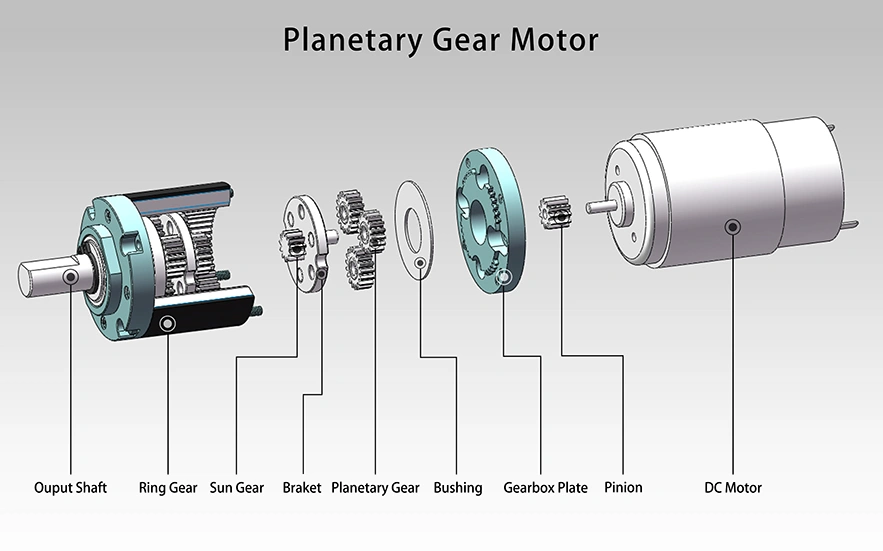
A planetary gear motor integrates a motor with a planetary gear set. A planetary gear set typically includes:
- A sun gear at the center
- Multiple planet gears orbit the central sun gear
- A ring gear (internal gear) that encircles the planets
- A carrier that holds the planet gears together
This gear arrangement provides:
- High torque multiplication in a compact footprint,
- Improved load sharing across gears,
- High stiffness and precision,
- Efficient power transmission.
When coupled with different motor types, the characteristics and performance outcomes of the planetary gear motor can vary substantially.
Why the Motor Type Matters
The motor drives the planetary gear set, so its attributes directly influence system performance. Key performance metrics affected by motor type include:
- Torque output
- Efficiency
- Speed control
- Thermal characteristics
- Noise and vibration
- Control complexity
- Cost
This section compares major motor types used in planetary gearboxes and explains how each impacts performance.
Brushed DC Motors + Planetary Gears
Brushed DC motors have simple construction, with brushes and a commutator providing mechanical switching of current. Mature and cost-effective, yet gradually replaced in many applications.
Characteristics
| Feature | Brushed DC |
| Ease of control | Very simple |
| Efficiency | Moderate (70–80%) |
| Torque | Good low speed torque |
| Maintenance | Brushes wear out |
| Cost | Low |
Performance with Planetary Gears
Torque: Planetary gears increase torque significantly, making brushed DC suitable for low-to-medium power applications.
- Control: Speed and direction are easy to manage with just voltage adjustment.
- Drawbacks: Brushes wear quickly; sparks and EMI affect sensitive environments.
- Use Cases: Conveyor drives, small automation units, basic robotics.
Brushless DC (BLDC) Motors + Planetary Gears
Brushless DC motors are electronically commutated, offering higher efficiency and performance than brushed DC.
Characteristics
| Feature | BLDC |
| Ease of control | Moderate (requires controller) |
| Efficiency | High (80–90%) |
| Torque | Excellent power to weight |
| Maintenance | Low |
| Cost | Moderate to high |
Performance with Planetary Gears
- High Efficiency: BLDC motors maintain efficiency even under load, improving total system performance.
- High Torque Density: When paired with planetary gears, they achieve very high torque in compact systems.
- Precise Control: Electronic commutation enables fine speed and torque control.
- Use Cases: Electric vehicles, precision robotics, automated guided vehicles (AGVs).
Stepper Motors + Planetary Gears
Stepper motors move in precise steps, perfect for open-loop positioning.
Characteristics
| Feature | Stepper |
| Control | Very precise position |
| Efficiency | Moderate (60–80%) |
| Torque | Good at low speed |
| Vibration | Higher than BLDC |
| Cost | Moderate |
Performance with Planetary Gears
Precision: Planetary gears increase resolution and holding torque, ideal for positioning applications.
- Noise/Vibration: Stepping can cause resonance; may require micro-stepping control.
- Low Speed Torque: Excellent when geared down.
- Use Cases: CNC machines, 3D printers, precision actuators.
AC Induction Motors + Planetary Gears
AC induction motors are durable and common in industrial applications.
Characteristics
| Feature | AC Induction |
| Power | High |
| Efficiency | High (85–95%) |
| Control | Requires VFD for speed control |
| Durability | Excellent |
| Cost | Moderate |
Performance with Planetary Gears
- Industrial Power: Suited for larger, high-power applications where size is less constrained.
- Control Complexity: Speed control generally requires a Variable Frequency Drive (VFD), adding system cost and complexity.
- Torque Response: Good continuous torque but less dynamic than BLDC.
- Use Cases: Heavy machinery, conveyors, pumps.
Comparison of Motor Types (Performance Metrics)
The following table compares planetary gear motors built with different motor types across key performance metrics:
| Metric | Brushed DC | BLDC | Stepper | AC Induction |
| Efficiency | ⭐⭐ | ⭐⭐⭐ | ⭐⭐ | ⭐⭐⭐⭐ |
| Torque Density | ⭐⭐ | ⭐⭐⭐ | ⭐⭐ | ⭐⭐⭐ |
| Speed Control | ⭐⭐ | ⭐⭐⭐ | ⭐⭐ | ⭐⭐ |
| Precise Positioning | ⭐⭐ | ⭐⭐ | ⭐⭐⭐⭐ | ⭐⭐ |
| Maintenance | ⭐⭐ | ⭐⭐⭐ | ⭐⭐ | ⭐⭐⭐⭐ |
| Cost | ⭐⭐⭐⭐ | ⭐⭐ | ⭐⭐ | ⭐⭐⭐ |
| Noise | Moderate | Low | Higher | Low |
| Application Range | Low–Med | Med–High | Low–Med | High |
⭐ = relative rating (4★ = best, 1★ = low)
How Gear Ratios Affect Performance
Gear ratio selection is another critical factor in planetary gear motors. Common gear ratio ranges include:
| Gear Ratio | Speed Reduction | Torque Output | Typical Use |
| 3:1 | Low | Low | Light automation |
| 10:1 | Medium | Medium | General applications |
| 25:1 | High | High | Robotics, actuators |
| 100:1+ | Very High | Very High | Heavy torque applications |
Increasing the gear ratio reduces output speed while increasing torque, allowing motors with lower torque to achieve high force outputs—critical in robotics and industrial drives.
Efficiency Considerations
Total system efficiency is the product of motor efficiency and gearbox efficiency—planetary gearboxes typically have efficiencies ranging from 85% to 98% depending on construction quality and lubrication.
Example Efficiency Calculation:
If a BLDC motor is 90% efficient and the planetary gearbox is 95% efficient:
Total Efficiency=0.90×0.95=0.855(85.5%)
This high efficiency is important for battery-powered applications like mobile robots and electric vehicles.
Thermal and Reliability Considerations
Thermal Management
Motors generate heat during operation. Planetary gearboxes also generate heat through friction. Motor types differ in thermal performance:
| Motor Type | Thermal Strength |
| Brushed DC | Low (brush wear) |
| BLDC | High |
| Stepper | Moderate |
| AC Induction | High |
Effective heat dissipation prolongs motor life and preserves torque output.
Reliability
- BLDC motors generally last longer due to lack of brushes.
- AC Induction motors are extremely durable in harsh environments.
- Stepper Motors can experience bearing wear and vibration induced issues.
- Brushed motors require frequent brush replacement for maintenance.
Real-World Application Examples
Case 1: Industrial Robot Joint
- Motor: BLDC
- Gear Ratio: 25:1
- Outcome: High torque with precise control → smooth motion control and high repeatability.
Case 2: Conveyor Drive
- Motor: AC Induction with VFD
- Gear Ratio: 10:1
- Outcome: Reliable continuous operation, low maintenance.
Case 3: Automated Door Actuator
- Motor: Brushed DC
- Gear Ratio: 15:1
- Outcome: Cost-effective, easy speed control.
Case 4: Precision Positioning Stage
- Motor: Stepper with micro stepping
- Gear Ratio: 50:1
- Outcome: Very fine positional control, excellent holding torque.
Selection Guidelines
When choosing a planetary gear motor configuration, consider:
Required Torque and Speed
Higher torque demands generally benefit from geared BLDC or AC induction systems.
Control Complexity
Stepper motors are simple to position; BLDC and AC induction may require controllers.
Budget Constraints
Brushed DC is lowest cost; BLDC and precision gearboxes increase expenses.
Lifetime and Maintenance
BLDC and AC motors usually need less maintenance than brushed.
Environment and Duty Cycle
High-duty, harsh environments favor robust motors like AC induction or sealed BLDC.
Future Trends
- Integration of sensors (e.g., encoders) with planetary gear motors improves feedback control.
- Smart motor controllers enable adaptive torque and efficiency optimization.
- Advanced materials and coatings decrease friction losses and extend life.
- IoT and predictive maintenance help prevent failures in industrial fleets.
Conclusion
Planetary gear motors are essential components across diverse applications, from industrial automation to autonomous robotics. The choice of motor type—brushed DC, BLDC, stepper, or AC induction—has a profound impact on performance attributes such as efficiency, torque output, speed control, reliability, and cost.
Understanding the strengths and limitations of each motor type, and how they interact with gear ratios and control systems, allows engineers and designers to tailor solutions that match both technical requirements and budget constraints. Whether the goal is precise positioning in a robotic arm or high torque operation in heavy machinery, the right planetary gear motor configuration can significantly elevate system performance.